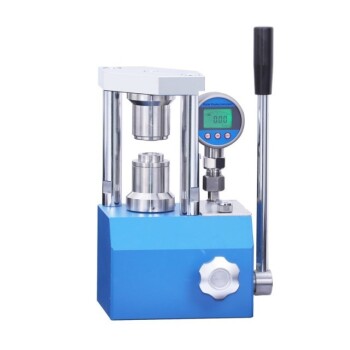
The primary purpose of applying high-pressure co-pressing is to mechanically force the rigid particles of the electrode and electrolyte into intimate, atom-level contact. By eliminating microscopic voids, this process transforms loose powder layers into a single, high-density structure. Without this massive physical compaction, the internal resistance would be too high for the battery to function effectively.
The Core Insight In liquid batteries, the electrolyte naturally flows into pores to create contact. In all-solid-state batteries, there is no liquid to fill the gaps; therefore, high mechanical pressure is the only way to minimize interfacial resistance and establish the continuous pathways necessary for ion transport.
Overcoming the Solid-Solid Interface Challenge
Eliminating Microscopic Voids
The fundamental hurdle in assembling solid-state batteries is the rigidity of the components. Without intervention, air gaps and voids remain between the cathode, anode, and solid electrolyte particles.
Applying high pressure (ranging from approximately 240 MPa to 700 MPa) compacts these composite powders into dense pellets. This effectively removes the voids that would otherwise act as insulators within the cell.
Maximizing Physical Contact Area
Efficiency in a solid-state battery is dictated by the quality of the contact between materials. Co-pressing ensures that the contact area at the solid-solid interfaces is maximized.
This transition from "point contact" (particles barely touching) to "surface contact" (particles pressed flat against each other) creates a cohesive interface.
Creating Low-Resistance Ion Pathways
Ions cannot jump across empty space; they require a continuous material bridge. The dense structure achieved through co-pressing establishes these essential ion transport highways.
By ensuring gap-free contact, the process drastically lowers the interfacial impedance (resistance). This allows for the smooth, rapid transport of ions, which is the direct driver of battery performance.
Ensuring Structural Integrity
Forming a Unified Cell Structure
Beyond electrochemical performance, pressure is required for mechanical adhesion. Co-pressing bonds the distinct layers—cathode, electrolyte, and anode—into a robust, integral unit.
For example, a secondary pressing step (often at lower pressures like 120 MPa) ensures the negative electrode adheres firmly to the electrolyte layer without gaps.
Maintaining Stability During Operation
The need for pressure extends beyond initial assembly. Maintaining a constant "stack pressure" (e.g., 50 MPa) is often required during testing and cycling.
This sustained pressure preserves the intimate contact established during assembly. It also helps the battery accommodate volumetric changes (expansion and contraction) that occur during charge and discharge cycles, preventing delamination.
Understanding the Trade-offs
Variable Pressure Requirements
It is critical to understand that "more pressure" is not always the answer for every step. The references highlight a range of pressures for different stages of assembly.
While the initial composite cathode might require 700 MPa to ensure electron transport networks, adding a softer negative electrode might only require 120 MPa.
The Necessity of External Fixtures
Unlike liquid cells, solid-state cells often cannot maintain this contact on their own after the press is removed.
To ensure long cycle life, the cell usually requires a casing or fixture that maintains external pressure. Without this, the interfaces may degrade over time as the materials expand and contract.
Making the Right Choice for Your Goal
When determining the pressing parameters for your sodium-sulfur assembly, consider which performance metric is your immediate priority:
- If your primary focus is lowering internal resistance: Prioritize higher pressures (up to ~700 MPa) on the cathode/electrolyte composite to maximize density and eliminate all voids.
- If your primary focus is full-cell structural integrity: Implement a multi-step pressing process, using lower pressure (e.g., 120 MPa) when attaching the anode to prevent damage while ensuring uniform adhesion.
- If your primary focus is long-term cycle life: Ensure your assembly fixture can maintain a constant stack pressure (e.g., 50 MPa) during operation to accommodate volume expansion.
Ultimately, high-pressure co-pressing is the manufacturing bridge that turns a collection of resistive powders into a high-performance electrochemical system.
Summary Table:
| Goal | Recommended Pressure | Primary Benefit |
|---|---|---|
| Lower Internal Resistance | Up to ~700 MPa | Maximizes density and eliminates voids |
| Full-Cell Structural Integrity | ~120 MPa (e.g., for anode attachment) | Ensures uniform adhesion without damage |
| Long-Term Cycle Life | Maintain ~50 MPa (stack pressure) | Accommodates volume expansion during cycling |
Ready to Optimize Your Solid-State Battery Assembly?
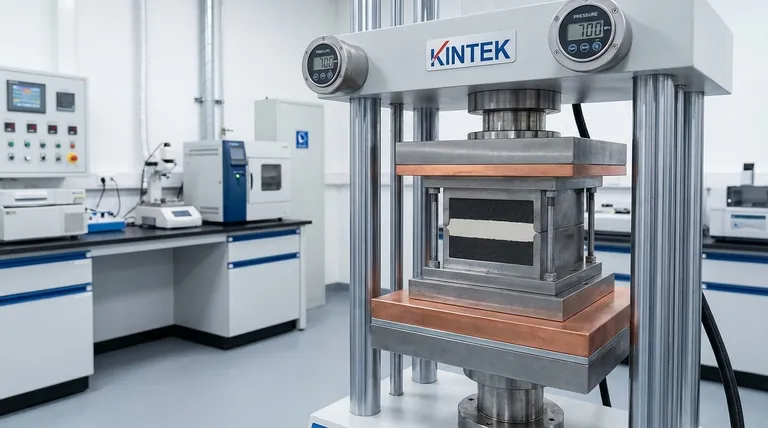
Achieving the precise pressure required for high-performance all-solid-state batteries is critical. KINTEK specializes in laboratory press machines, including automatic lab presses, isostatic presses, and heated lab presses, designed to meet the exacting demands of battery research and development.
Our robust and reliable equipment helps you:
- Eliminate Interfacial Resistance: Apply controlled, high pressures to create dense, void-free electrode and electrolyte layers.
- Ensure Structural Integrity: Utilize multi-step pressing processes for full-cell assembly without damaging sensitive materials.
- Accelerate Your R&D: Reproduce precise manufacturing conditions to reliably test and scale your battery designs.
Don't let manufacturing challenges limit your battery's potential. Contact our experts today to find the perfect lab press solution for your sodium-sulfur battery project!
Visual Guide

Related Products
- Warm Isostatic Press for Solid State Battery Research Warm Isostatic Press
- Laboratory Hydraulic Press Lab Pellet Press Button Battery Press
- Button Battery Sealing Press Machine for Lab
- Lab Infrared Press Mold for Laboratory Applications
- Lab Button Battery Tablet Press Sealing Mold
People Also Ask
- Why must composite cathodes be sealed in vacuum lamination bags for WIP? Ensure Battery Stability and Density
- What is the function of elastic molds in warm isostatic pressing? Achieve Uniform Density in Composite Particles
- How do sacrificial volume materials (SVM) maintain microchannels in isostatic pressing? Ensure Structural Integrity
- What is the mechanism of a Warm Isostatic Press (WIP) on cheese? Master Cold Pasteurization for Superior Safety
- What is the role of the flexible material in warm isostatic pressing? Key to Uniform Density & Precision