
Automated Cold Isostatic Press (CIP) systems achieve efficiency through a combination of compact, mobile engineering and durable component design. Specifically, their lightweight build allows for resource sharing between workspaces, while extended-life parts like static O-rings significantly reduce long-term maintenance expenditures.
Modern laboratory CIP systems decouple high-performance processing from the need for massive, fixed infrastructure. By integrating automated handling with a portable footprint, these units allow labs to maximize both floor space and budget by reducing maintenance frequency and enabling equipment mobility.
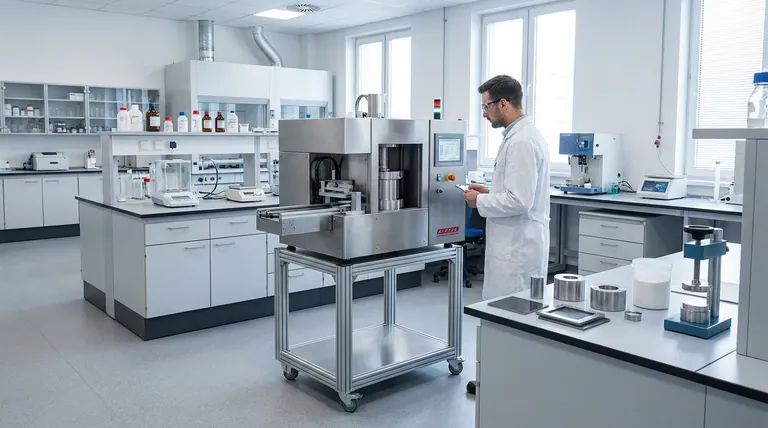
Maximizing Laboratory Real Estate
The Advantage of Mobility
Unlike traditional industrial presses which are often static heavyweights, laboratory CIP systems are designed to be lightweight and easy to move.
This portability transforms the equipment from a fixed asset into a shared resource.
A single unit can be transported between different labs as needed, preventing the need to purchase duplicate machines for different departments.
Compact Design Architecture
Space is a premium commodity in research environments.
Automated CIP systems utilize a compact footprint that fits easily into crowded lab layouts.
This allows facilities to integrate high-pressure capabilities without requiring extensive renovations or dedicating large floor areas to a single instrument.
Reducing Operational Costs
Durable Component Engineering
Maintenance labor and replacement parts often drive up the total cost of ownership for high-pressure equipment.
Automated CIP units mitigate this by utilizing durable components, specifically longer-lasting static O-rings.
Reliable sealing technology reduces the frequency of seal failures, directly lowering the cost of consumables and service downtime.
Automated Workflow Efficiency
Time is a critical cost factor in any laboratory setting.
These systems feature automated loading and unloading, which reduces the manual labor required for each cycle.
By streamlining the physical handling of materials, researchers can focus on analysis rather than machine operation.
Optimizing Material Performance
While space and cost are the primary physical constraints, true efficiency also involves getting the best results per cycle.
Precision Pressure Control
Efficiency also means avoiding failed experiments and material waste.
Automated systems offer high pressurization rates and customizable depressurization profiles.
This control is essential for achieving uniform microstructures and high green strength in processed materials.
Understanding the Trade-offs
Initial Complexity vs. Long-Term Gain
While automation offers significant efficiency, it introduces a layer of operational complexity compared to manual hydraulic presses.
Users must be prepared to manage customizable profiles and automated sequences.
Ensuring staff are trained to utilize these advanced features is necessary to realize the full efficiency benefits.
Making the Right Choice for Your Goal
To select the best CIP system for your specific laboratory needs, consider your primary constraints:
- If your primary focus is Space Constraint: Prioritize a lightweight system designed for mobility to allow resource sharing across multiple rooms.
- If your primary focus is Budget Optimization: Look for systems highlighting static O-ring technology to minimize ongoing maintenance and repair costs.
- If your primary focus is Sample Quality: Ensure the system features customizable depressurization profiles to guarantee uniform microstructures and high green strength.
By balancing physical footprint with robust component design, you can secure a system that delivers high-performance results without dominating your lab space or budget.
Summary Table:
| Efficiency Factor | Key Feature | Benefit for Your Lab |
|---|---|---|
| Space Savings | Lightweight, mobile design | Share one unit between labs; no need for duplicates |
| Space Savings | Compact footprint | Fits into crowded labs without renovations |
| Cost Savings | Durable static O-rings | Reduces frequency of seal failures and maintenance costs |
| Cost Savings | Automated loading/unloading | Cuts manual labor time and operational expenses |
| Performance | Precision pressure control | Ensures uniform microstructures and reduces material waste |
Ready to enhance your lab's efficiency with a space-saving, cost-effective press?
KINTEK's automated lab presses (including automatic lab press, isostatic press, and heated lab press) are engineered specifically for laboratory settings. We help you achieve superior material processing results while maximizing your valuable floor space and controlling long-term operational costs.
Contact KINTEK today to find the perfect CIP solution for your laboratory's unique needs and constraints.
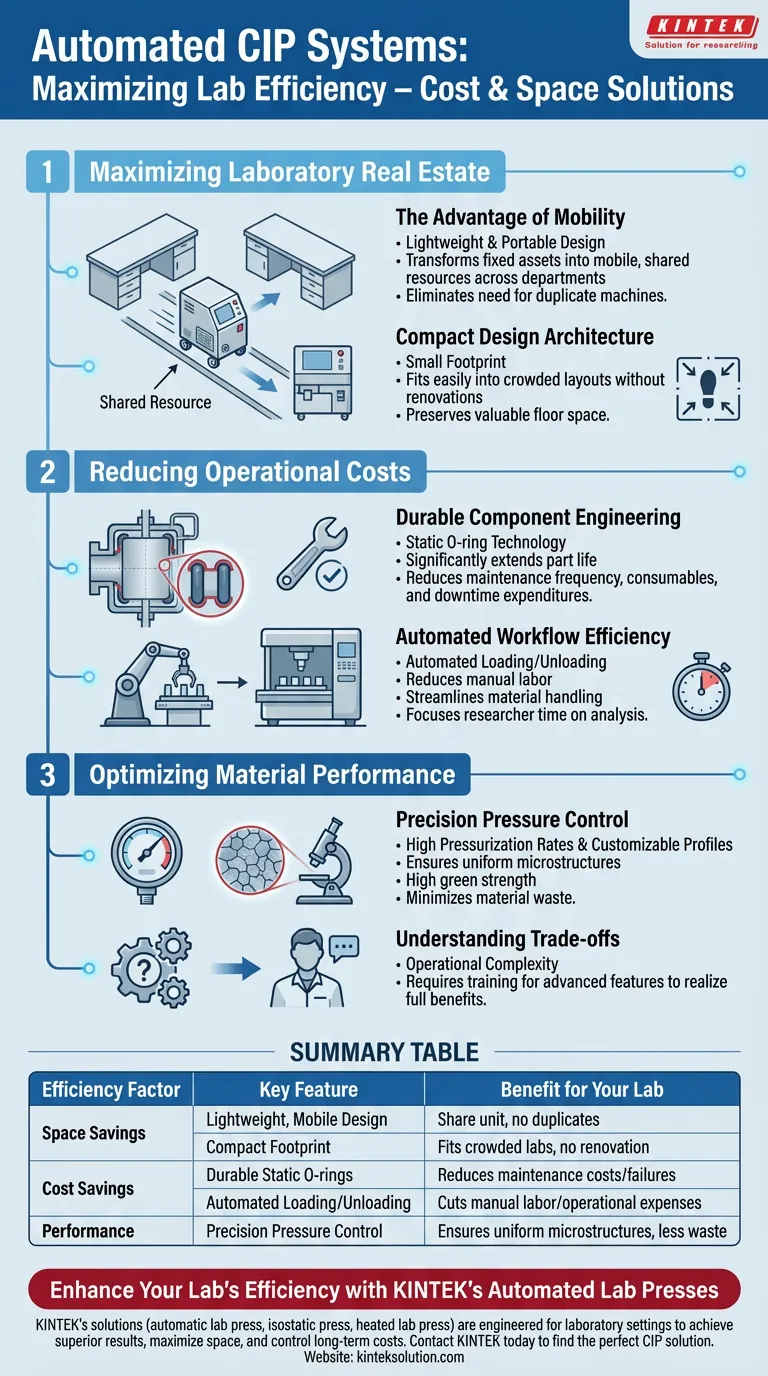
Visual Guide
Related Products
- Automatic Lab Cold Isostatic Pressing CIP Machine
- Electric Lab Cold Isostatic Press CIP Machine
- Manual Cold Isostatic Pressing CIP Machine Pellet Press
- Electric Split Lab Cold Isostatic Pressing CIP Machine
- Cylindrical Lab Electric Heating Press Mold for Laboratory Use
People Also Ask
- What are the key features of automated laboratory Cold Isostatic Press (CIP) systems? Achieve Precise, High-Pressure Powder Consolidation
- Why is an Isostatic Press (CIP) Necessary After Uniaxial Pressing? Achieve Transparency in Nd:Y2O3 Ceramics
- How does a Cold Isostatic Press (CIP) increase Bi-2223/Ag current density? Boost Superconductivity with Uniform Pressure
- How does a Cold Isostatic Press (CIP) facilitate the preparation of CaO-doped silicon carbide (SiC) green bodies?
- What is the primary function of a Cold Isostatic Press (CIP) in NASICON preparation? Achieve 96% Theoretical Density




