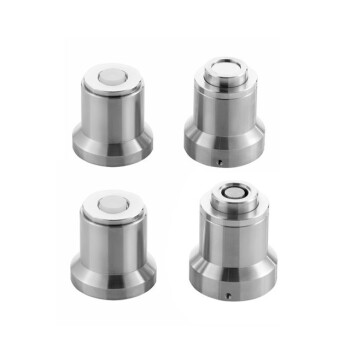
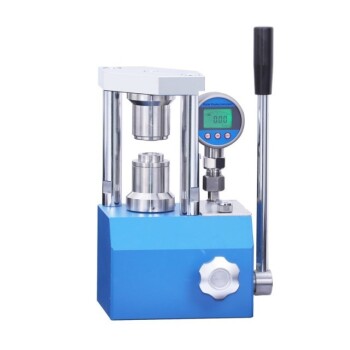
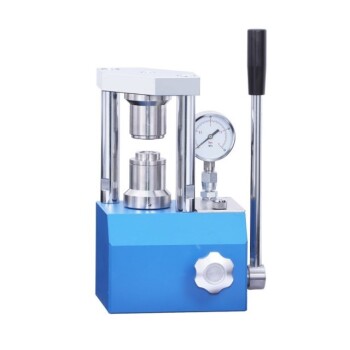
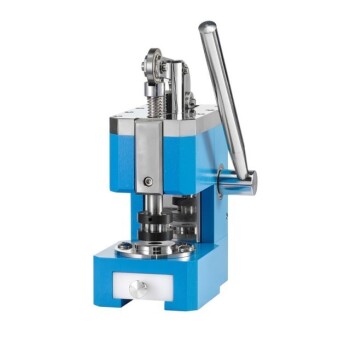
The coin cell crimper serves as the primary guardian of experimental validity by establishing the precise mechanical environment required for electrochemical testing. It impacts accuracy by delivering uniform pressure that creates an airtight seal, preventing electrolyte evaporation and impurity infiltration, while simultaneously maintaining the spinel-structured high-entropy oxide (HEO) electrode in a stable state of compression to eliminate contact resistance fluctuations.
Accurate HEO characterization depends as much on mechanical assembly as it does on material chemistry. A proper crimping process isolates the electrode from environmental variables and physical disconnection, ensuring that observed performance degradation is due to the material itself, not the test cell.
The Mechanics of Data Accuracy
Ensuring Chemical Isolation
The most immediate impact of a coin cell crimper is the creation of airtight encapsulation. By applying uniform mechanical pressure, the crimper seals the battery case against the external environment.
This sealing prevents the evaporation of the electrolyte, which is essential for consistent ionic transport. It also blocks the infiltration of external impurities, such as moisture or oxygen, which can cause parasitic reactions that skew test data.
Stabilizing Contact Resistance
For spinel-structured HEOs, data accuracy relies heavily on minimizing internal electrical noise. The crimper ensures the electrode remains in a stable state of compression.
This compression forces the internal components into tight contact. This prevents physical separation during operation, thereby avoiding fluctuations in contact resistance that would otherwise appear as erratic voltage or capacity data.
Critical Factors in HEO Performance
Reproducibility in Advanced Diagnostics
Advanced testing methods, such as Cyclic Voltammetry (CV) or Potentiostatic Electrochemical Impedance Spectroscopy (PEIS), require an extremely stable baseline. A high-quality crimper provides controllable radial pressure to ensure this stability.
By creating a uniform interface, the crimper significantly reduces interface impedance. This ensures that the complex data gathered regarding the HEO's redox behavior is reproducible and accurate, rather than an artifact of poor assembly.
Managing Electrode Mechanics
Internal components, including the cathode, separator, and anode, must function as a cohesive unit. The crimper establishes a solid-to-solid physical contact interface between these layers.
This is particularly vital for high-loading batteries or materials subject to volume changes. The tight mechanical contact helps accommodate the volume expansion pressure of thick electrodes, preventing sudden capacity loss caused by the physical detachment of active material.
Common Pitfalls to Avoid
The Risk of Insufficient Pressure
If the crimping force is too weak or uneven, the cell will suffer from poor physical contact. This leads to increased ohmic resistance, which severely hampers performance during high current density testing.
Misinterpreting Assembly Failure as Material Failure
A poorly crimped cell allows electrolyte to dry out or interfaces to separate over long cycles. Researchers often mistake these mechanical failures for chemical instability in the HEO material. Distinguishing between the two requires absolute confidence in the crimper's ability to maintain a constant internal environment.
Making the Right Choice for Your Goal
To ensure your HEO data is valid, tailor your crimping approach to your specific testing metrics:
- If your primary focus is Long-Cycle Stability: Prioritize a crimper that guarantees hermetic sealing to prevent electrolyte evaporation and ensure the electrode stays compressed over hundreds of cycles.
- If your primary focus is High-Rate Capability: Ensure your assembly process delivers high, uniform pressure to maximize solid-to-solid contact and minimize interfacial impedance.
Ultimately, a precise crimper transforms a stack of components into a unified electrochemical system, removing mechanical variables from your scientific equation.
Summary Table:
| Impact Factor | Role in HEO Testing | Benefit to Data Accuracy |
|---|---|---|
| Airtight Sealing | Prevents electrolyte evaporation | Ensures consistent ionic transport & blocks impurities |
| Mechanical Compression | Maintains stable electrode contact | Eliminates contact resistance fluctuations and noise |
| Interface Impedance | Reduces solid-to-solid resistance | Stabilizes baseline for advanced CV and PEIS diagnostics |
| Uniform Pressure | Manages electrode volume expansion | Prevents physical detachment and false capacity loss |
Elevate Your Battery Research with KINTEK
Don't let mechanical assembly variables compromise your material science breakthroughs. KINTEK specializes in comprehensive laboratory pressing solutions, offering manual, automatic, heated, multifunctional, and glovebox-compatible models, as well as cold and warm isostatic presses tailored for high-performance battery research.
Whether you are testing spinel-structured HEOs or high-loading thick electrodes, our precision crimping tools ensure the hermetic sealing and uniform pressure required for repeatable, publication-quality data. Contact us today to find the perfect pressing solution for your lab and eliminate assembly failure from your scientific equation!
References
- İrem Burcu Algan Şimşek, Michel W. Barsoum. Spinel-Structured High Entropy Oxides: Low Temperature Synthesis, Characterization, and Potential Applications. DOI: 10.1021/acsomega.5c00902
This article is also based on technical information from Kintek Solution Knowledge Base .
Related Products
- Lab Button Battery Disassembly and Sealing Mold
- Button Battery Sealing Machine for Button Batteries
- Manual Button Battery Sealing Machine for Battery Sealing
- Lab Button Battery Tablet Press Sealing Mold
- Button Battery Sealing Press Machine for Lab
People Also Ask
- How does a sealed battery mold facilitate the assembly and testing of asymmetric supercapacitors using VO2?
- What is the function of specialized battery molds and sealing consumables? Optimize Your In-situ XRD Testing Today
- How does the geometry of laboratory molds influence mycelium-based composites? Optimize Density and Strength
- Why are specialized battery test molds used? Ensure Peak Performance for All-Solid-State Sodium Batteries (ASSIBs)
- What role do battery testing molds play in electrolyte performance? Exploring Pressure vs. Viscoelasticity