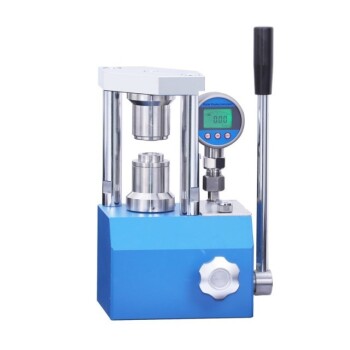
A coin cell packaging machine, also known as a crimper, serves as the critical final assembly tool that applies precise mechanical pressure to seal and compact the internal components of a solid-state battery. Its function is to permanently lock the cathode, composite electrolyte membrane, and lithium metal anode within the battery case while mechanically deforming the outer casing to create a hermetic seal.
Core Takeaway: In solid-state battery assembly, the packaging machine acts as both a compactor and a sealer. Its primary engineering goal is to force solid layers into intimate physical contact to minimize interfacial resistance, while simultaneously creating an airtight barrier to protect sensitive lithium components from atmospheric degradation.
The Critical Role of Pressure in Solid-State Assembly
Overcoming the Solid-Solid Interface Challenge
Unlike liquid electrolyte batteries where fluid fills gaps naturally, solid-state batteries rely entirely on physical contact for ion transport.
The packaging machine applies specific, uniform pressure to the cell stack.
This pressure eliminates microscopic gaps between the solid electrolyte and the electrodes, ensuring ions can move freely across the interface.
Reducing Interfacial Resistance
The primary metric improved by this machine is interfacial resistance.
By compacting the cathode, electrolyte, and anode layers tightly, the machine ensures continuous pathways for electrochemical reactions.
Without this compression, the internal resistance would be too high for the battery to function efficiently.
Hermetic Sealing and Protection
Creating an Airtight Environment
Solid-state batteries frequently utilize lithium metal anodes, which are highly reactive to moisture and oxygen.
The packaging machine deforms the metal battery case (usually stainless steel) against a polymer gasket.
This mechanical crimp creates a reliable airtight seal that blocks external contaminants from entering the cell.
Ensuring Data Consistency
For laboratory testing, the integrity of the seal is paramount for reproducibility.
If the packaging machine applies uneven pressure or fails to seal correctly, atmospheric interference will skew electrochemical test results.
A consistent crimp ensures that performance data reflects the chemistry of the battery, not manufacturing defects.
Understanding the Trade-offs
The Risk of Over-Compression
While pressure is necessary, too much force from the packaging machine can be detrimental.
Excessive pressure may crack brittle solid electrolyte membranes or cause short circuits between the anode and cathode.
Operators must calibrate the machine to apply enough force to lower resistance without structurally damaging the composite layers.
The Risk of Under-Compression
Conversely, insufficient pressure leads to delamination or poor contact.
If the crimp is too loose, the internal layers may separate over time, causing a sudden spike in impedance.
This often results in poor cycling stability and rapid capacity fading during long-term testing.
Making the Right Choice for Your Goal
To select or operate the correct packaging machine, you must align the equipment's capabilities with your specific assembly requirements.
- If your primary focus is Fundamental Material Research: Prioritize a machine with adjustable and highly precise pressure controls to experiment with how different compression levels affect interfacial impedance.
- If your primary focus is Production Consistency: Prioritize an automated or hydraulic machine that delivers uniform, repeatable mechanical pressure to ensure every cell in the batch performs identically.
The effectiveness of a solid-state battery is defined not just by its chemistry, but by the precision of the pressure that holds it together.
Summary Table:
| Function | Role in Solid-State Assembly | Impact on Battery Performance |
|---|---|---|
| Physical Compaction | Eliminates microscopic gaps between solid layers | Reduces interfacial resistance and enables ion transport |
| Hermetic Sealing | Deforms casing against a gasket to block moisture/oxygen | Protects reactive lithium anodes and ensures cell longevity |
| Mechanical Pressure | Applies uniform force to the internal cell stack | Prevents delamination and ensures reproducible test data |
| Structural Locking | Permanently secures cathode, electrolyte, and anode | Maintains structural integrity during electrochemical cycling |
Elevate Your Battery Research with KINTEK Precision
Maximize the performance of your solid-state cells with KINTEK’s advanced laboratory pressing solutions. Whether you are conducting fundamental material research or require high-throughput consistency, our range of manual, automatic, heated, and glovebox-compatible presses—including specialized cold and warm isostatic models—ensures perfect interfacial contact every time.
Don't let poor contact hinder your innovation. Contact KINTEK today to find the ideal pressing solution for your lab!
Related Products
People Also Ask
- Why use standardized CR2032 components & high-precision presses? Ensure reliability in lithium metal battery research.
- Why is a laboratory battery sealing press essential for desolvation energy testing? Ensure Reliable Kinetic Data
- Why is a laboratory hydraulic press or battery sealing machine essential? Ensure Coin Cell Data Integrity
- How do laboratory battery sealing machines ensure performance consistency? Master Your Lithium and LFP Battery Assembly
- What role does a laboratory sealing press play in thermal analysis of solid dispersion films? Ensure Data Integrity