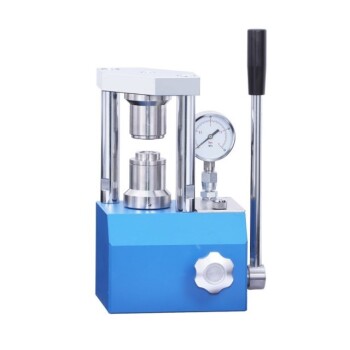
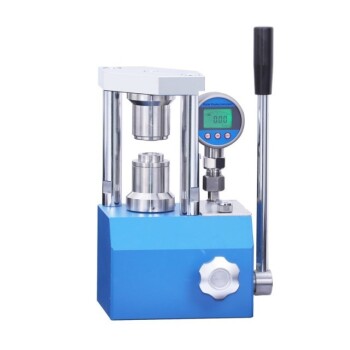
A laboratory coin cell sealing machine establishes the baseline for reliable data by applying precise, uniform mechanical pressure to the battery casing. This process creates a hermetic seal that simultaneously optimizes internal electrical contact and isolates the reactive sodium-ion chemistry from external environmental variables.
The core function of the machine is to eliminate assembly variables: by standardizing the physical pressure and airtightness of every cell, it ensures that test results reflect the true electrochemical performance of the materials rather than inconsistencies in the fabrication process.
Optimizing Internal Mechanical Contact
To obtain accurate electrochemical data, the internal components of the battery must behave as a single, cohesive unit. The sealing machine serves as the final step in ensuring this structural integrity.
Minimizing Contact Resistance
The machine applies stable mechanical pressure to force the electrode, separator, and current collector into tight contact.
This physical compression minimizes contact resistance (or ohmic resistance) between layers. Without this uniform pressure, gaps between components would create artificial impedance, skewing test results.
Enhancing Electrolyte Wetting
Proper sealing pressure ensures the electrolyte is evenly distributed within the porous framework of the cell.
By eliminating voids, the machine ensures the electrolyte sufficiently wets the electrodes and separator. This is critical for facilitating efficient ion transport during charge and discharge cycles.
Preserving the Chemical Environment
Sodium-ion batteries utilize highly reactive electrolytes and electrodes that degrade rapidly if exposed to the wrong conditions. The sealing machine acts as the primary defense against chemical instability.
Preventing Environmental Contamination
The high-precision sealing process hermetically encapsulates the cell contents.
This prevents the ingress of external air and moisture, which can react with sodium-based components to form unwanted byproducts. A compromised seal leads to parasitic reactions that mask the true efficiency of the battery material.
Stopping Electrolyte Volatilization
During long-term testing, liquid electrolytes can evaporate or leak if the casing is not perfectly crimped.
The sealing machine provides constant radial pressure to prevent this volatilization. Maintaining a stable electrolyte volume is essential for ensuring the validity of cycle life data and capacity retention measurements.
The Impact on Data Fidelity
The mechanical and chemical stability provided by the sealing machine directly correlates to specific metrics in your data analysis.
Accuracy in Kinetic Measurements
Techniques like Electrochemical Impedance Spectroscopy (EIS) rely heavily on the physical interface between components.
If the sealing pressure is inconsistent, the resulting impedance spectra will show artifacts unrelated to the material's kinetics. Precise sealing is a prerequisite for calculating accurate diffusion coefficients and reaction rates.
Reliability in Long-Cycle Testing
For tests that run over hundreds or thousands of cycles, the internal environment must remain static.
A rigorous seal ensures that any degradation observed in the data is due to the electrochemical aging of the material, not the gradual leakage of electrolyte or slow infiltration of oxygen.
Understanding the Trade-offs
While pressure is vital, it must be calibrated correctly to avoid compromising the test.
The Risk of Over-Compression
Applying excessive pressure during sealing can crush the porous separator or deform the casing. This can cause internal short circuits or restrict the flow of ions, leading to false failures or artificially low capacity readings.
The Risk of Under-Compression
Insufficient pressure often results in a "loose" cell with high internal resistance. This leads to poor rate performance and noisy data, making it impossible to distinguish between a poor battery material and a poor assembly process.
Making the Right Choice for Your Goal
To maximize the reliability of your sodium-ion testing, consider how the sealing parameters align with your specific research objectives:
- If your primary focus is Fundamental Kinetics (EIS/GITT): Prioritize a machine with high-precision pressure control to ensure minimal and consistent contact resistance across all samples.
- If your primary focus is Long-Term Cycle Life: Prioritize a machine with superior radial crimping mechanics to guarantee absolute airtightness and prevent electrolyte volatilization over weeks of testing.
Ultimately, the reliability of your sodium-ion research depends not just on the chemistry you synthesize, but on the mechanical precision with which you encapsulate it.
Summary Table:
| Feature | Impact on Data Reliability | Research Benefit |
|---|---|---|
| Precise Mechanical Pressure | Minimizes contact resistance & ensures electrolyte wetting | Consistent EIS & Kinetic measurements |
| Hermetic Sealing | Prevents air/moisture ingress & electrolyte leakage | Accurate long-term cycle life data |
| Standardized Crimping | Eliminates assembly-related variables | Reproducible results across cell batches |
| Calibrated Compression | Prevents separator damage or high impedance | Distinguishes material performance from assembly errors |
Elevate Your Battery Research with Precision Engineering
Consistency is the backbone of reliable electrochemical data. KINTEK specializes in comprehensive laboratory pressing solutions, offering a wide range of manual, automatic, heated, and glovebox-compatible coin cell sealing machines designed specifically for sensitive chemistries like sodium-ion.
Whether you are performing fundamental kinetic studies or long-term cycling, our equipment ensures your results reflect your material's true potential—not assembly inconsistencies. Beyond coin cells, we provide multifunctional cold and warm isostatic presses widely applied in advanced battery research.
Contact KINTEK today to find the perfect sealing solution for your lab!
References
- Darren M. C. Ould, Clare P. Grey. Properties of NaPF<sub>6</sub> electrolytes and effect of electrolyte concentration on performance in sodium-ion batteries. DOI: 10.1039/d5cc01447f
This article is also based on technical information from Kintek Solution Knowledge Base .
Related Products
- Button Battery Sealing Press Machine for Lab
- Manual Button Battery Sealing Machine for Battery Sealing
- Lab Button Battery Tablet Press Sealing Mold
- Lab Button Battery Disassembly and Sealing Mold
- Button Battery Sealing Machine for Button Batteries
People Also Ask
- Why use standardized CR2032 components & high-precision presses? Ensure reliability in lithium metal battery research.
- Why is a laboratory battery sealing press essential for desolvation energy testing? Ensure Reliable Kinetic Data
- Why is a laboratory hydraulic press or battery sealing machine essential? Ensure Coin Cell Data Integrity
- How do laboratory battery sealing machines ensure performance consistency? Master Your Lithium and LFP Battery Assembly
- What role does a laboratory sealing press play in thermal analysis of solid dispersion films? Ensure Data Integrity