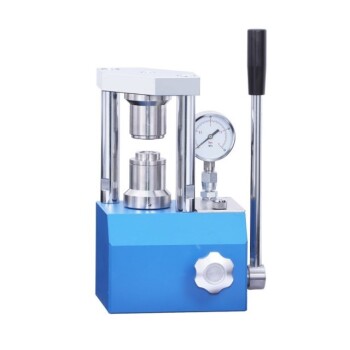
The use of dedicated laboratory pressing and sealing equipment is critical because it provides the uniform pressure and hermetic seal necessary to transform loose components into a functional electrochemical system. This equipment ensures optimal electrical contact between internal layers while isolating the cell’s chemistry from the external environment, preventing the corruption of test data.
The Core Reality A coin cell is only as good as its assembly. Without the precise mechanical compression provided by a laboratory press, internal resistance spikes and electrolytes degrade, making it impossible to distinguish between poor material performance and poor assembly quality.
Optimizing Internal Electrical Performance
Achieving Uniform Physical Contact
To function correctly, the internal stack of an R2032 coin cell—comprising the cathode, separator, and anode (such as sodium or lithium metal)—must be physically compacted.
Laboratory presses apply uniform pressure across the entire surface area of these components. This compaction ensures that the electrolyte sufficiently wets the porous structures and that the layers remain in intimate contact throughout the testing period.
Minimizing Interfacial Resistance
One of the primary causes of test failure is high contact resistance between components.
By tightly bonding the electrode, separator, and current collector, sealing equipment eliminates gaps that create ohmic internal resistance. This reduction in impedance is vital for accurate voltage readings and efficient charge transfer.
Ensuring Chemical Stability and Safety
Creating a Hermetic Seal
The chemical components inside a battery, particularly the electrolyte and alkali metal anodes, are highly sensitive.
Dedicated sealing machines crimp the stainless steel casing to create a tight mechanical seal. This hermetically isolates the internal environment, preventing the ingress of external air, moisture, or impurities that would react with the anode and compromise safety.
Preventing Electrolyte Loss
Electrolytes are volatile and prone to evaporation over time.
A rigorous seal prevents the volatilization of the internal electrolyte. If the electrolyte dries out (a phenomenon known as "dry-out"), ion transport ceases, leading to premature cell failure and misleading cycle life data.
Guaranteeing Data Reproducibility
Consistency in Electrochemical Testing
Scientific testing requires results that can be repeated and verified.
The consistency provided by automated or manual presses ensures that every cell is assembled with the same degree of compression. This uniformity is essential for obtaining accurate data on rate performance and cycle life, allowing researchers to compare different materials without assembly variables skewing the results.
Accuracy in Advanced Diagnostics
For sensitive measurements like Cyclic Voltammetry (CV) or Electrochemical Impedance Spectroscopy (PEIS), background noise must be minimized.
High-quality encapsulation stabilizes the interface impedance. This ensures that the data reflects the true electrochemical behavior of the materials, rather than artifacts caused by loose connections or fluctuating pressure.
Common Pitfalls in Sealing
The Risk of Over-Compression
While pressure is necessary, excessive force can be detrimental.
If the press applies too much pressure, it can crush the internal separator or deform the casing. This often leads to internal short circuits or compromised structural integrity, rendering the cell useless before testing begins.
Issues with Uneven Crimping
If the sealing pressure is not applied radially and evenly, the crimp may be defective.
An uneven crimp results in micro-leaks. While the cell may appear sealed initially, slow leakage of electrolyte or slow ingress of moisture will cause gradual degradation, resulting in confusing data drifts during long-term cycling.
Making the Right Choice for Your Goal
When setting up your assembly process, prioritize the specific needs of your testing protocol:
- If your primary focus is Cycle Life: Prioritize seal integrity to prevent electrolyte dry-out and moisture ingress over weeks of testing.
- If your primary focus is Rate Performance: Prioritize uniform compression to minimize internal contact resistance and maximize power capability.
- If your primary focus is Impedance Spectroscopy (EIS): Prioritize precise, repeatable pressure to ensure the stability of the electrode-electrolyte interface.
Ultimately, the laboratory press is not just a packaging tool; it is a precision instrument that establishes the baseline conditions required for valid scientific discovery.
Summary Table:
| Feature | Impact on Battery Performance | Importance for Research |
|---|---|---|
| Uniform Pressure | Minimizes interfacial & ohmic resistance | Ensures high-rate performance accuracy |
| Hermetic Sealing | Prevents moisture ingress & electrolyte loss | Essential for long-term cycle life stability |
| Mechanical Consistency | Standardizes assembly variables | Guarantees data reproducibility across batches |
| Controlled Compression | Avoids separator damage & short circuits | Protects cell structural integrity |
| Interface Stability | Stabilizes impedance (PEIS/CV) | Enables high-fidelity electrochemical diagnostics |
Maximize Your Battery Research Precision with KINTEK
Don’t let poor assembly quality compromise your scientific discovery. KINTEK specializes in comprehensive laboratory pressing solutions designed specifically for the rigorous demands of battery research. Whether you need manual, automatic, heated, or multifunctional models—including glovebox-compatible and isostatic presses—we provide the tools to ensure uniform compression and perfect hermetic seals.
Ready to eliminate assembly variables and achieve reproducible results?
Contact KINTEK today for a tailored consultation and find the ideal pressing solution for your lab.
References
- Shinichi Kumakura, Shinichi Komaba. Synthesis and Electrochemistry of Stacking Fault‐Free <i>β</i>‐NaMnO<sub>2</sub>. DOI: 10.1002/adma.202507011
This article is also based on technical information from Kintek Solution Knowledge Base .
Related Products
- Button Battery Sealing Press Machine for Lab
- Lab Button Battery Tablet Press Sealing Mold
- Lab Button Battery Disassembly and Sealing Mold
- Laboratory Hydraulic Press Lab Pellet Press Machine for Glove Box
- Automatic Heated Hydraulic Press Machine with Hot Plates for Laboratory
People Also Ask
- Why use standardized CR2032 components & high-precision presses? Ensure reliability in lithium metal battery research.
- Why is a laboratory battery sealing press essential for desolvation energy testing? Ensure Reliable Kinetic Data
- Why is a laboratory hydraulic press or battery sealing machine essential? Ensure Coin Cell Data Integrity
- How do laboratory battery sealing machines ensure performance consistency? Master Your Lithium and LFP Battery Assembly
- What role does a laboratory sealing press play in thermal analysis of solid dispersion films? Ensure Data Integrity