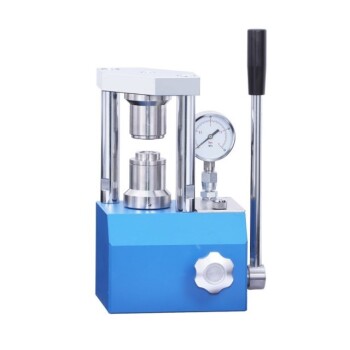
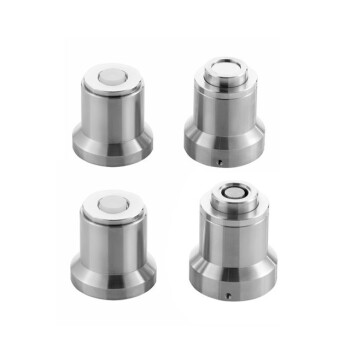
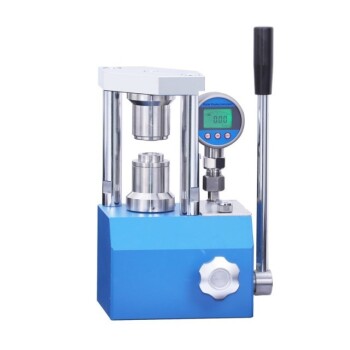
The laboratory sealing machine acts as the final guarantor of a coin cell’s structural and electrochemical integrity. It provides the uniform, stable mechanical pressure necessary to physically interlock the cell’s external shells with its internal components, transforming loose parts into a functional energy storage device.
Core Takeaway The sealing machine is not merely a packaging tool; it is a precision instrument that dictates the internal electrical continuity of the battery. By applying controlled mechanical pressure, it minimizes contact resistance and isolates the chemical environment, ensuring that the resulting test data reflects the true performance of the material rather than assembly defects.
The Mechanics of Precision Sealing
Achieving Uniform Mechanical Pressure
The primary function of the sealing machine (often referred to as a crimper) is to apply constant and uniform force to the coin cell assembly.
Manual assembly or inconsistent pressure leads to variations in how components sit within the shell. The machine ensures that the positive and negative shells are compressed against the sealing gasket with exact repeatability.
Component Interlocking
Inside the cell, you have a stack of components: the cathode, separator, lithium anode, and spacers.
The sealing machine forces these layers into tight physical contact. This compression physically locks the external stainless steel shells together while compressing the internal gasket to create a hermetic seal.
Impact on Electrochemical Performance
Minimizing Contact Resistance
The most critical electrical role of the sealing machine is the reduction of contact resistance.
If the internal components—specifically the electrode materials and the current collectors—are not pressed together tightly, electrons cannot flow efficiently. A loose seal creates high impedance, which artificially degrades the cell's performance data, masking the true capabilities of the electrode materials.
Ensuring Environmental Isolation
High-precision hydraulic crimpers prevent electrolyte leakage and air ingress.
Lithium-ion chemistries are highly sensitive to moisture and oxygen. A proper seal creates a closed system that excludes environmental interference. This isolation is strictly necessary to acquire accurate data regarding cycle life and stability.
Understanding the Trade-offs
The Balance of Pressure
While pressure is vital, it must be precisely controlled.
Insufficient pressure leads to poor electrical contact (high resistance) and potential leakage of the electrolyte. This compromises the safety of the test and renders the data regarding rate performance unusable.
Excessive pressure, conversely, can crush internal components or pierce the separator. This can cause internal short circuits or deform the cell casing, which also invalidates the test results. The machine's role is to find and maintain the "Goldilocks" zone of pressure that secures the cell without damaging its contents.
Making the Right Choice for Your Goal
To ensure your research yields valid results, consider how the sealing process aligns with your specific testing objectives.
- If your primary focus is Data Reproducibility: Prioritize a machine with high-precision pressure control to ensure every cell in your batch has identical internal contact resistance.
- If your primary focus is Long-Term Cycle Life: Ensure your sealing parameters are optimized to prevent even microscopic electrolyte leakage or air ingress over weeks of testing.
Ultimately, the reliability of your electrochemical data is only as good as the mechanical precision of your cell sealing process.
Summary Table:
| Feature | Impact on Electrochemical Evaluation |
|---|---|
| Uniform Pressure | Ensures consistent electrical contact across all internal layers. |
| Gasket Compression | Creates a hermetic seal to prevent electrolyte leakage and oxidation. |
| Controlled Force | Prevents internal short circuits and physical damage to separators. |
| Repeatability | Minimizes variables between test batches for reliable data comparison. |
Maximize Your Battery Research Precision with KINTEK
Don't let assembly defects mask your material's true potential. KINTEK specializes in comprehensive laboratory pressing solutions tailored for high-stakes battery research. Our range includes:
- Manual & Automatic Crimpers: Precision-engineered for consistent coin cell sealing.
- Heated & Multifunctional Presses: Versatile options for advanced electrode preparation.
- Glovebox-Compatible Designs: Seamlessly integrated tools for moisture-sensitive chemistries.
- Isostatic Presses: High-pressure solutions for solid-state battery development.
Ensure your electrochemical data reflects true performance through superior mechanical integrity. Contact KINTEK today to find the perfect sealing solution for your laboratory.
References
- S. H. Tang, Xin He. Revealing the Degradation Mechanism of Lithium‐Ion Batteries for Electric Aircraft. DOI: 10.1002/adma.202502363
This article is also based on technical information from Kintek Solution Knowledge Base .
Related Products
- Button Battery Sealing Press Machine for Lab
- Manual Button Battery Sealing Machine for Battery Sealing
- Lab Button Battery Tablet Press Sealing Mold
- Lab Button Battery Disassembly and Sealing Mold
- Button Battery Sealing Machine for Button Batteries
People Also Ask
- Why use standardized CR2032 components & high-precision presses? Ensure reliability in lithium metal battery research.
- Why is a laboratory battery sealing press essential for desolvation energy testing? Ensure Reliable Kinetic Data
- Why is a laboratory hydraulic press or battery sealing machine essential? Ensure Coin Cell Data Integrity
- How do laboratory battery sealing machines ensure performance consistency? Master Your Lithium and LFP Battery Assembly
- What role does a laboratory sealing press play in thermal analysis of solid dispersion films? Ensure Data Integrity