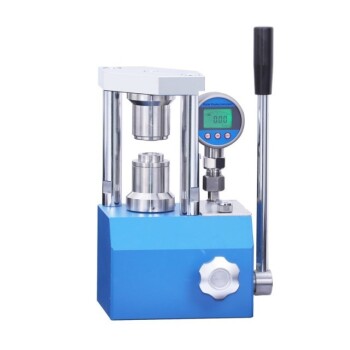
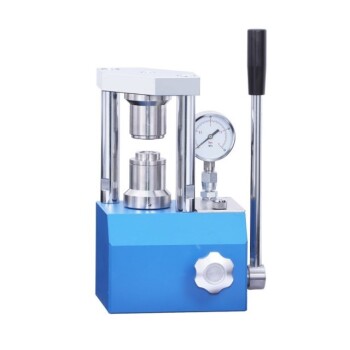
The application of high-pressure mechanical sealing is the definitive step that transforms a stack of loose components into a functional, testable solid-state battery. A manual or automatic coin cell crimper is required to exert precise force on the battery case, effectively locking the electrodes, electrolytes, and gaskets into a permanent, hermetically sealed unit.
Core Takeaway In solid-state batteries, high pressure is not merely about closing the case; it is a functional necessity to force rigid solid electrolytes and electrodes into intimate physical contact. This reduces interfacial impedance and creates a robust seal against environmental contaminants, ensuring data accuracy and long-term cycling stability.
Solving the Solid-State Interface Challenge
Forcing Solids into Contact
Unlike liquid electrolytes, which naturally flow and "wet" the electrode surfaces, solid-state electrolytes are rigid. They do not naturally form a connection with the anode or cathode.
High-pressure crimping overcomes this physical limitation. It mechanically forces the solid electrolyte and electrode materials together, eliminating microscopic gaps that would otherwise break the circuit.
Reducing Interfacial Impedance
The primary enemy of solid-state battery performance is high interfacial impedance (resistance) between layers.
By utilizing high-pressure encapsulation, the crimper ensures tight physical contact at these critical interfaces. This direct compression significantly lowers the resistance, allowing ions to move freely between components.
Ensuring Environmental and Structural Integrity
Creating a Hermetic Seal
Solid-state chemistries are often highly sensitive to the surrounding environment.
The crimper deforms the metal case against a gasket to create a superior physical seal. This prevents moisture and oxygen from infiltrating the cell, which is essential for maintaining chemical stability during long-term testing.
Maintaining Component Alignment
Inside the coin cell, multiple layers (springs, spacers, current collectors) must remain perfectly aligned.
The crimper applies uniform, constant pressure that "freezes" these components in place. This prevents internal shifting or loss of contact, which could lead to intermittent failure or short circuits.
The Critical Role of Data Accuracy
Eliminating Contact Resistance Variables
To obtain reliable electrochemical impedance data, you must eliminate variables caused by poor assembly.
If the crimping pressure is insufficient or uneven, contact resistance will fluctuate. A high-quality crimper ensures that the resistance measured is intrinsic to your materials, not a side effect of a loose assembly.
Ensuring Repeatability
Scientific validity relies on the ability to reproduce results across multiple sample cells.
Precise mechanical pressure ensures that every coin cell is sealed with the same force. This consistency allows you to confidently compare data between different batches, knowing the assembly conditions were identical.
Understanding the Precision Trade-off
The Importance of Uniformity
While high pressure is required, it must be applied uniformly.
A laboratory crimper is designed to apply this force evenly across the entire surface of the cell. Uneven pressure can lead to localized "hot spots" of high current density or physical damage to the internal separator.
Pressure Maintenance vs. Crushing
There is a balance between achieving a tight seal and crushing delicate internal structures.
The crimper provides controlled mechanical pressure. This distinction is vital; it applies enough force to bond the case and gasket tightly without deforming the active materials beyond their structural limits.
Making the Right Choice for Your Goal
To maximize the effectiveness of your solid-state battery assembly, consider your specific testing objectives:
- If your primary focus is lowering impedance: Ensure your crimper can deliver sufficient force to maximize the physical contact area between the solid electrolyte and the electrodes.
- If your primary focus is long-term cycling stability: Prioritize a crimper with precision dies that guarantee a hermetic seal to prevent atmospheric contamination over weeks of testing.
Ultimately, the crimper is not just a packaging tool; it is an active instrument that establishes the physical conditions necessary for solid-state chemistry to function.
Summary Table:
| Feature | Impact on Solid-State Batteries | Benefit to Researcher |
|---|---|---|
| Interfacial Contact | Forces rigid electrolytes and electrodes together | Lowers resistance and enables ion transport |
| Hermetic Sealing | Deforms case against gasket to block moisture/O2 | Ensures chemical stability and cycling longevity |
| Structural Alignment | Secures internal layers (spacers, springs) in place | Prevents internal shifts and short circuits |
| Pressure Uniformity | Eliminates variables in contact resistance | Ensures repeatable, scientifically valid data |
Elevate Your Battery Research with KINTEK Precision
At KINTEK, we understand that the success of your solid-state battery research depends on the integrity of every seal. We specialize in comprehensive laboratory pressing solutions, offering a versatile range of manual, automatic, heated, multifunctional, and glovebox-compatible crimpers, alongside advanced cold and warm isostatic presses.
Whether you are aiming to minimize interfacial impedance or maximize cycling stability, our high-precision equipment provides the controlled, uniform force your materials require. Contact us today to find the perfect crimping solution for your laboratory and ensure your data is as robust as your assembly.
References
- Ruirui Chang, Juan Yang. Weakening Lithium‐Ion Coordination in Poly(Ethylene Oxide)‐Based Solid Polymer Electrolytes for High Performance Solid‐State Batteries. DOI: 10.1002/aenm.202405906
This article is also based on technical information from Kintek Solution Knowledge Base .
Related Products
- Button Battery Sealing Machine for Button Batteries
- Button Battery Sealing Press Machine for Lab
- Manual Button Battery Sealing Machine for Battery Sealing
- Lab Button Battery Tablet Press Sealing Mold
- Lab Button Battery Disassembly and Sealing Mold
People Also Ask
- Why is a laboratory hydraulic press or battery sealing machine essential? Ensure Coin Cell Data Integrity
- What role does a laboratory press perform for CR2032 coin cell assembly? Ensure Precision in Battery Research
- How does a high-precision lab press or coin cell crimper affect the performance of assembled lithium-metal batteries?
- How does the mechanical pressure provided by a laboratory crimper affect the performance of assembled 2032-type coin cells?
- What role does a coin cell crimper play in solid-state batteries? Essential Pressure for Ionic Conductivity