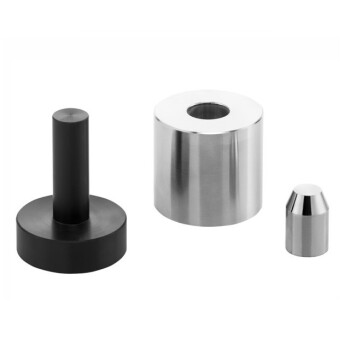
A laboratory coin cell crimping press serves a critical role in battery fabrication by applying consistent mechanical pressure to hermetically seal the battery casing. Its primary function is to lock the external case over the internal components—electrodes, separators, and electrolytes—to ensure a secure, leak-proof enclosure that maintains the necessary internal physical pressure for electrical operation.
Core Takeaway While its mechanical action is sealing, the crimping press is fundamentally a tool for experimental consistency. It ensures that the interface between internal components remains uniform across every sample, guaranteeing that performance data reflects the true chemistry of the materials rather than variations in assembly pressure or atmospheric contamination.
The Critical Role of Precision Sealing
Achieving Hermetic Isolation
The most immediate function of the crimping press is creating a hermetic seal. This barrier is vital for preventing the leakage of liquid electrolytes, which could corrode external equipment or pose safety hazards.
Equally important is the exclusion of the external environment. By blocking the infiltration of air and moisture, the press protects sensitive internal components, such as lithium foil, from degradation.
Ensuring Long-Term Reliability
For meaningful research, battery cells must survive long-term cycling tests without mechanical failure.
A proper crimp ensures the seal holds up against the internal pressure changes that occur during repeated charge and discharge cycles, preserving the cell's integrity over weeks or months of testing.
Optimizing Internal Electrical Contact
Minimizing Interfacial Resistance
Beyond simply closing the box, the crimping press applies a specific amount of force to the internal "stack" of materials.
This compression forces the active material layers, separators, and current collectors into tight physical contact. This tight integration significantly minimizes interfacial contact resistance, which is the electrical resistance found where two materials meet.
Stabilizing the Electrode Structure
The pressure applied during crimping ensures that components like the zinc or lithium metal anodes maintain distinct, continuous contact with the separator and electrolyte.
Without this "densification" of the internal assembly, gaps could form between layers. These gaps impede the flow of ions and electrons, leading to poor performance or erratic test data.
Understanding the Trade-offs
The Balance of Pressure
It is a common misconception that "tighter is better." There is a critical trade-off when configuring a crimping press.
Insufficient pressure leads to poor sealing and high internal resistance, rendering the cell useless.
Excessive pressure, however, can crush the internal separator or deform the casing. This can cause internal short circuits or damage the delicate structure of the electrode materials, artificially degrading performance.
Consistency vs. Force
The value of a laboratory press is not just the amount of force it can generate, but its repeatability.
Manual crimpers can introduce user error, resulting in variable pressure from cell to cell. Automatic or hydraulic crimpers are often preferred in rigorous studies because they apply the exact same pressure every time, removing human variability from the equation.
Making the Right Choice for Your Goal
To ensure your battery fabrication process yields valid data, consider the following based on your specific research objectives:
- If your primary focus is long-term cycling stability: Prioritize a press with high-precision die alignment to ensure a perfect hermetic seal that prevents electrolyte dry-out or oxidation over time.
- If your primary focus is rate capability (high current): Focus on the press’s ability to apply uniform, repeatable pressure to minimize contact resistance, which is the limiting factor during high-current operation.
Success in battery research depends not just on the chemistry you invent, but on the mechanical precision with which you package it.
Summary Table:
| Feature | Function in Battery Fabrication | Impact on Research |
|---|---|---|
| Hermetic Sealing | Prevents electrolyte leaks and moisture ingress | Ensures safety and prevents component degradation |
| Mechanical Compression | Minimizes interfacial contact resistance | Improves ion/electron flow and data accuracy |
| Structural Stabilization | Maintains tight contact between internal layers | Prevents gaps that lead to erratic performance |
| Pressure Repeatability | Eliminates human variability in assembly | Guarantees experimental consistency across samples |
Elevate Your Battery Research with KINTEK Precision
Precision assembly is the foundation of reliable battery data. KINTEK specializes in comprehensive laboratory pressing solutions designed for the rigorous demands of energy storage research. Whether you require manual, automatic, heated, or glovebox-compatible models, our equipment ensures perfect hermetic seals and consistent internal pressure for every coin cell.
From advanced battery research to specialized cold and warm isostatic presses, KINTEK provides the mechanical reliability your chemistry deserves. Contact us today to find the perfect crimping solution for your lab!
References
- Hojung Yun, Jitti Kasemchainan. Achieving Waste-Valorized Anode Materials for Li-Ion Batteries by Surface Engineering of Recycled Graphite from Spent Zn–C Batteries. DOI: 10.1021/acssuschemeng.5c04658
This article is also based on technical information from Kintek Solution Knowledge Base .
Related Products
- Button Battery Sealing Press Machine for Lab
- Lab Cylindrical Press Mold for Laboratory Use
- Lab Button Battery Tablet Press Sealing Mold
- Assemble Lab Cylindrical Press Mold for Laboratory Use
- Lab Cylindrical Press Mold with Scale
People Also Ask
- Why use standardized CR2032 components & high-precision presses? Ensure reliability in lithium metal battery research.
- Why is a laboratory battery sealing press essential for desolvation energy testing? Ensure Reliable Kinetic Data
- Why is a laboratory hydraulic press or battery sealing machine essential? Ensure Coin Cell Data Integrity
- How do laboratory battery sealing machines ensure performance consistency? Master Your Lithium and LFP Battery Assembly
- What role does a laboratory sealing press play in thermal analysis of solid dispersion films? Ensure Data Integrity