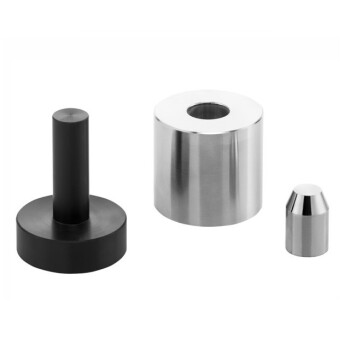
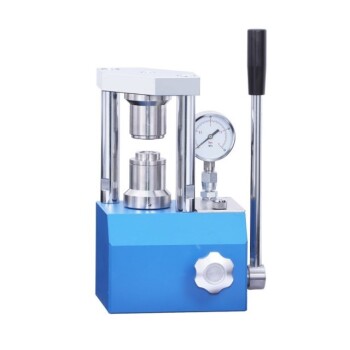
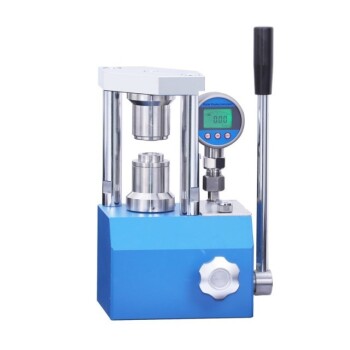
Technically, a high-precision battery crimper assures the integrity of coin cell batteries by applying constant radial and axial pressure to the casing. This mechanical action guarantees a reliable seal that prevents electrolyte leakage or evaporation while establishing stable physical contact between the internal cathode, separator, and anode. These factors are prerequisites for achieving uniform internal resistance and ensuring the accuracy of electrochemical test results.
Core Takeaway The crimper is not just a packaging tool; it is a critical instrument for standardizing internal resistance. By regulating pressure and sealing, it eliminates mechanical variables that would otherwise distort electrochemical data, ensuring that test results reflect the chemistry of the battery, not the quality of the assembly.
The Mechanics of Sealing Integrity
Precise Application of Pressure
A high-precision crimper applies force in two specific directions: radially and axially. This dual-vector pressure ensures the battery case deforms uniformly against the sealing gasket without warping the materials.
Preventing Electrolyte Loss
For systems utilizing volatile or aqueous electrolytes, the seal is the primary defense against failure. The crimper ensures the casing creates a hermetic barrier, preventing the evaporation of the electrolyte.
Environmental Isolation
Beyond keeping materials in, the seal keeps contaminants out. A proper crimp isolates internal components from external air and moisture, which is vital for maintaining the stability of sensitive active materials.
Optimizing Electrochemical Performance
Establishing Physical Contact
The crimper compresses the internal "stack"—the anode, separator, and cathode—into a unified electrochemical system. This compression must be sufficient to maintain continuous physical contact between layers, such as the Sodium Vanadium Phosphate cathode and the zinc anode mentioned in specific applications.
Reducing Interface Resistance
Loose components create gaps that impede electron flow. By enforcing tight physical contact, the crimper significantly reduces interface contact resistance (impedance).
Enhancing Ion Transport
Uniform mechanical pressure improves the efficiency of ion transport across the separator. This is fundamental for the stable operation of the battery, particularly during high-current charging and discharging cycles where polarization must be minimized.
Understanding the Trade-offs
The Risk of Over-Compression
While contact is essential, excessive force can be detrimental. Over-compressing the cell can damage the porous structure of the separator or crush the cathode material, potentially causing internal short circuits or reduced capacity.
Precision vs. Force
High precision does not simply mean "high force." It refers to the repeatability and uniformity of the pressure applied. A crimper that applies uneven pressure will result in inconsistent test data, regardless of how tight the seal appears visually.
Making the Right Choice for Your Goal
To select the correct assembly parameters, you must align the crimping process with your specific experimental objectives.
- If your primary focus is Data Accuracy: Prioritize a crimper with calibrated pressure controls to ensure low and uniform internal resistance, eliminating mechanical noise from your results.
- If your primary focus is Cycle Life Testing: Focus on the hermeticity of the seal to prevent electrolyte evaporation, which is the leading cause of failure in long-term cycling.
Ultimately, the crimper transforms a collection of raw materials into a standardized, testable electrochemical environment.
Summary Table:
| Technical Feature | Benefit to Battery Assembly |
|---|---|
| Dual-Vector Pressure | Ensures uniform radial/axial deformation for a hermetic seal. |
| Environmental Isolation | Prevents electrolyte evaporation and air/moisture contamination. |
| Stack Compression | Minimizes interface contact resistance for stable ion transport. |
| Calibrated Repeatability | Eliminates mechanical variables to ensure data reproducibility. |
| Internal Resistance Control | Standardizes the electrochemical environment for accurate testing. |
Elevate Your Battery Research with KINTEK Precision
Precision is the bridge between a collection of raw materials and reliable electrochemical data. KINTEK specializes in comprehensive laboratory pressing solutions, offering a versatile range of manual, automatic, heated, and glovebox-compatible battery crimpers, as well as cold and warm isostatic presses.
Whether you are developing next-generation aqueous systems or high-performance lithium-ion cells, our equipment is engineered to provide the exact mechanical repeatability required to eliminate internal resistance variables. Don't let inconsistent assembly compromise your research results.
Contact KINTEK Today to find the perfect pressing or crimping solution for your laboratory’s unique requirements.
References
- Na Chen, Wenju Wang. The Effect of Sodium Dodecyl Sulphate Additives on the Electrochemical Performance of Aqueous Zinc Ion Batteries. DOI: 10.3390/molecules30030529
This article is also based on technical information from Kintek Solution Knowledge Base .
Related Products
- Lab Button Battery Tablet Press Sealing Mold
- Manual Button Battery Sealing Machine for Battery Sealing
- Button Battery Sealing Machine for Button Batteries
- Button Battery Sealing Press Machine for Lab
- Laboratory Hydraulic Press Lab Pellet Press Button Battery Press
People Also Ask
- How does a sealed battery mold facilitate the assembly and testing of asymmetric supercapacitors using VO2?
- Why use standardized CR2032 components & high-precision presses? Ensure reliability in lithium metal battery research.
- Why is a laboratory battery sealing press essential for desolvation energy testing? Ensure Reliable Kinetic Data
- What is the function of specialized battery molds and sealing consumables? Optimize Your In-situ XRD Testing Today
- What role does a laboratory sealing press play in thermal analysis of solid dispersion films? Ensure Data Integrity