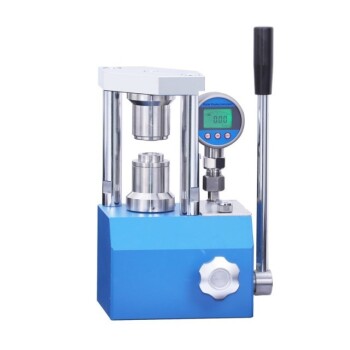
Precision pressure control is the critical variable in reliable battery assembly. For MXene-based batteries specifically, a coin cell crimping machine must deliver exact force to ensure the tight sealing of the battery case, gaskets, and wave springs. This controlled pressure is the only way to maintain extremely low contact resistance between the active materials and current collectors while simultaneously preventing moisture and oxygen ingress that would otherwise invalidate high-rate performance data.
Core Takeaway Proper crimping pressure does more than mechanically close the cell; it creates the necessary electrochemical environment for MXene materials to function. By eliminating microscopic voids and hermetically sealing the system, precise pressure ensures that test results reflect the true intrinsic properties of the electrode rather than assembly artifacts.
The Mechanics of Electrical and Ionic Integrity
Minimizing Interfacial Resistance
The primary function of pressure control is to establish a low-resistance pathway for electrons. The crimping machine forces the active MXene materials, separators, and current collectors into intimate physical contact.
Eliminating Microscopic Gaps
Without sufficient pressure, surface roughness on the material layers can create microscopic voids. Controlled pressure eliminates these gaps, ensuring void-free contact between solid layers. This is essential for reducing the impedance at solid-solid interfaces.
Optimizing Ionic Transport
Beyond electrical contact, pressure influences how ions move through the cell. Proper compression ensures that electrolyte precursors (especially in gel polymer systems) fully infiltrate the separator and electrode pores. This facilitates the formation of continuous, efficient ion transport channels required for high-rate performance.
Environmental Isolation and Stability
Preventing Chemical Contamination
MXene electrodes are sensitive to environmental factors. The crimper’s pressure ensures a hermetic seal that blocks external moisture and oxygen from entering the cell. Ingress of these elements can trigger electrolyte failure or unwanted side reactions, which would obscure the actual performance of the MXene material.
Ensuring Mechanical Stability
During long-term cycling, internal components must remain static. Constant and uniform mechanical pressure prevents the structural loosening of the cathode, anode, and separator stack. This stability is vital for obtaining reproducible data over hundreds or thousands of charge-discharge cycles.
Leakage Prevention
A high-quality seal prevents the leakage of liquid or aqueous electrolytes. This is particularly important for safety and for maintaining the consistency of the chemical environment throughout the lifespan of the test.
Understanding the Trade-offs
The Risk of Imprecise Pressure
While high pressure is generally necessary, it must be controlled pressure. If the pressure is too low, the interface impedance remains high, leading to poor rate performance.
Balancing Seal vs. Component Integrity
Conversely, the goal is to achieve an "optimal encapsulation pressure." The target—often specific values like 60 kg/cm² or roughly 74 MPa depending on the stack—must be hit precisely. Deviation results in either a breached seal (leakage/contamination) or potential damage to delicate separator structures if force is applied unevenly.
Making the Right Choice for Your Goal
To ensure your MXene battery assembly yields valid scientific data, tailor your focus based on your testing objectives:
- If your primary focus is High-Rate Performance: Prioritize pressure settings that maximize physical contact to minimize internal contact resistance and impedance.
- If your primary focus is Long-Term Cycling Stability: Focus on the consistency of the hermetic seal to prevent electrolyte leakage and environmental contamination over time.
Ultimately, the crimping machine is not just a packaging tool; it is a precision instrument that defines the internal electrochemical architecture of your battery.
Summary Table:
| Factor | Impact on MXene Battery Assembly | Benefit for Research |
|---|---|---|
| Interfacial Resistance | Minimizes gaps between MXene and current collectors | Lower impedance and better high-rate data |
| Environmental Seal | Prevents moisture and oxygen ingress | Protects electrode stability and prevents side reactions |
| Mechanical Stability | Maintains stack integrity during cycling | Enhances reproducibility over long-term testing |
| Pressure Precision | Prevents component damage from over-compression | Ensures structural integrity of separators |
| Ionic Transport | Optimizes electrolyte infiltration | Facilitates efficient ion transport channels |
Elevate Your Battery Research with KINTEK Precision
Don't let assembly artifacts compromise your MXene material data. KINTEK specializes in comprehensive laboratory pressing solutions, offering manual, automatic, heated, and glovebox-compatible crimping models designed for the rigorous demands of battery research. From achieving the perfect hermetic seal to ensuring uniform pressure for isostatic pressing, our equipment provides the consistency and reliability your lab needs.
Ready to optimize your cell assembly? Contact us today to find the ideal pressing solution for your specific battery research goals.
References
- Olha Mashtalir, Yury Gogotsi. Intercalation and delamination of layered carbides and carbonitrides. DOI: 10.1038/ncomms2664
This article is also based on technical information from Kintek Solution Knowledge Base .
Related Products
People Also Ask
- Why use standardized CR2032 components & high-precision presses? Ensure reliability in lithium metal battery research.
- Why is a laboratory battery sealing press essential for desolvation energy testing? Ensure Reliable Kinetic Data
- Why is a laboratory hydraulic press or battery sealing machine essential? Ensure Coin Cell Data Integrity
- How do laboratory battery sealing machines ensure performance consistency? Master Your Lithium and LFP Battery Assembly
- What role does a laboratory sealing press play in thermal analysis of solid dispersion films? Ensure Data Integrity