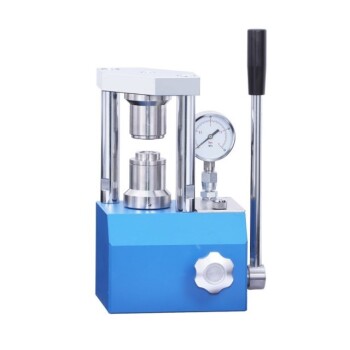
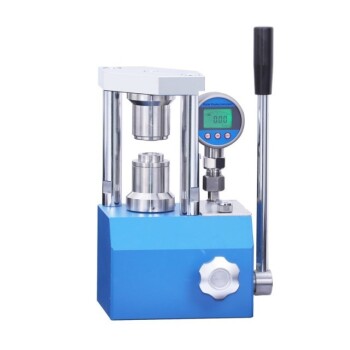
Reliable zinc-ion battery performance relies on the strict maintenance of a closed electrochemical system. High-quality coin cell components and precision sealing are required to generate a complete hermetic seal and maintain constant internal pressure. Without these mechanical conditions, you cannot minimize contact resistance between the MnCl₂N₄-CFs anode and the MnO₂ cathode, nor can you prevent electrolyte leakage, rendering long-term cycling data invalid.
Core Takeaway The physical assembly of a battery is just as critical as its chemical composition. Precision sealing and high-quality components are the only way to guarantee the constant contact pressure and chemical isolation necessary to produce reliable, reproducible stability data for MnCl₂N₄-CFs systems.
The Critical Role of the Hermetic Seal
Eliminating Electrolyte Leakage
The primary function of a precision sealing machine is to mechanically deform the coin cell case (typically CR2032) to create an airtight lock.
This process prevents the liquid electrolyte from leaking out of the cell during operation.
Ensuring Chemical Isolation
A proper seal isolates the battery’s internal chemical environment from the outside world.
This isolation prevents the evaporation of volatile electrolyte components and blocks environmental interference that would otherwise skew performance metrics.
The Necessity of Constant Internal Pressure
Minimizing Contact Resistance
Battery performance depends heavily on the interface between layers.
High-quality components, specifically spacers and precise cases, ensure the stack is compressed uniformly.
This compression minimizes contact resistance between the MnCl₂N₄-CFs anode, the separator, and the MnO₂ cathode.
Facilitating Ion Transport
If the internal pressure fluctuates or relaxes due to poor sealing, the gaps between components increase.
This disrupts the ionic path, leading to poor conductivity and erratic voltage profiles.
Understanding the Trade-offs: Quality vs. Cost
The Risk of False Negatives
Using low-quality components or manual sealing methods often saves money upfront but compromises data integrity.
Inconsistent sealing pressures can cause a chemically sound material (like MnCl₂N₄-CFs) to appear unstable, leading to "false negatives" in your research.
Long-Term Stability Data
Short-term tests might survive imperfect assembly, but long-cycle stability testing is unforgiving.
Minor leaks or pressure losses that go unnoticed in the first few cycles will inevitably cause failure in long-term tests, wasting weeks of testing time.
Making the Right Choice for Your Goal
To ensure your MnCl₂N₄-CFs zinc-ion batteries perform as designed, align your assembly process with your specific objectives:
- If your primary focus is reproducible scientific data: Invest in a precision crimper and standardized spacers to ensure every cell has identical internal pressure and contact resistance.
- If your primary focus is long-term cycling stability: Prioritize the quality of the cell case materials and the seal integrity to strictly prevent electrolyte evaporation over weeks of testing.
Ultimately, the mechanical integrity of your cell assembly is the baseline requirement for observing the true electrochemical potential of your materials.
Summary Table:
| Feature | Impact on MnCl₂N₄-CFs Batteries | Research Benefit |
|---|---|---|
| Precision Sealing | Prevents electrolyte leakage and evaporation | Ensures long-term cycling stability |
| High-Quality Spacers | Maintains constant internal compression | Minimizes contact resistance for clear data |
| Hermetic Seal | Isolates internal chemistry from environment | Eliminates environmental interference |
| Uniform Pressure | Optimizes ionic path between electrodes | Guarantees reproducible electrochemical results |
Maximize Your Battery Research Precision with KINTEK
Don't let mechanical failures compromise your electrochemical breakthroughs. KINTEK specializes in comprehensive laboratory pressing solutions tailored for advanced battery research. Whether you are assembling MnCl₂N₄-CFs zinc-ion systems or testing new solid-state chemistries, our range of manual, automatic, heated, and glovebox-compatible presses, alongside our isostatic pressing technology, ensures every cell achieves the perfect hermetic seal and uniform internal pressure.
Unlock reproducible data and long-term stability today. Contact our laboratory specialists to find the ideal pressing solution for your research goals.
References
- Yibo Zhu, Qihui Shen. Anchoring Unimolecular Metal Chloride as a Sterically Active Site for Conformal Zinc Electrodeposition. DOI: 10.1002/adma.202506756
This article is also based on technical information from Kintek Solution Knowledge Base .
Related Products
- Manual Button Battery Sealing Machine for Battery Sealing
- Button Battery Sealing Press Machine for Lab
- Button Battery Sealing Machine for Button Batteries
- Lab Button Battery Tablet Press Sealing Mold
- Lab Button Battery Disassembly and Sealing Mold
People Also Ask
- Why is a laboratory hydraulic press or battery sealing machine essential? Ensure Coin Cell Data Integrity
- How do laboratory battery sealing machines ensure performance consistency? Master Your Lithium and LFP Battery Assembly
- Why is stable pressure control necessary when assembling SC-NCM83/PLM-3/Li batteries? Optimize Solid-State Interfaces
- How does the mechanical pressure provided by a laboratory crimper affect the performance of assembled 2032-type coin cells?
- What role does a laboratory press perform for CR2032 coin cell assembly? Ensure Precision in Battery Research