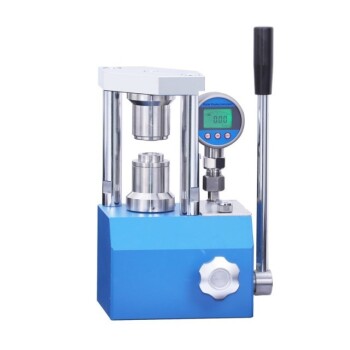
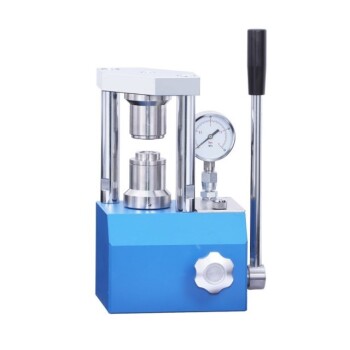
The use of a laboratory coin cell sealer or manual press is critical because it applies consistent radial pressure to the cell assembly. This pressure ensures tight physical contact between all internal components—including the electrode, separator, electrolyte, and spacers—which minimizes internal contact resistance. By eliminating variable resistance, the test results accurately reflect the intrinsic rate performance and cycling stability of the LMTO-DRX material, specifically under high current densities.
Core Takeaway Reliable electrochemical data depends not just on the material chemistry, but on the mechanical integrity of the test cell. A precise sealer eliminates "assembly noise" (variable contact resistance), ensuring that measured limitations are inherent to the cathode material, not artifacts of a loose or uneven cell construction.
The Role of Radial Pressure in Data Integrity
Ensuring Component Connectivity
A coin cell is a stack of layers that must function as a single unit. The sealer or press applies consistent radial pressure to compress these layers together.
This forces the electrode, separator, spacers, and current collectors into intimate contact. Without this mechanical pressure, gaps can form between layers, disrupting the ion and electron transport pathways.
Minimizing Internal Contact Resistance
The primary adversary in electrochemical testing is unintended resistance. Loose assembly results in high internal contact resistance.
By applying precise pressure, the sealer reduces this resistance significantly. This ensures that the voltage drops observed during testing are due to the material's electrochemistry, not poor connectivity between the cell parts.
Standardizing the Testing Environment
To compare different batches of LMTO-DRX materials, the testing variables must be constant. A laboratory press provides repeatable pressure application.
This repeatability ensures that any difference in performance between two cells is due to the material itself, rather than one cell being crimped tighter than the other.
Impact on Electrochemical Metrics
Accurate Rate Performance Analysis
LMTO-DRX materials are often tested for their ability to handle high current densities. High-rate testing is extremely sensitive to resistance.
Proper sealing minimizes resistance, allowing the test to accurately reflect the material's rate performance. If the contact resistance is too high due to poor sealing, the material will appear to fail at high rates, leading to false negative results.
Verifying Cycling Stability
Long-term cycling tests measure how a material degrades over time. A consistent seal is vital for maintaining the cell's internal environment over hundreds of cycles.
The primary reference notes that precise pressure control allows for the accurate measurement of cycling stability. A poor seal could lead to gradual loss of contact or electrolyte issues, which would be mistaken for material degradation.
Understanding the Trade-offs
The Risk of Over-Pressure
While contact is essential, it is possible to apply too much pressure if the equipment is not calibrated.
Excessive force can crush the separator or deform the casing, potentially causing short circuits. The goal is optimized contact, not maximum force.
Distinguishing Process from Material
A common pitfall in battery research is attributing poor performance to the cathode chemistry when the fault lies in the assembly.
If the sealer does not provide uniform radial pressure, the data becomes "noisy." You may waste time optimizing the LMTO-DRX synthesis when the actual fix involves calibrating the manual press or sealer.
Making the Right Choice for Your Goal
To ensure your data is publication-quality and accurately reflects your material's potential, apply these principles:
- If your primary focus is High-Rate Capability: Prioritize a sealer with high-precision pressure control to minimize ohmic resistance, as contact impedance dominates at high currents.
- If your primary focus is Material Comparison: Use the exact same pressure settings for every cell to ensure that performance variations are strictly due to material differences, not assembly inconsistencies.
Ultimately, the coin cell sealer is not just a packaging tool; it is a precision instrument that defines the baseline reliability of your electrochemical data.
Summary Table:
| Parameter | Impact of Proper Sealing | Benefit to LMTO-DRX Research |
|---|---|---|
| Contact Resistance | Significantly reduced | Minimizes voltage drops; reflects intrinsic material kinetics |
| Radial Pressure | Uniform and consistent | Ensures intimate contact between electrode, separator, and spacers |
| Rate Performance | High-fidelity data | Accurately measures material behavior under high current densities |
| Cycling Stability | Mechanical integrity | Prevents assembly-related failures during long-term testing |
| Repeatability | Standardized assembly | Eliminates "assembly noise" when comparing material batches |
Elevate Your Battery Research with KINTEK Precision
Ensure your electrochemical data reflects the true potential of your cathode materials by eliminating assembly variables. KINTEK specializes in comprehensive laboratory pressing solutions, offering manual, automatic, heated, multifunctional, and glovebox-compatible models, alongside high-performance cold and warm isostatic presses.
Whether you are optimizing LMTO-DRX rate performance or testing next-generation battery architectures, our precision tools provide the consistent radial pressure required for publication-quality results.
Ready to minimize resistance and maximize accuracy? Contact our laboratory specialists today to find the ideal sealing solution for your research.
References
- Tim Kodalle, Carolin M. Sutter‐Fella. Solvent Determines the Formation Pathway in Sol–Gel Synthesized Disordered Rock Salt Material for Lithium Ion Battery Application. DOI: 10.1021/acs.nanolett.5c02618
This article is also based on technical information from Kintek Solution Knowledge Base .
Related Products
- Button Battery Sealing Press Machine for Lab
- Button Battery Sealing Machine for Button Batteries
- Lab Button Battery Tablet Press Sealing Mold
- Manual Button Battery Sealing Machine for Battery Sealing
- Lab Button Battery Disassembly and Sealing Mold
People Also Ask
- Why use standardized CR2032 components & high-precision presses? Ensure reliability in lithium metal battery research.
- Why is a laboratory battery sealing press essential for desolvation energy testing? Ensure Reliable Kinetic Data
- Why is a laboratory hydraulic press or battery sealing machine essential? Ensure Coin Cell Data Integrity
- How do laboratory battery sealing machines ensure performance consistency? Master Your Lithium and LFP Battery Assembly
- What role does a laboratory sealing press play in thermal analysis of solid dispersion films? Ensure Data Integrity