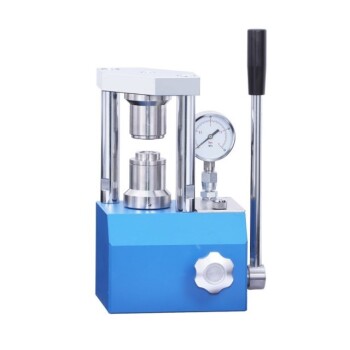
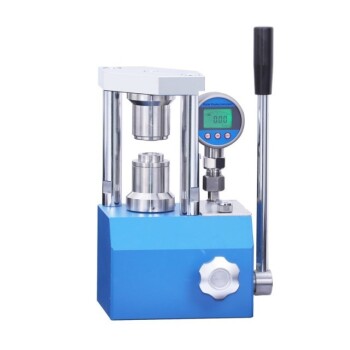
A high-precision battery sealing machine is essential for assembling sodium-ion full cells because it applies the exact, regulated pressure needed to create a hermetic seal and ensure uniform internal contact. Without this precision, you cannot guarantee the physical connection between the hard carbon anode, separator, and cathode, nor can you prevent the electrolyte leakage and air ingress that ruin cell performance.
By strictly regulating sealing pressure, high-precision equipment isolates the cell's sensitive internal chemistry from the environment, ensuring that your test results accurately reflect the true energy density and cycle life of the hard carbon material.
The Criticality of Regulated Pressure
Achieving Uniform Component Contact
In a sodium-ion coin cell, you are compressing a stack of distinct layers: the hard carbon anode, the separator soaked in sodium salt electrolyte, and the cathode.
Uniform mechanical pressure is required to force these layers into close physical contact. High-precision sealing machines regulate this pressure to ensure it is neither too weak (causing high resistance) nor too strong (crushing the separator).
Reducing Internal Resistance
Proper contact between the electrodes and the electrolyte is vital for ion transport.
If the sealing pressure is inconsistent, you create gaps or areas of poor contact. This increases contact resistance, which artificially lowers the cell's performance metrics regardless of how good your hard carbon material actually is.
Preserving Chemical Stability
Preventing Electrolyte Leakage
The immediate risk of poor sealing is the physical loss of electrolyte.
A high-precision machine crimps the coin cell case to a specific depth and geometry. This creates a mechanical lock that keeps the sodium salt electrolyte contained within the active area, preventing it from drying out during operation.
Blocking Air and Moisture Ingress
Sodium-ion chemistry is highly sensitive to the external environment.
Even if the cell is assembled in a glovebox, it must eventually be removed for testing. A perfect seal prevents the ingress of air and moisture, which would otherwise react with the internal components and destabilize the chemical environment.
Ensuring Experimental Validity
Eliminating Assembly Variables
When testing hard carbon anodes, your goal is to evaluate the material, not the assembly quality.
Variable sealing pressure acts as a hidden variable in your experiments. High-precision automation removes this variable, ensuring that differences in performance are due to material properties, not inconsistent crimping.
Accurate Cycle Life Testing
Long-term cycling tests are notoriously sensitive to environmental contamination.
To determine the true cycle life and energy density of your cell, the internal environment must remain stable over weeks or months. Only a high-precision seal can guarantee this stability over long durations.
Common Pitfalls to Avoid
The "False Negative" of Low Precision
Using low-precision or manual crimpers often leads to uneven force distribution.
This frequently results in "false negatives" where a researcher believes a hard carbon material has failed, when in reality, the cell assembly failed due to micro-leakage or poor contact.
Over-Pressurization Risks
While loose seals are obvious, over-sealing is equally dangerous.
Excessive pressure can damage the internal structure of the separator or electrode coating. High-precision machines allow you to dial in the exact force required to seal the can without deforming the active components inside.
Making the Right Choice for Your Goal
Whether you are conducting fundamental research or quality control, the consistency of your sealing process dictates the value of your data.
- If your primary focus is Material Characterization: A high-precision sealer is required to ensure that measured capacity losses are due to the hard carbon chemistry, not poor electrode contact.
- If your primary focus is Long-Term Cycling: You need the hermetic reliability of high-precision sealing to prevent electrolyte degradation caused by slow air ingress over time.
Reliable data begins with a reliable seal; without it, even the most advanced hard carbon anode cannot demonstrate its true potential.
Summary Table:
| Feature | Impact on Sodium-ion Cell Performance |
|---|---|
| Regulated Pressure | Ensures uniform contact between hard carbon anode, separator, and cathode. |
| Hermetic Sealing | Prevents electrolyte leakage and blocks air/moisture ingress. |
| Contact Resistance | High-precision crimping minimizes internal resistance for better ion transport. |
| Experimental Integrity | Eliminates assembly variables to focus on material characterization. |
| Cycle Life Stability | Guarantees long-term chemical stability for accurate energy density testing. |
Optimize Your Sodium-ion Battery Research with KINTEK
Don't let inconsistent assembly ruin your material characterization. KINTEK specializes in comprehensive laboratory pressing solutions, offering manual, automatic, heated, and glovebox-compatible models designed for the rigorous demands of battery research. Whether you are working with hard carbon anodes or advanced isostatic pressing, our high-precision equipment ensures your data reflects the true potential of your chemistry.
Ready to achieve perfect seals and reliable data? Contact KINTEK today to find the ideal sealing solution for your lab!
References
- Chi Chen, Xinwei Cui. Regulating Pores and Carbonyl Groups of Biomass‐Derived Hard Carbon for Enhanced Sodium Storage. DOI: 10.1002/advs.202510328
This article is also based on technical information from Kintek Solution Knowledge Base .
Related Products
- Button Battery Sealing Press Machine for Lab
- Lab Button Battery Tablet Press Sealing Mold
- Manual Button Battery Sealing Machine for Battery Sealing
- Button Battery Sealing Machine for Button Batteries
- Lab Button Battery Disassembly and Sealing Mold
People Also Ask
- Why use standardized CR2032 components & high-precision presses? Ensure reliability in lithium metal battery research.
- Why is a laboratory battery sealing press essential for desolvation energy testing? Ensure Reliable Kinetic Data
- Why is a laboratory hydraulic press or battery sealing machine essential? Ensure Coin Cell Data Integrity
- How do laboratory battery sealing machines ensure performance consistency? Master Your Lithium and LFP Battery Assembly
- What role does a laboratory sealing press play in thermal analysis of solid dispersion films? Ensure Data Integrity