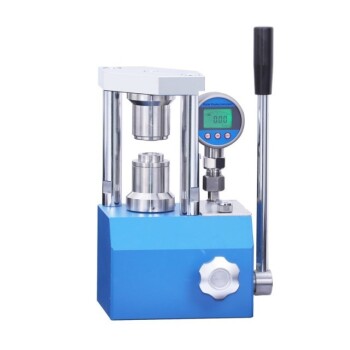
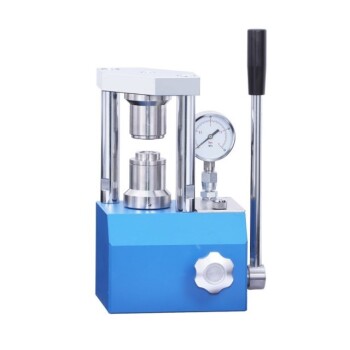
A laboratory hydraulic press or battery sealing machine is the primary determinant of mechanical consistency in coin cell assembly. It provides the precise, uniform pressure necessary to crimp the battery casing, ensuring that the internal stack—electrode, separator, and lithium foil—is bonded tightly together. Without this controlled mechanical force, the cell cannot maintain the physical structure required for valid electrochemical analysis.
The core function of these machines is to transform a loose stack of materials into a unified electrochemical system. By ensuring uniform physical contact and a hermetic seal, they eliminate assembly variables that would otherwise corrupt data on cycle life and rate performance.
Optimizing Internal Electrical Contact
The primary electrochemical goal of the press is to facilitate electron and ion flow by manipulating the physical arrangement of the cell's internals.
Minimizing Contact Resistance
A loose assembly creates gaps between layers, leading to high ohmic internal resistance. The press applies precise compression to force the current collectors, electrodes, and separators into tight physical contact. This directly reduces charge transfer resistance (Rct) and interface impedance, ensuring voltage drops are caused by the chemistry, not poor assembly.
Ensuring Electrolyte Wetting
The pressure applied during sealing does more than just hold parts together; it aids in fluid dynamics. Compression helps force the liquid electrolyte into the porous framework of the electrode materials and separator. This ensures the active materials are fully utilized, which is vital for accurate capacity measurements.
Ensuring Environmental Isolation
Beyond internal contact, the press acts as the gatekeeper between the sensitive internal chemistry and the external environment.
Creating a Hermetic Barrier
The machine applies radial pressure to mechanically crimp the battery case edges (such as a 2032 type) against a sealing gasket. This creates a rigorous seal that prevents the ingress of external moisture and oxygen. Even trace amounts of moisture can react with lithium or sodium anodes, causing immediate degradation and false test results.
Preventing Electrolyte Volatilization
Electrolytes contain volatile solvents that can evaporate over time if the cell is not air-tight. A proper crimp ensures the electrolyte remains contained within the cell. This prevents the cell from "drying out," which is critical for maintaining consistency during long-term cycle life testing.
Understanding the Risks of Pressure Variation
While pressure is essential, it must be applied with high precision. Relying on manual or uncalibrated sealing methods introduces significant trade-offs.
The Impact of Under-Compression
If the sealing pressure is too low, the mechanical crimp will be insufficient. This leads to unstable internal resistance that fluctuates during testing, making rate performance evaluations unrepeatable. It also increases the risk of electrolyte leakage, which poses safety hazards and equipment damage.
The Dangers of Over-Compression
Conversely, excessive force can physically damage the internal components. Over-compression may crush the porous separator or deform the casing, potentially leading to internal short circuits. The hydraulic press allows for regulated force application to hit the "Goldilocks" zone—tight enough to conduct, but not so tight that it destroys the structure.
Ensuring Data Integrity for Your Research
To achieve reproducible scientific data, the assembly process must be as controlled as the chemical synthesis.
- If your primary focus is Rate Performance: Prioritize pressure consistency to minimize internal contact resistance, ensuring that voltage drops are minimized at high currents.
- If your primary focus is Long-Cycle Life: Prioritize seal integrity to prevent electrolyte evaporation and environmental contamination over weeks of testing.
By standardizing the mechanical assembly of the cell, you ensure that your data reflects the true performance of your materials, rather than the quality of your crimp.
Summary Table:
| Feature | Impact on Coin Cell Performance | Benefit for Researchers |
|---|---|---|
| Precise Compression | Minimizes ohmic internal resistance (Rct) | Accurate capacity & rate performance data |
| Hermetic Sealing | Prevents moisture ingress & electrolyte evaporation | Reliable long-term cycle life testing |
| Wetting Assistance | Forces electrolyte into porous electrodes | Full utilization of active materials |
| Regulated Force | Avoids separator damage or internal shorts | Consistent, reproducible assembly results |
Elevate Your Battery Research with KINTEK
Don't let poor assembly compromise your electrochemical data. KINTEK specializes in comprehensive laboratory pressing solutions designed for precision and reliability. Whether you require manual, automatic, heated, multifunctional, or glovebox-compatible models, our equipment ensures the mechanical consistency your research demands.
From high-performance coin cell crimpers to cold and warm isostatic presses, we provide the tools needed to optimize internal contact and guarantee hermetic isolation.
Ready to achieve superior data integrity? Contact our experts today to find the perfect pressing solution for your lab.
References
- Cai Sun, Shou‐Tian Zheng. Single‐Crystal‐to‐Single‐Crystal Transformation in a Thermally Stable All‐Inorganic Polyoxoniobate Framework Boosts Lithium Ion Battery Anode Performance. DOI: 10.1002/anie.202506533
This article is also based on technical information from Kintek Solution Knowledge Base .
Related Products
- Button Battery Sealing Machine for Button Batteries
- Button Battery Sealing Press Machine for Lab
- Manual Button Battery Sealing Machine for Battery Sealing
- Lab Button Battery Tablet Press Sealing Mold
- Lab Button Battery Disassembly and Sealing Mold
People Also Ask
- What role does a laboratory press perform for CR2032 coin cell assembly? Ensure Precision in Battery Research
- Why is a high-pressure manual or automatic coin cell crimper required? Optimize Solid-State Battery Performance
- How does a high-precision lab press or coin cell crimper affect the performance of assembled lithium-metal batteries?
- How does the mechanical pressure provided by a laboratory crimper affect the performance of assembled 2032-type coin cells?
- What role does a coin cell crimper play in solid-state batteries? Essential Pressure for Ionic Conductivity