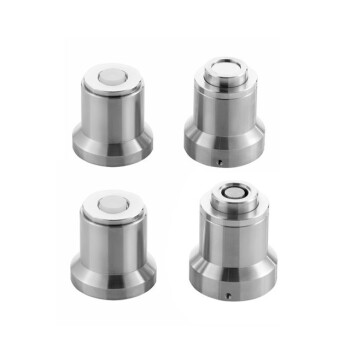
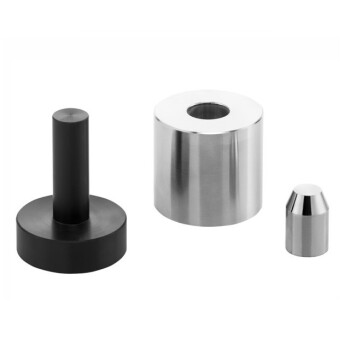
High-performance PEEK sleeves serve as the critical structural and isolating core in solid-state battery assembly, acting as the primary containment vessel for the active materials. Their function is three-fold: they withstand radial pressures of several hundred megapascals, chemically resist corrosive sulfide electrolytes, and electrically insulate the system to prevent short circuits and ensure accurate data collection.
High-performance PEEK is the material of choice because it solves the "triad of incompatibility" in solid-state battery molds: it offers the mechanical strength of a structural material, the electrical insulation of a dielectric, and the chemical inertness required for reactive electrolytes.
Mechanical Containment Under Pressure
Withstanding Extreme Radial Loads
Solid-state batteries require high-pressure compaction to ensure ion mobility. PEEK sleeves provide the structural integrity necessary to contain the battery stack against radial pressures reaching several hundred megapascals.
Maintaining Structural Geometry
During assembly, the sleeve acts as a mold that withstands lateral stresses. This ensures the battery components remain aligned and compressed without the sleeve deforming or failing, which is critical for consistent performance.
Chemical and Electrical Isolation
Resisting Corrosive Electrolytes
Standard battery materials often react poorly with solid electrolytes. PEEK is chemically inert, specifically proving effective against corrosive sulfide electrolytes that would degrade other containment materials.
Preventing Metal Contamination
By acting as a barrier between the sample and the external assembly, PEEK prevents metal impurities from the housing or pistons from leaching into the battery sample. This purity is vital for obtaining valid experimental results.
Ensuring Electrical Isolation
The sleeve serves as an electrical insulator between the electrode leads and the metal housing or pistons. This prevents short circuits and ensures that the potential measurements taken during testing are accurate and free from interference.
Enabling In-Situ Analysis
Facilitating Electrochemical Testing
Because PEEK provides both containment and insulation, it allows for in-situ electrochemical testing directly within the mold. This eliminates the need to transfer the delicate sample to a different testing rig.
Preserving Interface Integrity
Transferring a pressed solid-state battery often damages the fragile solid-solid interfaces. By testing inside the PEEK sleeve, researchers avoid interface damage, ensuring the data reflects the battery's true performance capabilities.
Understanding the Trade-offs
Mechanical Limits vs. Metal
While PEEK is a high-performance plastic, its mechanical modulus is lower than that of steel. While it can handle hundreds of megapascals, engineers must ensure the wall thickness and sleeve design are calculated correctly to prevent creep or deformation at the upper limits of pressure, which could compromise the internal pressure applied to the battery.
Making the Right Choice for Your Goal
Select your assembly materials based on the specific constraints of your testing environment:
- If your primary focus is High-Pressure Durability: Ensure the PEEK sleeve wall thickness is rated for the specific radial loads (hundreds of MPa) required to wet your solid electrolyte interfaces.
- If your primary focus is Data Accuracy: Prioritize PEEK for its ability to enable in-situ testing, as avoiding sample transfer is the single best way to preserve interfacial resistance data.
- If your primary focus is Chemical Compatibility: Verify that the specific grade of PEEK used is certified for inertness against your specific electrolyte chemistry, particularly if using sulfides.
Success in solid-state battery assembly relies on using PEEK not just as a holder, but as an active component that preserves the chemical and structural reality of the cell under test.
Summary Table:
| Key Function | Benefit for Solid-State Battery Assembly |
|---|---|
| Mechanical Containment | Withstands radial pressures up to several hundred MPa without deformation. |
| Chemical Resistance | Inert to corrosive sulfide electrolytes and prevents metal leaching. |
| Electrical Isolation | Prevents short circuits between electrodes and metal housing for accurate data. |
| In-Situ Capability | Enables testing within the mold to preserve fragile solid-solid interfaces. |
Elevate Your Battery Research with KINTEK Precision Solutions
Don't compromise your experimental results with inferior containment materials. KINTEK specializes in comprehensive laboratory pressing solutions, offering a versatile range of manual, automatic, and heated presses, as well as cold and warm isostatic presses tailored for battery research.
Our high-performance PEEK sleeve systems and specialized molds are designed to handle the extreme pressures and chemical sensitivities of solid-state battery assembly. Whether you are working on sulfide electrolytes or high-pressure compaction, we provide the tools to ensure data accuracy and structural integrity.
Ready to optimize your lab's efficiency? Contact us today to find your perfect pressing solution!
References
- Mervyn Soans, Christoffer Karlsson. Using a Zero‐Strain Reference Electrode to Distinguish Anode and Cathode Volume Changes in a Solid‐State Battery. DOI: 10.1002/admi.202500709
This article is also based on technical information from Kintek Solution Knowledge Base .
Related Products
- Warm Isostatic Press for Solid State Battery Research Warm Isostatic Press
- Lab Button Battery Disassembly and Sealing Mold
- Lab Button Battery Tablet Press Sealing Mold
People Also Ask
- Why must composite cathodes be sealed in vacuum lamination bags for WIP? Ensure Battery Stability and Density
- How do sacrificial volume materials (SVM) maintain microchannels in isostatic pressing? Ensure Structural Integrity
- What is the function of elastic molds in warm isostatic pressing? Achieve Uniform Density in Composite Particles
- What is the significance of temperature control in Warm Isostatic Pressing? Unlock Uniform Densification and Process Stability
- What is the function of hydraulic pressure in warm isostatic pressing? Achieve Uniform Material Density