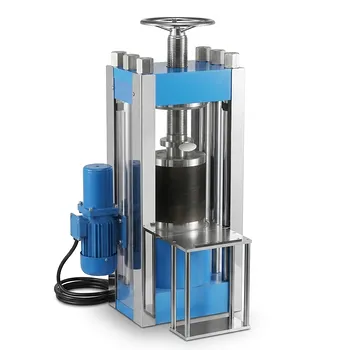
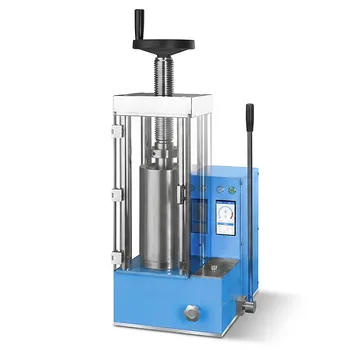
Precise cold pressing is the fundamental process used to transform loose solid electrolyte powders into a high-performance, dense ceramic layer. By applying specific, controlled pressure (often ranging from 150 MPa to over 370 MPa), a laboratory press induces plastic deformation in the electrolyte particles. This forces them to bond tightly, creating a uniform film that maximizes ionic conductivity while acting as a robust physical barrier against short circuits.
The core necessity of precise pressure control lies in achieving maximum densification without structural failure. High-precision pressing eliminates internal pores and grain boundary resistance, establishing the continuous ion transport channels required for a functional all-solid-state battery.
The Role of Pressure in Structural Densification
Inducing Plastic Deformation and Bonding
At the microscopic level, solid electrolyte particles must be physically fused to allow for ion movement. High-precision laboratory presses apply the necessary force to cause plastic deformation, allowing individual particles to flow together and bond into a single, cohesive film.
Eliminating Internal Porosity
Internal voids or pores act as significant barriers to both mechanical strength and electrochemical performance. Precise cold pressing minimizes this porosity, often aiming for a relative density of approximately 82% or higher to ensure the layer is sufficiently compact.
Controlling Layer Thickness and Uniformity
The electrolyte layer must be as thin as possible to reduce ion transport resistance while remaining thick enough to prevent contact between electrodes. Precise control ensures a uniform thickness across the entire pellet, preventing localized thin spots that could lead to premature battery failure.
Enhancing Ionic Transport and Conductivity
Minimizing Grain Boundary Resistance
In a loose powder state, the boundaries between particles resist the flow of lithium ions. Systematic compression reduces this grain boundary impedance by increasing the contact area between particles, essentially "smoothing" the path for ion migration.
Creating Continuous Ion Channels
For a battery to function, ions must move rapidly from the anode to the cathode. The densification achieved through cold pressing creates continuous physical channels, which are the foundation for high ionic conductivity in a solid-state system.
Ensuring Battery Safety and Longevity
The Electrolyte as a Mechanical Separator
Unlike liquid electrolytes, the solid layer must also serve as a physical separator. A precise press ensures the material is dense and free of cracks, maintaining its structural integrity despite being inherently brittle.
Mitigating Lithium Dendrite Penetration
A dense, defect-free structure is the primary defense against lithium dendrites—needle-like structures that grow during charging. If the electrolyte layer has pores or micro-cracks due to poor pressure control, dendrites can penetrate the layer and cause a catastrophic short circuit.
Optimizing the Electrode-Electrolyte Interface
Mechanical Interlocking for Better Contact
Because there is no liquid to wet the surfaces, interface contact in solid-state batteries depends entirely on mechanical pressure. High-precision pressing creates a tight, interlocking interface between the active material and the electrolyte particles.
Uniform Current Distribution
Uniform pressure distribution during the pressing of components, such as a Lithium-Indium alloy anode, ensures a perfect fit between layers. This prevents interface detachment and ensures that current is distributed evenly across the surface, extending the cycle life of the battery.
Understanding the Trade-offs and Pitfalls
Balancing Pressure and Material Brittleness
While higher pressure generally increases density, exceeding the material's structural limits can cause micro-fractures. Because sulfide electrolytes and other solid-state materials are often brittle, "too much" pressure without precise feedback can ruin the pellet's integrity.
The Risk of Non-Uniform Stress
If the laboratory press does not provide constant and uniform axial pressure, stress concentrations can develop. These concentrated stress points often lead to contact loss during battery cycling, where the layers physically pull apart as the battery expands and contracts.
How to Apply This to Your Research
When selecting a pressing strategy for electrolyte preparation, your goals should dictate your pressure parameters and equipment choice.
- If your primary focus is maximizing ionic conductivity: Prioritize higher pressures (300 MPa+) and utilize sulfide-based electrolytes that exhibit high plastic deformability to minimize grain boundary resistance.
- If your primary focus is preventing battery short circuits: Focus on the precision of the pressure feedback system to ensure a defect-free, high-density film that can effectively block dendrite growth.
- If your primary focus is improving cycle life: Ensure the press provides highly uniform pressure distribution to create a stable mechanical bond between the electrolyte and the electrodes, preventing interface delamination.
Precise cold pressing is not merely a preparation step, but the defining mechanical process that determines the efficiency, safety, and lifespan of an all-solid-state battery.
Summary Table:
| Key Requirement | Impact on Performance | Consequence of Poor Control |
|---|---|---|
| Densification | Maximizes ionic conductivity via particle bonding | Internal pores & high resistance |
| Thickness Control | Minimizes ion transport resistance | Short circuits or high impedance |
| Interface Contact | Ensures mechanical interlocking with electrodes | Interface detachment & capacity loss |
| Uniform Pressure | Prevents lithium dendrite penetration | Micro-cracks & battery failure |
Elevate Your Battery Research with KINTEK Precision Pressing
Achieving the perfect electrolyte layer requires more than just force—it requires absolute precision. KINTEK specializes in comprehensive laboratory pressing solutions tailored for high-performance battery development. Our range includes manual, automatic, heated, multifunctional, and glovebox-compatible models, as well as advanced cold and warm isostatic presses designed to meet the rigorous demands of all-solid-state battery research.
Don't let poor pressure control compromise your ionic conductivity or safety. Partner with KINTEK to access the tools that bridge the gap between loose powders and high-performance ceramic layers.
Contact KINTEK today to find the ideal pressing solution for your lab!
References
- Zhaoyang Chen, Yan Yao. Low-Pressure Operation of All-Solid-State Batteries Enabled by Low-Hardness Creep-Prone Electrodes. DOI: 10.26434/chemrxiv-2025-0fvvk
This article is also based on technical information from Kintek Solution Knowledge Base .
Related Products
- Laboratory Hydraulic Press Lab Pellet Press Button Battery Press
- Carbide Lab Press Mold for Laboratory Sample Preparation
- Warm Isostatic Press for Solid State Battery Research Warm Isostatic Press
- Electric Lab Cold Isostatic Press CIP Machine
- Electric Split Lab Cold Isostatic Pressing CIP Machine
People Also Ask
- How is a laboratory hydraulic press used for HAP composite gels? Master Mineral Substrate Standardization
- What role does a laboratory hydraulic press play in the preparation of piezoelectric ceramic discs for DC-PG? | KINTEK
- What role does a laboratory hydraulic press play in reaction pellets? Optimizing Lunar Soil and Metal Fuel Density
- Why is a laboratory hydraulic press required for PBAT and PLA sample preparation? Achieve Flawless Characterization
- What role does a laboratory hydraulic press play in the assembly of all-solid-state battery test cells? Expert Guide