Slight mechanical compression acts as the physical bridge necessary for chemical repair. While heat initiates the healing capability of the material, it cannot spontaneously pull separated parts together. Compression is required to eliminate gaps at the fracture site, ensuring that the hydrogel interfaces and activated carbon nanotube layers achieve the molecular-level contact needed for the hydrogen bonds to reconnect.
While heating to 95 °C triggers the mobilization of hydrogen bonds, compression facilitates the physical proximity required for amide groups to cross the fracture. This combination allows the material to rebuild its internal network, restoring both structural strength and electrical capacitance.
The Mechanism of Physical Repair
Bridging the Molecular Gap
Heat alone is insufficient to repair a fracture because it only activates the chemistry within the separated pieces. To actually heal the break, the fractured hydrogel interfaces and activated carbon nanotube layers must physically touch. Slight mechanical compression forces these surfaces together, removing air gaps that would otherwise prevent interaction.
Reforming the Cross-Linking Network
Once compression establishes molecular-level contact, the chemical repair process begins. The pressure allows amide groups within the supramolecular hydrogel to move across the fracture line. This movement enables the reformation of a high-density physical cross-linking network, effectively stitching the material back together at a microscopic level.
Restoring Critical Performance
The synergy of heat and pressure produces near-complete restoration of the device's properties. By re-establishing continuity in both the hydrogel and the conductive layers, the device achieves a capacitance recovery rate of over 94%. Simultaneously, the structural integrity of the supercapacitor is restored, with a strength recovery of 92%.
Understanding the Trade-offs
The Necessity of "Slight" Pressure
The requirement is specifically for slight compression, not excessive force. The goal is solely to create contact between the fractured surfaces. Applying too much pressure runs the risk of distorting the hydrogel geometry or damaging the alignment of the carbon nanotube layers, which could negatively impact the final capacitance.
Heat Without Contact
Attempting to repair the device using only heat (95 °C) leads to incomplete healing. Without the mechanical aid to close the fracture, the hydrogen bond reorganization occurs in isolation on either side of the break. The result is a device that fails to regain its original mechanical strength or electrical connectivity.
Optimizing the Healing Process
To maximize the recovery of your self-healing supercapacitor, apply these principles:
- If your primary focus is electrical restoration: Ensure the compression is applied uniformly to fully reconnect the activated carbon nanotube layers, aiming for the >94% capacitance recovery benchmark.
- If your primary focus is mechanical integrity: Maintain the temperature at 95 °C during compression to ensure the amide groups have sufficient energy to reorganize into a dense cross-linking network.
By mechanically closing the gap, you empower the chemical properties of the hydrogel to restore the device to full functionality.
Summary Table:
| Factor | Role in Repair Process | Impact on Recovery |
|---|---|---|
| Heat (95 °C) | Activates hydrogen bonds and amide group mobility | Enables chemical cross-linking |
| Slight Compression | Bridges the physical fracture gap | Restores molecular-level contact |
| Hydrogel Interface | Rebuilds internal network | 92% structural strength recovery |
| Carbon Nanotubes | Re-establishes electrical continuity | >94% capacitance recovery |
Maximize Your Material Research with KINTEK Precision
Precise control over heat and pressure is critical for the restoration of advanced electronics and battery materials. KINTEK specializes in comprehensive laboratory pressing solutions designed to meet the rigorous demands of material science.
Whether you are conducting battery research or developing self-healing polymers, our range of equipment ensures optimal performance:
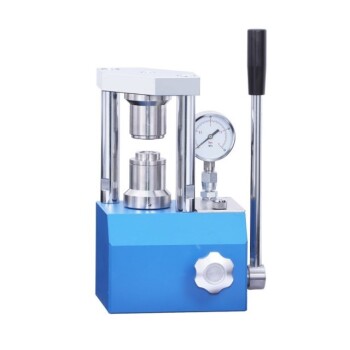
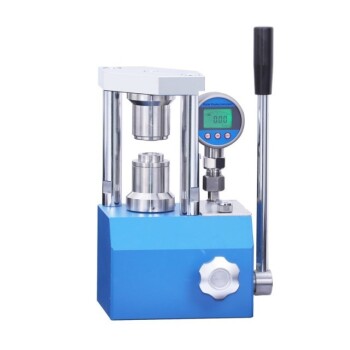
- Manual & Automatic Presses: For consistent, slight mechanical compression.
- Heated & Multifunctional Models: To perfectly synchronize thermal and physical repair parameters.
- Isostatic Presses (Cold/Warm): For uniform density in complex material research.
- Glovebox-Compatible Solutions: For sensitive chemical environments.
Ready to elevate your lab's capabilities? Contact KINTEK today to find the perfect press for your research goals.
References
- Roman Elashnikov, Oleksiy Lyutakov. High‐Strength Self‐Healable Supercapacitor Based on Supramolecular Polymer Hydrogel with Upper Critical Solubility Temperature. DOI: 10.1002/adfm.202314420
This article is also based on technical information from Kintek Solution Knowledge Base .
Related Products
- Manual Button Battery Sealing Machine for Battery Sealing
- Button Battery Sealing Machine for Button Batteries
- Lab Button Battery Disassembly and Sealing Mold
- Warm Isostatic Press for Solid State Battery Research Warm Isostatic Press
- Button Battery Sealing Press Machine for Lab
People Also Ask
- Why is a laboratory hydraulic press or battery sealing machine essential? Ensure Coin Cell Data Integrity
- How do laboratory battery sealing machines ensure performance consistency? Master Your Lithium and LFP Battery Assembly
- Why is stable pressure control necessary when assembling SC-NCM83/PLM-3/Li batteries? Optimize Solid-State Interfaces
- How does the mechanical pressure provided by a laboratory crimper affect the performance of assembled 2032-type coin cells?
- What role does a laboratory press perform for CR2032 coin cell assembly? Ensure Precision in Battery Research