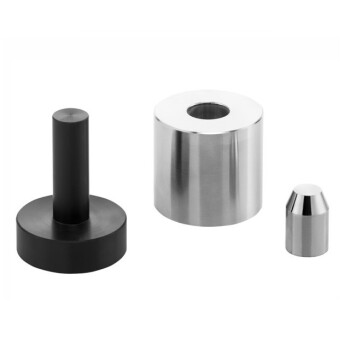
Precision forming dies serve as the fundamental control mechanism in feed analysis. By constraining wafer feed samples to exact dimensions—typically 2cm x 2cm x 1.5cm—these dies ensure a highly uniform geometric shape and volume. This standardization is the critical prerequisite for obtaining accurate data on density, specific gravity, and water absorption.
Inconsistent sample shapes lead to unreliable data. Precision forming dies eliminate measurement errors caused by geometric irregularities, allowing researchers to scientifically isolate the impact of ingredients, such as protein sources, on the physical quality of the feed.
Achieving Geometric Consistency
Eliminating Volumetric Variables
In feed analysis, the physical volume of a sample is a primary variable. Precision dies force every sample into an identical geometric shape, removing the natural variance found in loose or hand-formed feed.
Standardizing Dimensions
The specific dimensions often used, such as 2cm x 2cm x 1.5cm, provide a constant baseline. This uniformity ensures that every sample undergoing testing starts from the exact same physical state.
Enhancing Physical Indicator Accuracy
Calculating Density and Specific Gravity
Accurate calculations of density and specific gravity rely entirely on knowing the precise volume of the object being measured. By fixing the volume via the die, the resulting data reflects true physical properties rather than measurement estimates.
Measuring Water Absorption Rates
Water absorption is heavily influenced by surface area and shape. Standardized dies ensure that the surface area exposed to water is consistent across all samples, making absorption rate comparisons valid.
Enabling Scientific Ingredient Evaluation
Isolating Protein Source Impact
Researchers often need to evaluate how different protein sources change the feed's characteristics. Using precision dies removes shape as a variable, ensuring that observed differences in quality are due to the ingredients, not the sample preparation.
Reducing Measurement Error
Irregular shapes introduce noise into data sets, making it difficult to detect subtle changes in feed quality. Precision forming creates a controlled environment where measurement errors are minimized, leading to more scientific and reproducible results.
Common Pitfalls to Avoid
The Risk of Irregular Shapes
Attempting to assess feed quality without precision forming leads to samples with varying volumes and surface areas. This irregularity inevitably causes measurement errors that skew the final assessment of the feed's physical properties.
Data Misinterpretation
Without standardized dimensions, a researcher might mistakenly attribute a change in density to the feed formulation. In reality, the discrepancy may simply be the result of inconsistent sample geometry.
Making the Right Choice for Your Assessment
To ensure your wafer feed quality assessment is statistically valid, consider your specific analytical goals:
- If your primary focus is Physical Metrics: Use precision dies to fix the volume, ensuring that calculations for density and specific gravity are mathematically accurate.
- If your primary focus is Ingredient Comparison: Use standardized forming to isolate variables, allowing you to clearly see how different protein sources affect the feed structure.
Standardization is the bridge between raw observations and scientific fact.
Summary Table:
| Key Metric | Contribution of Precision Forming Dies | Impact on Feed Quality Assessment |
|---|---|---|
| Geometric Consistency | Standardizes samples to exact dimensions (e.g., 2cm x 2cm x 1.5cm) | Eliminates volumetric variables and measurement noise. |
| Density & Specific Gravity | Fixes a constant volume for every sample | Ensures mathematically accurate and reproducible physical data. |
| Water Absorption | Provides a uniform surface area for testing | Validates absorption rate comparisons across different formulations. |
| Ingredient Evaluation | Isolates variables by removing shape irregularities | Enables scientific assessment of protein sources on feed structure. |
Elevate Your Feed Research Precision with KINTEK
Don't let inconsistent sample geometry compromise your data. KINTEK specializes in comprehensive laboratory pressing solutions designed to provide the repeatability your research demands. Whether you are conducting battery research or assessing agricultural feed quality, our range of manual, automatic, heated, and multifunctional presses, along with cold and warm isostatic presses, ensures your samples meet the strictest standards.
Ready to eliminate measurement error? Contact us today to find the perfect precision pressing solution for your laboratory needs!
References
- Gerson Frans Bira, Agustinus Akoit. Quality of complete feed wafer supplemented with different plant protein sources for small ruminants. DOI: 10.20961/lar.v22i1.68165
This article is also based on technical information from Kintek Solution Knowledge Base .
Related Products
- Lab Button Battery Tablet Press Sealing Mold
- Lab XRF Boric Acid Powder Pellet Pressing Mold for Laboratory Use
- Lab Ball Press Mold
- Lab Cylindrical Press Mold with Scale
- Lab Ring Press Mold for Sample Preparation
People Also Ask
- How does a sealed battery mold facilitate the assembly and testing of asymmetric supercapacitors using VO2?
- Why use standardized CR2032 components & high-precision presses? Ensure reliability in lithium metal battery research.
- Why is a laboratory battery sealing press essential for desolvation energy testing? Ensure Reliable Kinetic Data
- What is the function of specialized battery molds and sealing consumables? Optimize Your In-situ XRD Testing Today
- What role does a laboratory sealing press play in thermal analysis of solid dispersion films? Ensure Data Integrity