
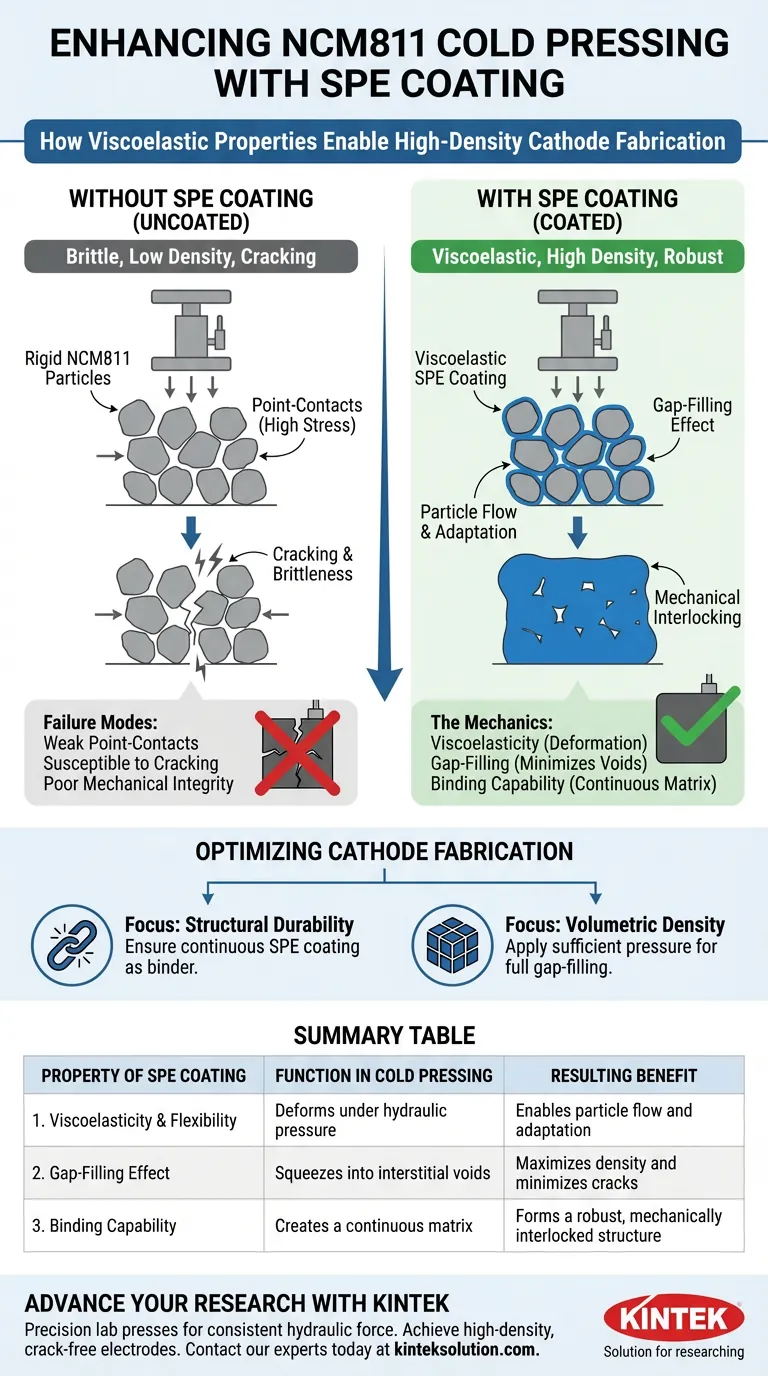
The viscoelastic and flexible properties of a solid polymer electrolyte (SPE) coating function as a critical mechanical enabler during the cold pressing of NCM811 powder. By acting as both a "buffer" and a "binder," the coating allows the material to deform under hydraulic pressure rather than resist it. This deformation enables the powder to settle into a dense, mechanically interlocked structure, directly solving the issue of brittleness found in uncoated materials.
While uncoated NCM811 particles rely on fragile point contacts, an SPE coating introduces a flexible interface that deforms under hydraulic pressure. This deformation fills inter-particle gaps to produce high-density, crack-free cathode sheets with superior mechanical integrity.

The Mechanics of Densification
To understand why the SPE coating is effective, one must look at how the material behaves under the stress of a hydraulic press. The coating changes the interaction from rigid-on-rigid to a compliant, cohesive process.
Utilizing Viscoelasticity
The defining characteristic of the SPE coating is its viscoelastic nature. Unlike the underlying NCM811 particles, which are rigid and unforgiving, the polymer coating is flexible. This allows the material to flow and adapt its shape in response to applied force.
The "Gap-Filling" Effect
When pressure is applied, the flexible SPE coating deforms physically. It is squeezed into the interstitial voids—the gaps between the rigid powder particles. This process minimizes empty space, resulting in a significantly higher density for the final cathode sheet.
Structural Interlocking
As the coating fills these gaps, it facilitates the formation of a mechanically interlocked structure. The particles are no longer just touching; they are embedded within a continuous matrix. This creates a robust composite rather than a loosely packed aggregate.
Risks of the Uncoated Alternative
To fully appreciate the value of the SPE coating, it is necessary to examine the specific failure modes of processing uncoated NCM811 powder. The absence of a viscoelastic layer fundamentally weakens the cathode sheet.
Brittle Point-Contacts
Without a coating, rigid NCM811 particles make direct contact with one another at single points. These "point-contact" structures create areas of high stress concentration. Consequently, the connection between particles remains structurally weak and unstable.
Susceptibility to Cracking
The inability of uncoated particles to deform and distribute stress leads to mechanical failure. Pressing uncoated powder frequently results in sheets that are brittle and prone to cracking. This lack of structural integrity compromises the manufacturing yield and the quality of the final electrode.
Optimizing Cathode Fabrication
Leveraging the properties of SPE coatings allows you to move beyond simple powder compaction and towards engineering robust composite structures.
- If your primary focus is structural durability: Ensure the SPE coating is continuous to act as a consistent "binder," preventing the formation of brittle point-contacts that lead to cracking.
- If your primary focus is maximizing volumetric density: Exploit the "buffer" effect of the SPE by applying sufficient hydraulic pressure to deform the coating fully into the inter-particle gaps.
By treating the SPE coating as a functional structural component, you ensure the production of high-density cathode sheets that are mechanically sound.
Summary Table:
| Property of SPE Coating | Function in Cold Pressing | Resulting Benefit |
|---|---|---|
| Viscoelasticity & Flexibility | Deforms under hydraulic pressure | Enables particle flow and adaptation |
| "Gap-Filling" Effect | Squeezes into interstitial voids | Maximizes density and minimizes cracks |
| Binding Capability | Creates a continuous matrix | Forms a robust, mechanically interlocked structure |
Ready to optimize your cathode fabrication process?
The principles of using a functional coating to enhance material behavior under pressure are central to our expertise at KINTEK. We specialize in designing and manufacturing precision lab press machines, including automatic and heated lab presses, that deliver the consistent, controlled hydraulic force needed to fully exploit the benefits of SPE coatings and similar advanced materials.
Our equipment helps researchers and battery developers like you achieve high-density, crack-free electrodes with superior mechanical integrity, directly addressing the challenges of brittleness and poor yield.
Contact our experts today to discuss how a KINTEK lab press can advance your battery research and development.
Visual Guide
Related Products
- Electric Lab Cold Isostatic Press CIP Machine
- Manual Cold Isostatic Pressing CIP Machine Pellet Press
- Automatic Lab Cold Isostatic Pressing CIP Machine
- Electric Split Lab Cold Isostatic Pressing CIP Machine
- Laboratory Hydraulic Pellet Press for XRF KBR FTIR Lab Press
People Also Ask
- What are the applications of electric lab cold isostatic presses in research settings? Advance Material R&D with High-Pressure CIPs
- What role do electric lab cold isostatic presses play in industrial contexts? Bridge R&D and Manufacturing with Precision
- How does electrical Cold Isostatic Pressing (CIP) contribute to cost savings? Unlock Efficiency and Reduce Expenses
- What are some research applications of electric lab CIPs? Unlock Uniform Powder Densification for Advanced Materials
- What are the characteristics of standard off-the-shelf electric lab CIP solutions? Achieve Immediate, Cost-Effective Processing



















