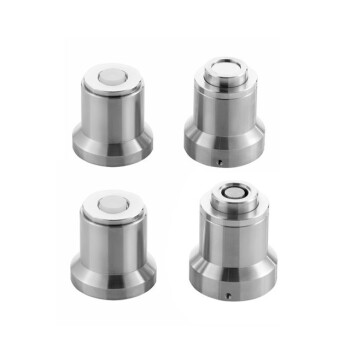
In battery research and testing, a hollow Polytetrafluoroethylene (PTFE) spacer is primarily used to create a controlled environment that lacks physical constriction. By introducing a void within the cell assembly, this component simulates a condition of "ample space" and low internal pressure. This allows researchers to isolate the electrochemical behavior of the battery from the mechanical forces that typically compress the internal components.
By removing external physical constraints, the hollow spacer forces the lithium to reveal its natural growth tendencies. This setup is crucial for verifying if a charging protocol can chemically suppress dendrites without relying on mechanical pressure to flatten them.
Simulating the Deposition Environment
Creating "Ample Space"
In a standard battery stack, components are tightly sandwiched together. The hollow PTFE spacer introduces a specific volume of empty space above the anode surface. This void prevents the immediate physical contact that would usually occur between the separator or cathode and the growing lithium layer.
Minimizing External Constraint
The primary goal is to simulate a low-pressure deposition environment. Mechanical pressure is known to help flatten lithium deposits; by removing it, the spacer creates a more challenging environment for the battery. This ensures that any stability observed is due to the chemistry, not the packaging pressure.
Analyzing Lithium Growth Patterns
Observing Aggregation vs. Uniformity
Without the "ironing" effect of stack pressure, lithium metal is free to grow in three dimensions. Researchers use this setup to see if the lithium aggregates into clumps or distributes itself effectively across the surface. This distinction is vital for determining the longevity of the cell.
Detecting Dendrite Formation
The unconstrained environment acts as a litmus test for dendrites. Because there is no physical barrier suppressing vertical growth, any tendency for the lithium to form spikes or needles becomes immediately apparent. This makes the hollow spacer an excellent tool for worst-case scenario testing.
Validating Charging Protocols
Isolating Protocol Effectiveness
The ultimate utility of this setup is to evaluate the effectiveness of specific charging protocols. If a specific charging method results in smooth, flat lithium deposition even inside a hollow spacer, the protocol is highly effective.
Confirming Chemical Suppression
This method confirms that the suppression of dendrites is a result of electrochemical control rather than mechanical force. It proves that the charging strategy itself is capable of managing the lithium flux and deposition morphology.
Understanding the Trade-offs
Deviation from Commercial Reality
It is important to note that this setup does not perfectly mimic a commercial battery. Commercial cells almost always utilize stack pressure to enhance performance. Therefore, data gathered here represents a specific experimental condition, not necessarily the final operating state of a consumer product.
The "Worst-Case" Bias
Because it removes the beneficial effects of pressure, this method can make lithium morphology appear worse than it would be in a finished cell. It is a stress test, meant to expose weaknesses rather than simulate average performance.
Applying This to Your Research
When deciding whether to incorporate hollow PTFE spacers into your testing regimen, consider your specific analytical goals.
- If your primary focus is testing charging algorithms: Use this setup to prove that your protocol can suppress dendrites chemically without relying on mechanical stack pressure.
- If your primary focus is electrolyte formulation: Use the hollow spacer to observe how well your chemistry promotes uniform plating in the absence of physical constraints.
This approach ensures you are evaluating the fundamental stability of your electrochemical system, independent of mechanical aid.
Summary Table:
| Feature | Purpose in Lithium Deposition Study |
|---|---|
| Hollow Design | Creates a void for unconstrained 3D lithium growth |
| PTFE Material | Provides chemical inertness and electrical insulation |
| Low Pressure | Eliminates mechanical 'flattening' to isolate chemical effects |
| Stress Testing | Exposes natural dendrite formation for worst-case analysis |
| Validation | Confirms if protocols suppress dendrites without physical aid |
Advance Your Battery Research with KINTEK Precision Solutions
Are you looking to isolate electrochemical performance from mechanical constraints? KINTEK specializes in comprehensive laboratory pressing and battery research solutions. From creating the perfect low-pressure environment with specialized spacers to utilizing our manual, automatic, and heated presses, we provide the tools necessary for precise material analysis.
Whether you are refining electrolyte formulations or developing next-generation charging protocols, our range of cold and warm isostatic presses and glovebox-compatible models ensures your research is backed by industry-leading reliability.
Ready to optimize your battery testing workflow? Contact us today to discover how KINTEK can enhance your laboratory's efficiency and accuracy!
References
- Liu Yuanming, GUOHUA CHEN. Tailored charging protocol for densified lithium deposition and stable initially anode-free lithium metal pouch cells. DOI: 10.1038/s41467-025-66271-0
This article is also based on technical information from Kintek Solution Knowledge Base .
Related Products
- Lab Cylindrical Press Mold for Laboratory Use
- Lab Double Plate Heating Mold for Laboratory Use
- XRF KBR Plastic Ring Lab Powder Pellet Pressing Mold for FTIR
- Lab Infrared Press Mold for No Demolding
- XRF KBR Steel Ring Lab Powder Pellet Pressing Mold for FTIR
People Also Ask
- What is the purpose of incorporating cartridge heaters into a lab press mold for MLCC block compression? Optimize Results
- What is the function of a pressing tool in thermoplastic panels? Master Precision Shaping & Fusion Bonding
- Why is precise cooling management of the lab press mold necessary? Protect Core Integrity in Thermoforming
- Why is a high-performance laboratory molding press critical for in-situ electrolyte formation? Unlock Battery Success
- How does the geometry of laboratory molds influence mycelium-based composites? Optimize Density and Strength