
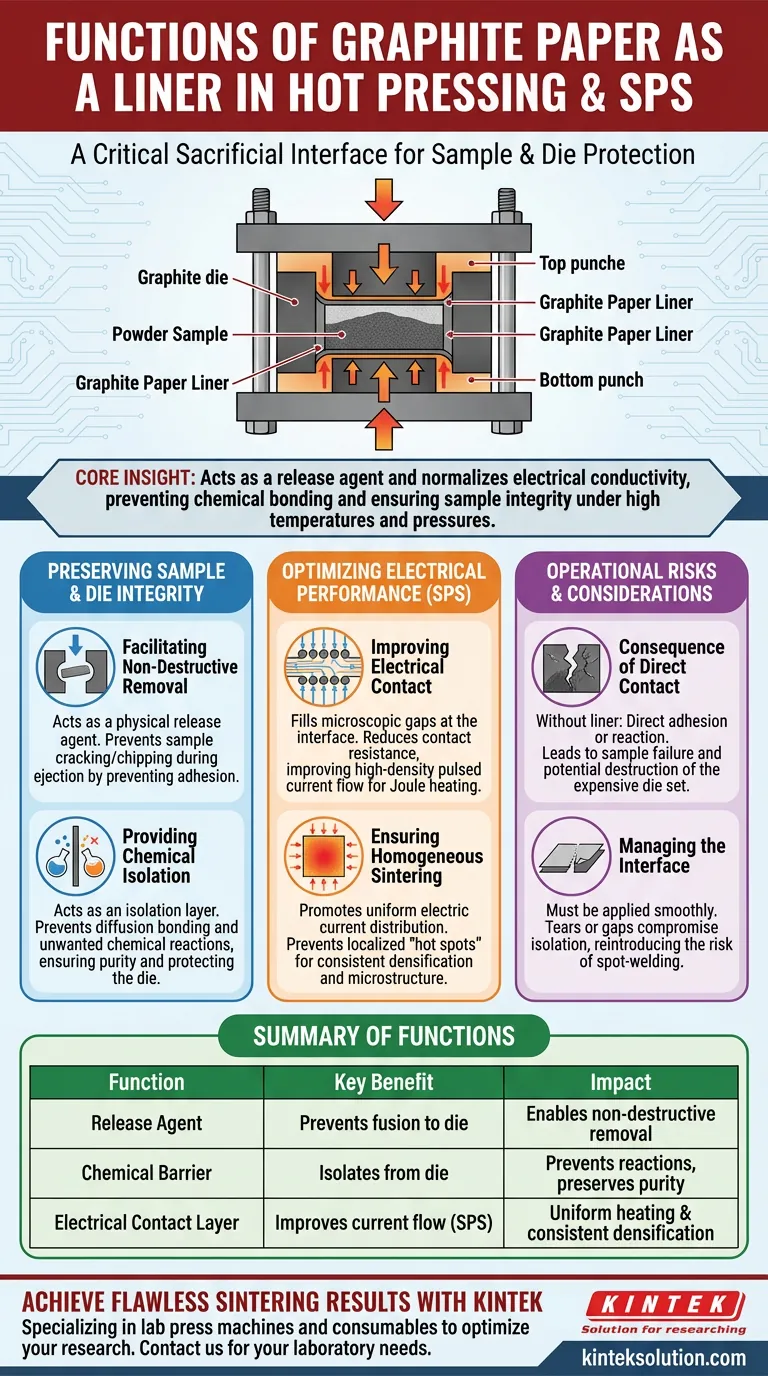
Graphite paper serves as a critical sacrificial interface between the sintering material and the tooling assembly. Its primary purpose is to act as a release agent, ensuring that the sintered sample does not fuse to the graphite die under high temperatures and pressures. In current-assisted processes like Spark Plasma Sintering (SPS), it also plays a vital role in normalizing electrical conductivity across the sample assembly.
Core Insight: In hot pressing environments, the graphite die functions as both a mold and a heating element. Without the graphite paper liner, the combination of thermal energy and mechanical pressure would likely cause chemical bonding between the powder and the die, leading to catastrophic sample damage during removal.
Preserving Sample and Die Integrity
The most immediate function of graphite paper is mechanical and chemical protection. It acts as a barrier that preserves both the sample you are creating and the expensive tooling used to create it.
Facilitating Non-Destructive Removal
Under the intense conditions of hot pressing, materials often adhere to the inner walls of the die. Graphite paper prevents this adhesion by acting as a physical release agent.
This ensures that once the process is complete, the dense ceramic or metallic pellet can be removed easily. This prevents the sample from cracking or chipping during ejection, which is a common failure point in unlined dies.
Providing Chemical Isolation
Beyond simple sticking, high temperatures can induce chemical reactions between the powder sample and the graphite die.
The graphite paper serves as an isolation layer. It prevents diffusion bonding and unwanted chemical interactions, ensuring the purity of the sample surface and protecting the die from chemical erosion.
Optimizing Electrical Performance in SPS
In Spark Plasma Sintering (SPS), the die is not just a container; it is an active part of the electrical circuit. The graphite paper is essential for managing how current flows through the material.
Improving Electrical Contact
SPS relies on passing high-density pulsed current through the die and the sample to generate Joule heat.
Graphite paper significantly improves the electrical contact between the powder sample and the press punches. It fills microscopic gaps at the interface, reducing contact resistance that could otherwise impede the process.
Ensuring Homogeneous Sintering
By establishing better electrical contact, the paper promotes a uniform distribution of electric current.
This uniformity is critical for achieving consistent heating throughout the sample. It prevents localized "hot spots" or uneven densification, leading to a more homogeneous final microstructure.
Operational Risks and Considerations
While graphite paper is a simple consumable, its role is absolute. Understanding the risks of improper usage is vital for process success.
The Consequence of Direct Contact
Attempting to sinter without this liner forces the die to perform dual functions—containment and heating—without a buffer.
References indicate this leads to direct adhesion or reaction. The result is often a damaged pellet that cannot be separated from the die, rendering the experiment a failure and potentially destroying the graphite die set.
Managing the Interface
The paper acts as a medium for pressure transmission and current transfer.
However, users must ensure the liner is applied smoothly. Any tears or gaps in the paper compromise the isolation, reintroducing the risk of spot-welding the sample to the die wall.
Making the Right Choice for Your Goal
Using graphite paper is standard practice, but understanding why you are using it helps you troubleshoot issues with sample quality.
- If your primary focus is Sample Quality: Ensure the paper covers the entire contact surface area to function as a complete chemical barrier and release agent.
- If your primary focus is Microstructural Consistency: Verify that the paper is smooth and unbroken to guarantee uniform electrical contact and homogeneous Joule heating.
The graphite paper liner is not merely a spacer; it is the essential component that enables the simultaneous application of heat and pressure without sacrificing the integrity of your material.
Summary Table:
| Function | Key Benefit |
|---|---|
| Release Agent | Prevents sample from fusing to the die, enabling non-destructive removal. |
| Chemical Barrier | Isolates the sample from the die to prevent unwanted reactions and preserve purity. |
| Electrical Contact Layer | Improves current flow in SPS for uniform heating and consistent densification. |
Achieve flawless sintering results with the right tooling. Graphite paper is a simple consumable, but its correct application is critical for protecting your samples and your investment in tooling. KINTEK specializes in lab press machines—including automatic lab presses, isostatic presses, and heated lab presses—and the consumables that ensure their success. Let our experts help you optimize your hot pressing or Spark Plasma Sintering process. Contact our team today to discuss your specific laboratory needs and how we can support your research and development goals.
Visual Guide
Related Products
- Lab Heat Press Special Mold
- Heated Hydraulic Press Machine With Heated Plates For Vacuum Box Laboratory Hot Press
- Automatic High Temperature Heated Hydraulic Press Machine with Heated Plates for Lab
- Automatic Heated Hydraulic Press Machine with Hot Plates for Laboratory
- Warm Isostatic Press for Solid State Battery Research Warm Isostatic Press
People Also Ask
- How is a laboratory heat press used to evaluate bio-based aliphatic polyesters? Prepare Reliable Samples for Analysis
- How is a laboratory heat press utilized in MEA preparation? Achieve High-Efficiency Iron-Chromium Redox Flow Batteries
- Why is a laboratory heat press necessary for biodegradable films? Unlock Precision Bonding and Barrier Performance
- What is the purpose of incorporating cartridge heaters into a lab press mold for MLCC block compression? Optimize Results
- What is the significance of pressure and temperature control in a laboratory heated press for ZIF-8/NF coatings?













