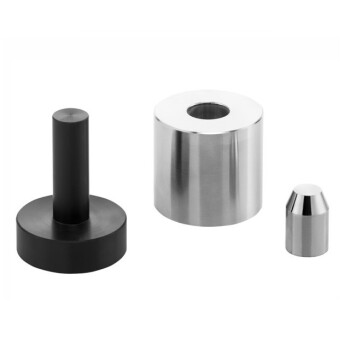
A pressure-adjustable test cell is the definitive instrument for managing the critical mechanical variables in solid-state battery (SSB) research. It allows researchers to apply precise, controllable axial pressure to the battery stack, ensuring that the solid electrodes and electrolytes maintain physical contact despite the significant volume changes that occur during charging and discharging.
Core Insight: In solid-state batteries, electrochemical performance is inextricably linked to mechanical pressure. A pressure-adjustable test cell bridges this gap, allowing you to identify the specific pressure required—often between 1 MPa and 15 MPa—to prevent interfacial delamination, suppress dendrites, and achieve stable, long-term cycling.
The Critical Role of Mechanical Constraint
Counteracting Volume Fluctuations
Unlike liquid electrolytes, which flow to fill gaps, solid electrolytes are rigid.
During cycling, electrode materials (particularly Lithium metal) undergo significant volume expansion and contraction.
The test cell applies continuous external pressure to compensate for this "breathing," ensuring the battery stack remains intact.
Preventing Interfacial Failure
When volume changes occur without external pressure, voids form at the interface between the electrode and the electrolyte.
These voids interrupt the ion path, leading to a spike in interfacial resistance.
The test cell prevents this contact loss, which is the primary cause of capacity fading and premature cell failure.
Inhibiting Dendrite Growth
High localized pressure helps suppress the formation of lithium dendrites.
By maintaining a uniform mechanical constraint, the test cell physically impedes these needle-like structures from penetrating the solid electrolyte.
This is essential for preventing short circuits and ensuring the safety of the battery system.
Optimizing Operational Parameters
Determining the "Goldilocks" Pressure
One of the primary uses of this device is finding the ideal operating pressure for a specific chemistry.
While a pressure of 15 MPa might maximize contact, it may be impractical for commercial applications; conversely, 1 MPa might be sufficient for stability.
The adjustable nature of the cell allows you to dial in the exact force needed to balance performance with practical constraints.
Standardizing Test Data
Reliable data requires a stable testing environment.
If pressure fluctuates or is applied unevenly, cycle life data becomes erratic and unrepeatable.
These devices often use springs, bolts, or pneumatic systems to ensure the pressure remains constant, providing a trustworthy baseline for comparing different materials.
Understanding the Trade-offs
The Gap Between Lab and Reality
While these cells are excellent for characterization, they represent an idealized mechanical environment.
A massive steel test cell provides constraints that are difficult to replicate in a lightweight, commercial battery pack.
You must distinguish between performance enabled by materials versus performance enabled by the massive external fixture.
Risks of Excessive Pressure
Applying too much pressure can yield diminishing returns or even damage components.
Excessive force may crack brittle solid electrolytes or cause internal short circuits through soft separators.
The goal is not maximum pressure, but the minimum effective pressure required for stability.
Making the Right Choice for Your Goal
To maximize the value of a pressure-adjustable test cell, align your testing protocols with your specific objectives:
- If your primary focus is Fundamental Material Stability: Use the cell to apply high pressure (e.g., >10 MPa) to eliminate contact resistance variables and isolate the intrinsic electrochemical properties of your materials.
- If your primary focus is Commercial Viability: Use the cell to determine the lowest possible pressure (e.g., <2 MPa) that still maintains cycling stability, as this replicates the constraints of a real-world battery pack.
Ultimately, the pressure-adjustable test cell transforms mechanical pressure from an uncontrolled variable into a precise tool for optimizing battery life.
Summary Table:
| Feature | Significance in SSB Testing | Impact on Performance |
|---|---|---|
| Volume Compensation | Counteracts electrode expansion/contraction | Maintains physical contact during cycling |
| Interfacial Contact | Minimizes void formation at interfaces | Reduces interfacial resistance and capacity fade |
| Dendrite Suppression | Provides uniform mechanical constraint | Prevents short circuits and enhances safety |
| Pressure Optimization | Identifies the "minimum effective pressure" | Balances lab performance with commercial viability |
| Data Standardization | Ensures constant, repeatable axial force | Provides reliable baselines for material comparison |
Elevate Your Battery Research with KINTEK Precision
Unlock the full potential of your solid-state battery (SSB) materials by mastering the mechanical variables of your testing environment. KINTEK specializes in comprehensive laboratory pressing solutions, offering a versatile range of manual, automatic, heated, and multifunctional models, alongside cold and warm isostatic presses designed for the most demanding research applications.
Whether you are aiming to suppress dendrite growth or determine the ideal pressure for commercial viability, our glovebox-compatible systems provide the precision and reliability you need.
Ready to optimize your battery stack performance? Contact KINTEK today to find the perfect pressing solution for your lab!
References
- Lowack, Ansgar, Michaelis Alexander. Feasibility study on high-energy-density almost-solid-state sodium batteries with thin ceramic Na 3.4 Zr 2 Si 2.4 P 0.6 O 12 separators. DOI: 10.34734/fzj-2025-04322
This article is also based on technical information from Kintek Solution Knowledge Base .
Related Products
- Warm Isostatic Press for Solid State Battery Research Warm Isostatic Press
- Lab Button Battery Tablet Press Sealing Mold
- Button Battery Sealing Press Machine for Lab
- Laboratory Hydraulic Press Lab Pellet Press Button Battery Press
- Carbide Lab Press Mold for Laboratory Sample Preparation
People Also Ask
- Why must composite cathodes be sealed in vacuum lamination bags for WIP? Ensure Battery Stability and Density
- How do sacrificial volume materials (SVM) maintain microchannels in isostatic pressing? Ensure Structural Integrity
- What is the function of elastic molds in warm isostatic pressing? Achieve Uniform Density in Composite Particles
- What is the mechanism of a Warm Isostatic Press (WIP) on cheese? Master Cold Pasteurization for Superior Safety
- What are the advantages of using a Warm Isostatic Press (WIP) for batteries? Achieve Superior Interface Contact