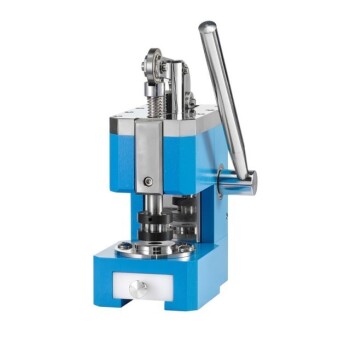
Laboratory direct shear testers and sieving devices are the primary tools for establishing the ground truth of sand properties in bridge experiments. The direct shear tester is utilized to determine the average internal friction angle, a critical measure of the sand's mechanical strength. Simultaneously, the sieving device maps the particle size distribution curve to calculate the coefficient of uniformity, ensuring the physical consistency of the material.
These instruments provide the high-precision scientific basis necessary to standardize experimental materials and accurately calibrate the Hardening Soil (HS) model for finite element analysis.
Determining Mechanical Parameters
To understand how sand will support a bridge structure, you must quantify its resistance to movement.
The Role of the Direct Shear Tester
The direct shear tester focuses on the mechanical behavior of the soil. Its specific function is to determine the average internal friction angle of the sand.
Why Friction Angle Matters
This parameter defines how the sand grains interact and interlock under stress. It is the defining metric for the material's shear strength. Without this specific value, calculations regarding the sand's stability would be based on guesswork rather than data.
Determining Physical Parameters
Before mechanical testing can be validated, the physical composition of the sand must be standardized.
The Role of the Sieving Device
The sieving device is used to physically separate sand particles by size. This process generates a particle size distribution curve.
The Coefficient of Uniformity
From the distribution curve, researchers calculate the coefficient of uniformity. This metric confirms whether the sand is well-graded or poorly graded. It ensures that the sand used in the experiment meets strict standardization requirements.
Connecting Lab Data to Simulation
Modern bridge experiments rarely rely on physical testing alone; they are often paired with digital simulations.
Calibrating the Hardening Soil (HS) Model
Finite element analysis software requires precise input data to function correctly. The data derived from these tools serves as the scientific basis for setting Hardening Soil (HS) model parameters.
Ensuring Standardization
By using high-precision physical and chemical analysis tools, you ensure the sand in the software behaves exactly like the sand in the lab. This synchronization is vital for the validity of the experiment.
Common Pitfalls in Parameter Selection
While these tools provide precision, they must be applied correctly to avoid data discrepancies.
The Risk of Assumed Values
A common error is relying on generic textbook values for friction angle or uniformity rather than testing the specific batch of sand.
The Necessity of Local Calibration
The Hardening Soil model is highly sensitive to input parameters. Skipping the direct shear or sieving tests means the finite element analysis lacks a scientific basis, rendering the simulation unreliable.
Making the Right Choice for Your Goal
To ensure your bridge experiment is both physically accurate and digitally valid, prioritize the following based on your immediate needs:
- If your primary focus is mechanical stability: Prioritize the direct shear tester to obtain an accurate average internal friction angle for strength calculations.
- If your primary focus is digital simulation: Ensure you use both tools to derive the specific inputs needed to populate the Hardening Soil (HS) model in your software.
precise data from these tools bridges the gap between raw material behavior and accurate predictive modeling.
Summary Table:
| Instrument | Parameter Measured | Key Output | Application in Bridge Experiments |
|---|---|---|---|
| Direct Shear Tester | Mechanical Strength | Average Internal Friction Angle | Defines shear strength and soil stability under stress |
| Sieving Device | Physical Composition | Particle Size Distribution Curve | Calculates coefficient of uniformity for material standardization |
| Combined Analysis | Soil Characteristics | HS Model Parameters | Calibrates finite element analysis for digital simulations |
Elevate Your Geotechnical Research with KINTEK Precision
Ensure your bridge experiments are backed by the highest quality data. KINTEK specializes in comprehensive laboratory pressing and material analysis solutions tailored for demanding research environments. Whether you are conducting battery research or soil stability testing, our range of manual, automatic, heated, and multifunctional models—including advanced isostatic presses—provides the reliability you need.
Why choose KINTEK?
- Unmatched Accuracy: Standardize your experimental materials with high-precision instruments.
- Versatile Solutions: From glovebox-compatible models to cold/warm isostatic presses.
- Expert Support: We bridge the gap between raw material behavior and predictive modeling.
Ready to optimize your lab's performance? Contact our technical experts today to find the perfect solution for your research goals!
References
- Yufeng Tang, Fuyun Huang. Experimental and Numerical Investigations of Flat Approach Slab–Soil Interaction in Jointless Bridge. DOI: 10.3390/app142411726
This article is also based on technical information from Kintek Solution Knowledge Base .
Related Products
- Lab Round Bidirectional Press Mold
- Lab Anti-Cracking Press Mold
- Automatic Laboratory Hydraulic Press Lab Pellet Press Machine
- Lab Manual Microtome Slicer for Tissue Sectioning
- Automatic Laboratory Hydraulic Press for XRF and KBR Pellet Pressing
People Also Ask
- What is the purpose of incorporating cartridge heaters into a lab press mold for MLCC block compression? Optimize Results
- What is the function of a pressing tool in thermoplastic panels? Master Precision Shaping & Fusion Bonding
- Why is precise cooling management of the lab press mold necessary? Protect Core Integrity in Thermoforming
- Why is a high-performance laboratory molding press critical for in-situ electrolyte formation? Unlock Battery Success
- How do the design and geometric precision of pressing molds and mandrels affect the quality of PTFE composite samples?