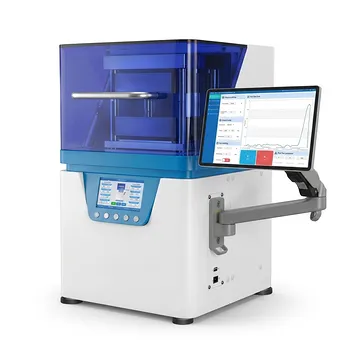
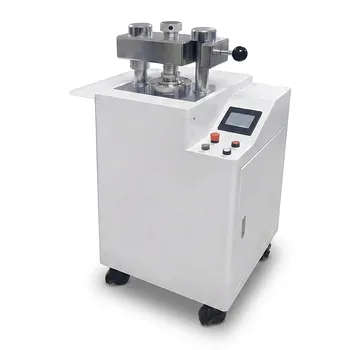
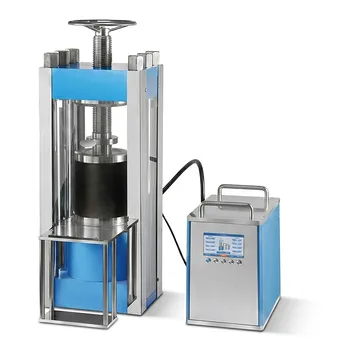
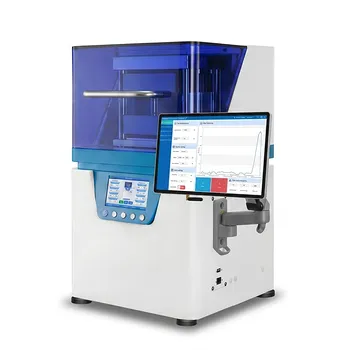
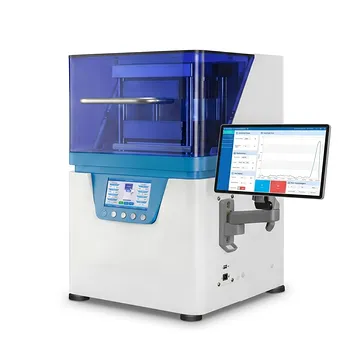
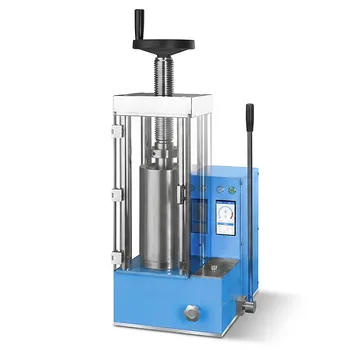
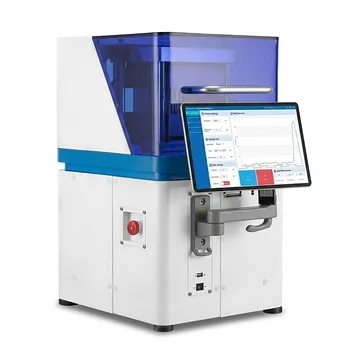
A high-tonnage laboratory hydraulic press is required to deliver the massive unit pressures, often ranging from 300 to 1000 MPa, necessary to overcome inter-particle friction and induce plastic deformation in aluminum powders. Precision control is equally critical to ensure uniform density throughout the compact, facilitate mechanical interlocking, and prevent internal micro-cracks that would lead to failure during the subsequent sintering process.
Core Takeaway: To transform loose powder into a structural "green compact," a press must provide enough force to break surface oxides and deform metal particles while maintaining the precise control needed to eliminate density gradients and entrapped air.
The Physics of Powder Consolidation
Overcoming Particle Friction and Oxide Layers
Aluminum particles are naturally coated in a thin, hard oxide film that prevents bonding. High tonnage is necessary to generate enough unit pressure to rupture these films, allowing fresh metal surfaces to come into contact.
Once the oxides are breached, the high pressure drives mechanical interlocking between the particles. This interlocking provides the "green strength" necessary for the compact to be handled without crumbling before it is sintered.
Achieving Plastic Deformation and Rearrangement
In the initial stages of pressing, particles undergo rearrangement to fill large voids. However, high tonnage is required to move beyond simple packing into the realm of plastic deformation.
Under extreme pressure, the aluminum particles actually change shape to fill the remaining microscopic gaps. This process significantly reduces internal porosity and increases the initial bulk density of the sample.
The Role of Precision in Green Compact Integrity
Eliminating Density Gradients and Micro-cracks
Precision in a hydraulic press is not just about the total force, but how that force is distributed. Uniaxial pressure must be applied consistently to prevent density gradients, where one part of the compact is denser than another.
If density is non-uniform, the compact will likely warp or crack during the high-temperature sintering stage. Precise control ensures that the internal stresses are balanced, creating a structurally sound preform.
Managing Air Entrapment and Loading Speed
The speed at which pressure is applied—often regulated at specific rates like 0.6 MPa/s—is vital for quality. Controlled loading allows trapped air to escape from the powder mixture as it consolidates.
If the pressure is applied too rapidly, air can become trapped in pockets, leading to internal macro-pores. A precise pressure-holding phase is also used to ensure the particles have adequate time to settle into a stable, dense configuration.
Understanding the Trade-offs
Balancing Pressure and Tooling Wear
While higher pressure generally leads to higher green density, there is a point of diminishing returns. Excessive pressure can lead to die wall friction issues, where the powder sticks to the mold, potentially damaging the equipment or the compact during ejection.
Limits of Cold Uniaxial Pressing
Cold pressing alone rarely achieves 100% theoretical density. If the pressure is too high without proper lubrication or precision, it can induce lamination cracks, where the compact splits into layers because of stored elastic energy that is released when the pressure is removed.
How to Apply This to Your Project
Making the Right Choice for Your Goal
- If your primary focus is Maximum Density: Use a high-tonnage press capable of reaching at least 840 MPa to ensure total plastic deformation of the aluminum matrix.
- If your primary focus is Structural Integrity: Prioritize precision loading controls (e.g., 0.6 MPa/s) to allow air escape and prevent the formation of internal micro-cracks.
- If your primary focus is Sintering Stability: Focus on minimizing density gradients through precise uniaxial control to prevent warping or deformation at high temperatures.
Achieving the perfect aluminum matrix composite requires a calculated balance between the raw force of high tonnage and the surgical precision of modern hydraulic control systems.
Summary Table:
| Key Requirement | Primary Purpose | Benefit to Green Compact |
|---|---|---|
| High Tonnage (300-1000 MPa) | Rupture oxide films & induce plastic deformation | Increases green strength and initial bulk density |
| Precision Control | Uniform uniaxial pressure distribution | Prevents density gradients and warping during sintering |
| Controlled Loading Rate | Effective air evacuation (e.g., 0.6 MPa/s) | Eliminates internal macro-pores and lamination cracks |
| Pressure-Holding Phase | Stable particle settlement | Ensures a stable, dense, and structurally sound configuration |
Optimize Your Composite Fabrication with KINTEK Precision
Successful aluminum matrix consolidation demands a perfect balance of high tonnage and meticulous pressure control. KINTEK specializes in comprehensive laboratory pressing solutions, offering manual, automatic, heated, multifunctional, and glovebox-compatible models, as well as cold and warm isostatic presses widely applied in battery research and advanced materials science. Our precision-engineered systems help you eliminate density gradients and micro-cracks, ensuring the structural integrity of your green compacts from start to finish.
Ready to enhance your lab's efficiency and sample quality? Contact KINTEK today for a tailored solution!
References
- Sridhar Idapalapati, Karthic R. Narayanan. Processing and characterization of MWCNT reinforced aluminum matrix composites. DOI: 10.1007/s10853-009-3290-5
This article is also based on technical information from Kintek Solution Knowledge Base .
Related Products
- 24T 30T 60T Heated Hydraulic Lab Press Machine with Hot Plates for Laboratory
- Automatic Large Format Laboratory Heated Hydraulic Press 400x400mm Plate Capacity
- Laboratory Hydraulic Press 2T Lab Pellet Press for KBR FTIR
- Automatic High Temperature Heated Hydraulic Press Machine with Heated Plates for Lab
- Automatic Fluorescence Sample Preparation Press 40 Ton Lab Pellet Press for XRF Analysis
People Also Ask
- Function of a Laboratory Hydraulic Press with Heated Platens in SSE? Enhance Battery Density & Conductivity
- Why is a laboratory hydraulic press with heating plates required for PLA/TEC films? Achieve Precise Sample Integrity
- What role does a laboratory heated hydraulic press play in LTCC? Essential for High-Density Ceramic Lamination
- Why reduce load when applying composite strengthening tabs? Protect Specimen Integrity and Data Accuracy
- Why is a laboratory heated hydraulic press required? Ensure Precise Vulcanization for NBR/EPDM Nanocomposites