
Beyond the high-profile sectors of aerospace and medicine, isostatic pressing is a critical manufacturing process for the energy, electronics, industrial ceramic, and consumer goods industries.
Its ability to achieve uniform density across complex shapes makes it the standard for producing nuclear fuel, sodium-sulfur battery electrolytes, industrial grinding wheels, electronic ferrites, and even high-end dinnerware.
The Core Insight While often associated with high-strength alloys, the true versatility of isostatic pressing lies in its application to ceramics and composite materials. In sectors ranging from nuclear energy to food processing, this technique is chosen not just for strength, but to eliminate internal voids and ensure consistent material properties in parts that cannot be reliably manufactured through uniaxial pressing.
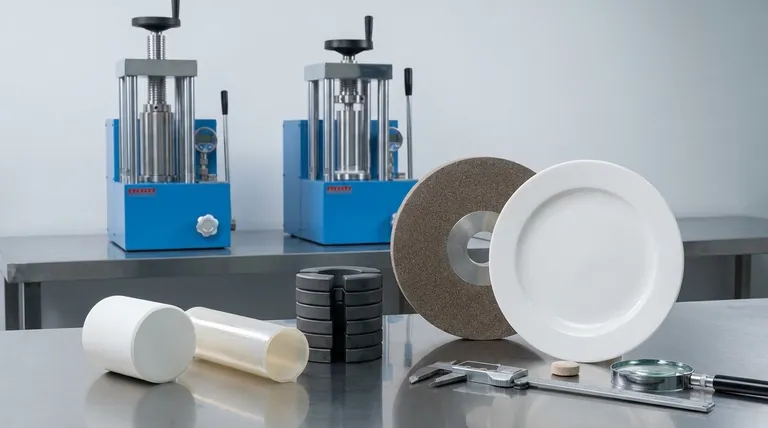
Critical Applications in Energy and Electronics
Nuclear Energy Components
The nuclear sector relies heavily on isostatic pressing for the production of nuclear fuel.
The process ensures the fuel pellets have a completely uniform density. This uniformity is a non-negotiable safety requirement for controlled fission and thermal management within a reactor.
Advanced Battery Technologies
In the realm of energy storage, specifically sodium-sulfur batteries, isostatic pressing is used to manufacture the solid electrolyte.
These electrolytes are often ceramic beta-alumina tubes. The process ensures they are defect-free, which is vital for ionic conductivity and battery longevity.
Electronic Ferrites and Insulators
The electronics industry utilizes this method to manufacture ferrites (magnetic cores used in inductors and transformers).
It is also used to create high-quality insulators, such as those found in specialized lighting tubes and fuse tubes. The process allows for the high-volume production of these small, dense ceramic parts with excellent dielectric properties.
Industrial Manufacturing and Infrastructure
Abrasives and Tooling
One of the most common industrial uses is the production of grinding wheels.
Because grinding wheels spin at high velocities, any internal structural flaw could cause a catastrophic explosion. Isostatic pressing ensures the abrasive material is compacted uniformly, preventing weak spots.
Fluid Handling and Metallurgy
The process is extensively used to create components that must withstand wear and chemical attack.
Applications include nozzles, teeming tubes (used in metal casting), and central heating water pump shafts. In infrastructure, it is even used for the production of durable sewer pipes that require high structural integrity.
Consumer Goods and Chemical Processing
High-End Ceramics
Surprisingly, isostatic pressing is a standard method for manufacturing dinnerware.
It allows for the rapid production of plates and bowls that are denser and more chip-resistant than those made via traditional pottery methods. It also enables the creation of complex shapes that would warp during standard drying processes.
Food and Pharmaceuticals
The technology extends into the processing of sensitive compounds. In pharmaceuticals, it is used to compress tablets and medical compounds to precise densities.
In food processing, high-pressure isostatic treatment is used for pasteurization (often called HPP), preserving freshness while eliminating bacteria.
Chemical and Explosive Compounds
The chemical industry uses isostatic pressing to process various chemical compounds and manufacture explosives.
When dealing with volatile materials, the uniform pressure application ensures consistent density without the friction or heat generation associated with mechanical pressing, enhancing safety.
Understanding the Trade-offs
Production Speed vs. Quality
Isostatic pressing is generally slower than uniaxial die compaction.
If you are manufacturing simple shapes where slight density gradients are acceptable, standard die pressing is more cost-effective. Isostatic pressing is reserved for parts where uniformity is critical.
Dimensional Tolerances
While isostatic pressing creates "near-net-shape" parts, the flexible molds used (bags) result in less precise surface finishes compared to rigid dies.
Consequently, parts often require secondary machining or grinding to achieve final dimensional tolerances, which can add to the total manufacturing cost.
Making the Right Choice for Your Goal
Isostatic pressing is rarely the cheapest option, but it is often the only option for zero-defect reliability in complex geometries.
- If your primary focus is electrical or chemical consistency: Choose this method for ferrites, electrolytes, or nuclear fuels where internal density variations would cause system failure.
- If your primary focus is structural safety in rotating or pressurized parts: Use this for grinding wheels, pump shafts, or nozzles to eliminate potential fracture points.
- If your primary focus is aesthetic durability: Apply this to consumer ceramics to achieve chip resistance and complex geometries that stand out in the market.
The value of isostatic pressing is not just in high strength; it is in the absolute predictability of the material structure it creates.
Summary Table:
| Industry | Key Applications | Material Benefit |
|---|---|---|
| Energy | Nuclear fuel pellets, Battery electrolytes | Uniform density for safety & performance |
| Electronics | Ferrites, Insulators | Consistent electrical properties |
| Industrial | Grinding wheels, Nozzles, Pipes | Structural integrity & wear resistance |
| Consumer Goods | Dinnerware, Pharmaceuticals | Chip resistance & precise density |
Need to produce parts with zero-defect reliability and uniform material properties?
KINTEK specializes in lab press machines, including isostatic presses, to help you achieve absolute predictability in your material structure. Whether you are developing components for the energy sector, electronics, or durable consumer goods, our expertise ensures your lab can produce complex, high-integrity parts reliably.
Contact KINTEK today to discuss how our isostatic press solutions can enhance your R&D and manufacturing processes.
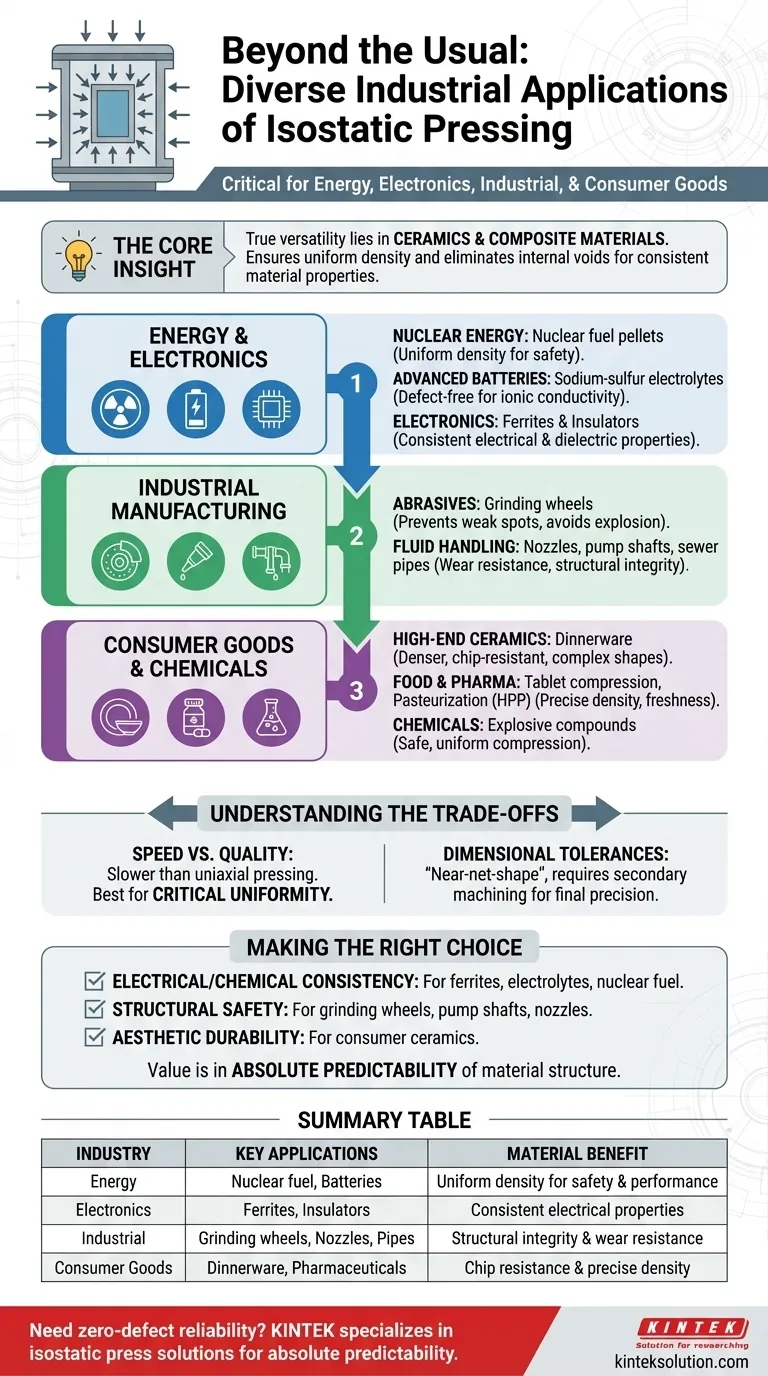
Visual Guide
Related Products
- Warm Isostatic Press for Solid State Battery Research Warm Isostatic Press
- Automatic Lab Cold Isostatic Pressing CIP Machine
- Lab Isostatic Pressing Molds for Isostatic Molding
- Electric Lab Cold Isostatic Press CIP Machine
- Electric Split Lab Cold Isostatic Pressing CIP Machine
People Also Ask
- Why must composite cathodes be sealed in vacuum lamination bags for WIP? Ensure Battery Stability and Density
- How do sacrificial volume materials (SVM) maintain microchannels in isostatic pressing? Ensure Structural Integrity
- What is the function of elastic molds in warm isostatic pressing? Achieve Uniform Density in Composite Particles
- What is the mechanism of a Warm Isostatic Press (WIP) on cheese? Master Cold Pasteurization for Superior Safety
- What is the process involved in warm isostatic pressing? Mastering Uniform Density with WIP Technology



















