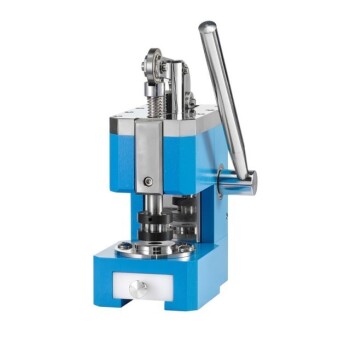
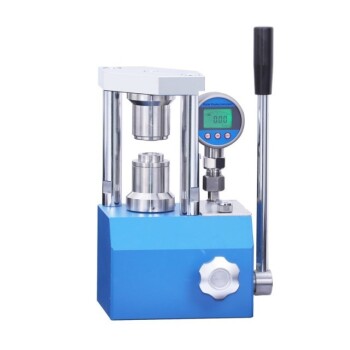
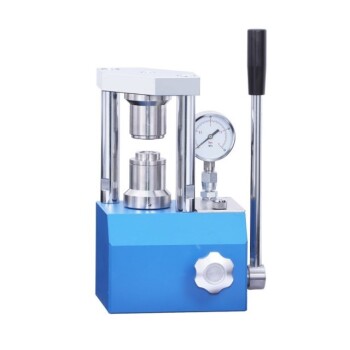
A precision disc puncher ensures accuracy by strictly standardizing the geometry of your electrode samples. It functions by cutting large-area coated electrode sheets into circular pieces with identical diameters. This mechanical consistency creates a reliable baseline, ensuring that subsequent calculations for active material mass and current density are based on precise, unvarying physical dimensions.
Core Takeaway The precision disc puncher removes geometric variability from your experiment. By guaranteeing that every sample has the exact same surface area, it ensures that observed differences in performance are due to material properties or process parameters, rather than inconsistent sample sizes.
The Mechanics of Experimental Rigor
Eliminating Geometric Variables
In electrochemical evaluation, valid comparisons are impossible without identical test subjects. A precision disc puncher converts irregular, large-format electrode sheets into uniform discs.
By mechanically fixing the diameter, the device eliminates the surface area as a variable. This allows researchers to assemble three-electrode or button cells with the confidence that every unit is physically identical.
The Foundation for Mass Calculation
To evaluate performance, you must know exactly how much active material is reacting. This calculation relies heavily on the area of the electrode.
If the cut is imprecise, the assumed area differs from the actual area, leading to errors in mass calculation. A precision puncher ensures the area is a constant, allowing for high-accuracy mass determination.
Impact on Performance Metrics
Ensuring Accurate Current Density
Current density—the amount of current flowing per unit of area—is one of the most critical metrics in battery testing. It is calculated by dividing the measured current by the electrode's surface area.
If the puncher produces discs with slight diameter variations, the "Area" variable in your equation becomes incorrect. This distorts the current density data, rendering the electrochemical evaluation unreliable.
Enabling Rigorous Comparisons
Research often involves testing different process parameters to optimize battery performance. To do this scientifically, you must isolate the variable being tested.
Standardized discs ensure that any change in capacity or cycle life is actually caused by the process parameter you changed. Without this precision, you cannot distinguish between a process improvement and a simple cutting error.
Understanding the Trade-offs
Geometry vs. Uniformity
While a precision puncher guarantees identical areas, it does not correct for inconsistent coating thickness.
If your original electrode sheet has uneven loading (thick spots and thin spots), two discs of the exact same diameter will still contain different amounts of active material. The puncher solves the geometric problem, but the coating process must solve the uniformity problem.
Edge Quality Concerns
Using a puncher requires maintenance of the cutting die. A dull or low-quality puncher can cause burrs or delamination at the edges of the disc.
These edge defects can lead to short circuits inside a button cell, invalidating the test regardless of how accurate the diameter is.
Applying Precision to Your Workflow
To maximize the value of your electrochemical evaluations, align your equipment choice with your specific research goals:
- If your primary focus is Fundamental Material Research: You need precise diameter control to calculate exact specific capacity and current density figures.
- If your primary focus is Process Optimization: You need high reproducibility to ensure that performance shifts are strictly due to your parameter changes, not sample variance.
Reliable data starts before the test begins; precision preparation is the invisible step that validates every subsequent result.
Summary Table:
| Feature | Impact on Experimental Accuracy |
|---|---|
| Geometric Standardization | Eliminates surface area variability for consistent test baselines. |
| Mass Calculation | Provides a constant area variable for high-precision active material determination. |
| Current Density Control | Ensures current flow calculations ($A/cm^2$) are based on exact physical dimensions. |
| Reproducibility | Isolates material performance from physical sample variance during process optimization. |
| Edge Quality | Minimizes burrs and delamination to prevent short circuits in button cells. |
Elevate Your Electrochemical Research with KINTEK
Precision preparation is the foundation of reliable battery data. KINTEK specializes in comprehensive laboratory pressing and sample preparation solutions, offering a range of precision disc punchers alongside manual, automatic, heated, and glovebox-compatible models. Whether you are performing fundamental material research or complex process optimization, our cold and warm isostatic presses are engineered to meet the rigorous demands of modern battery development.
Ready to remove variability from your experiments? Contact KINTEK today to find the perfect precision tools for your lab!
References
- Minji Kang, Cheol-Hwi Ryu. Study on Direct-Contact Prelithiation of Soft Carbon Anodes Using Lithium Foil for Lithium-Ion Capacitors. DOI: 10.3390/en18092276
This article is also based on technical information from Kintek Solution Knowledge Base .
Related Products
- Lab Manual Microtome Slicer for Tissue Sectioning
- Manual Laboratory Hydraulic Press Lab Pellet Press
- Laboratory Hydraulic Split Electric Lab Pellet Press
- Laboratory Hydraulic Press Lab Pellet Press Machine for Glove Box
- Button Battery Sealing Machine for Button Batteries
People Also Ask
- Why is a precision disc cutter used to process samples? Ensure Accuracy in Gel Content and Swelling Ratio Testing
- Why is it necessary to use a high-precision disc cutter for coin cells? Ensure Data Accuracy and Prevent Shorts
- How do chemical etchants assist in Micro EDM microstructure analysis? Reveal Heat-Affected Zones and Recast Layers
- Why is a blade grinder necessary for PLA composites? Master Pretreatment for Perfect Hot-Press Molding
- How does the use of a precision disc puncher contribute to the consistency of battery testing results? Ensure Accuracy