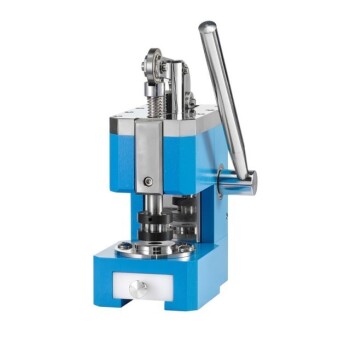
Nanoindentation testing (NI) serves as the critical validation tool for H2Pc thin films because it allows for the precise, quantitative measurement of mechanical properties at the nanometer scale. By controlling load and displacement with extreme accuracy, NI isolates the properties of the sub-micron film from the hard glass substrate, providing the only reliable way to confirm the strengthening effects of Cold Isostatic Pressing.
Core Takeaway: The unique value of nanoindentation lies in its ability to decouple the thin film's data from the supporting substrate, offering definitive proof that the Cold Isostatic Press has successfully densified the material and improved its mechanical integrity.
The Challenge of Sub-Micron Characterization
Overcoming the "Substrate Effect"
H2Pc thin films are frequently processed at sub-micron thicknesses on hard glass substrates.
This presents a significant measurement challenge for traditional testing methods, which lack the sensitivity to test the film without penetrating through to the glass.
Nanoindentation overcomes this by applying precisely controlled loads, allowing you to measure the properties of the film itself rather than the substrate beneath it.
Validating Densification
The Cold Isostatic Press (CIP) process is designed to apply omnidirectional, uniform hydrostatic pressure to the film.
The goal of this process is to crush internal pores and achieve material densification while maintaining geometric similarity.
Nanoindentation provides the necessary resolution to detect the resulting changes in the film's microstructure, validating that the internal defects have indeed been eliminated.
Quantifying Mechanical Improvements
Measuring Martens Hardness and Modulus
To objectively assess the quality of the film, you need quantifiable metrics.
Nanoindentation delivers specific values for Martens hardness and indentation modulus.
These metrics serve as direct indicators of the film's density and structural integrity following the pressing process.
Assessing Bending Strength
Beyond hardness, the flexibility and durability of the film are critical.
NI allows for the calculation of bending strength at the nanoscale.
This data helps verify that the CIP process has effectively improved the film's elastic modulus and flexural strength.
Understanding Measurement Criticality
The Risk of False Data
It is crucial to understand why alternative testing methods fail in this context.
If the testing depth is not strictly controlled at the nanometer level, the hard glass substrate will dominate the results.
This leads to artificially inflated hardness values, which disguise the true mechanical state of the H2Pc film and make it impossible to judge the effectiveness of the CIP process.
Making the Right Choice for Your Goal
To effectively evaluate your H2Pc thin films, you should tailor your analysis based on your specific verification needs:
- If your primary focus is Structural Integrity: Use NI to measure Martens hardness, as this directly correlates to the reduction of internal pores and increased densification achieved by the CIP.
- If your primary focus is Mechanical Flexibility: Prioritize indentation modulus and bending strength data to confirm the film's ability to withstand deformation without failure.
Nanoindentation is the definitive bridge between the processing capabilities of the Cold Isostatic Press and the verified performance of your thin film.
Summary Table:
| Metric Evaluated | Benefit for H2Pc Thin Films | Impact on CIP Validation |
|---|---|---|
| Martens Hardness | Measures material resistance to deformation | Confirms reduction of internal pores & densification |
| Indentation Modulus | Evaluates elastic properties at nanoscale | Verifies structural integrity of the processed film |
| Bending Strength | Assesses flexibility and durability | Confirms improved flexural performance after pressing |
| Load/Displacement | Decouples film data from glass substrate | Prevents false data caused by the "Substrate Effect" |
Elevate Your Materials Research with KINTEK Precision
Unlock the full potential of your thin film characterization and material densification. KINTEK specializes in comprehensive laboratory pressing solutions, offering a versatile range of manual, automatic, heated, and multifunctional models, as well as cold and warm isostatic presses essential for cutting-edge battery research and H2Pc film processing.
Whether you need to eliminate internal defects or achieve uniform hydrostatic pressure, our equipment provides the reliability required for precise nanoindentation validation.
Ready to optimize your lab's pressing capabilities? Contact KINTEK today to find the perfect solution for your research!
References
- Moriyasu Kanari, Ikuo IHARA. Improved Density and Mechanical Properties of a Porous Metal-Free Phthalocyanine Thin Film Isotropically Pressed with Pressure Exceeding the Yield Strength. DOI: 10.1143/apex.4.111603
This article is also based on technical information from Kintek Solution Knowledge Base .
Related Products
- Warm Isostatic Press for Solid State Battery Research Warm Isostatic Press
- Laboratory Hydraulic Split Electric Lab Pellet Press
- Lab Double Plate Heating Mold for Laboratory Use
- Assemble Square Lab Press Mold for Laboratory Use
- Lab Cylindrical Press Mold for Laboratory Use
People Also Ask
- Why must composite cathodes be sealed in vacuum lamination bags for WIP? Ensure Battery Stability and Density
- How do sacrificial volume materials (SVM) maintain microchannels in isostatic pressing? Ensure Structural Integrity
- What is the function of elastic molds in warm isostatic pressing? Achieve Uniform Density in Composite Particles
- What is the mechanism of a Warm Isostatic Press (WIP) on cheese? Master Cold Pasteurization for Superior Safety
- What is the function of hydraulic pressure in warm isostatic pressing? Achieve Uniform Material Density