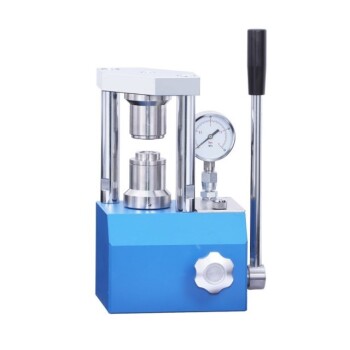
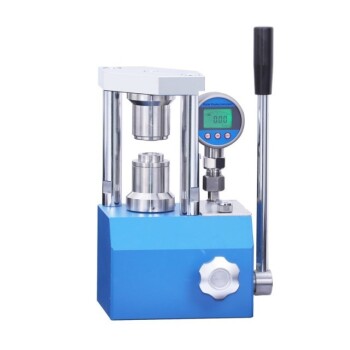
The primary advantage of using potassium bromide (KBr) for sample preparation in infrared (IR) spectroscopy is its near-total transparency to infrared radiation. Because KBr does not absorb IR light across the typical analysis range, it acts as a perfect window, allowing the spectrometer to record a clean spectrum of the sample without any interference from the surrounding matrix.
The core function of KBr is to act as an inert, transparent solid solvent. It dilutes a solid sample and disperses it uniformly, creating a thin, clear pellet that is ideal for transmission IR analysis, resulting in high-quality, high-sensitivity spectra.
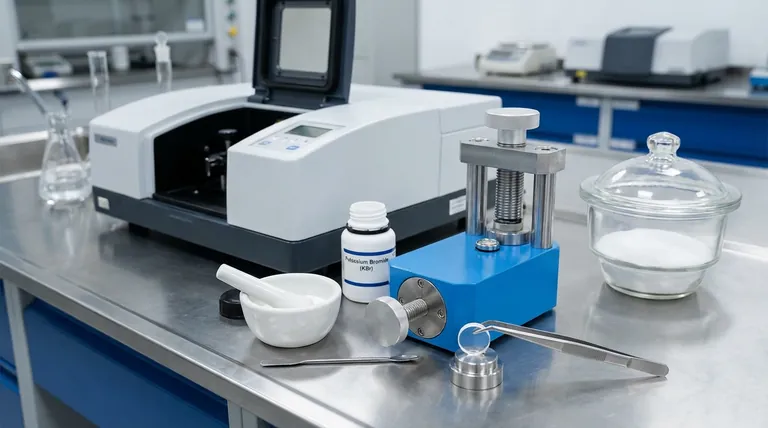
Why KBr is a Standard for Solid Samples
The KBr pellet method is a classic transmission technique for a reason. It is designed to overcome the challenges of analyzing solid materials that are often opaque to infrared light in their pure form.
Complete Transparency in the IR Range
KBr is an ionic salt that has no molecular vibrations in the mid-infrared region (4000-400 cm⁻¹). This means it does not produce any absorption bands of its own.
This property is critical, as it ensures that every peak observed in the final spectrum originates from your sample, not from the medium holding it.
Achieving Optimal Sample Dilution
A pure solid sample is often too concentrated and will absorb all the IR light, resulting in a useless spectrum with "flat-lined" peaks.
Mixing a tiny amount of sample (typically 1-2 mg) with a much larger amount of KBr (100-200 mg) creates an ideal dilution. This allows a sufficient amount of IR light to pass through for accurate measurement.
Uniform Dispersion for Consistent Results
The process requires grinding the sample and KBr together into a fine, homogenous powder. This ensures the sample molecules are distributed evenly throughout the pellet.
This uniform dispersion prevents inconsistencies in the spectrum caused by clumps of sample and guarantees the IR beam interacts with a representative portion of the material.
The Impact on Spectral Quality
Using KBr correctly directly translates to a higher quality and more useful spectrum, enabling more precise analysis.
Enhancing the Signal-to-Noise Ratio
The KBr pellet method concentrates the diluted sample into a small, well-defined disc. This focus improves the ratio of the sample's signal relative to the instrument's background noise.
A higher signal-to-noise ratio makes it easier to detect very weak absorption bands, which might otherwise be lost in the noise.
High Sensitivity for Trace Analysis
Because the technique enhances weak signals, it is exceptionally well-suited for identifying trace components or impurities within a sample.
The combination of an interference-free background and high signal-to-noise allows for detection limits that can be superior to other methods.
Chemical Inertness Preserves the Sample
Potassium bromide is a stable, chemically inert salt. It will not react with the vast majority of organic and inorganic compounds.
This ensures that the spectrum you obtain is of the original sample, not of a new substance formed by a reaction with the matrix.
Understanding the Trade-offs: The Challenge of Moisture
While powerful, the KBr method requires careful technique to avoid a significant pitfall: water contamination.
The Hygroscopic Nature of KBr
KBr is hygroscopic, meaning it readily absorbs moisture from the atmosphere. This is the single greatest challenge when preparing a KBr pellet.
How Moisture Corrupts Your Spectrum
Any absorbed water will appear in your IR spectrum, showing a very broad peak around 3400 cm⁻¹ (O-H stretching) and a weaker peak near 1640 cm⁻¹ (H-O-H bending).
These strong, broad water peaks can easily obscure important peaks from your actual sample in those regions, compromising your analysis.
Critical Handling Techniques
To obtain a clean spectrum, you must minimize moisture exposure. This involves heating the die set before use, always using finely ground KBr that has been stored in a desiccator or drying oven, and working efficiently to press the pellet.
Making the Right Choice for Your Goal
The KBr pellet method is a benchmark technique, but whether it's right for you depends on your analytical objective.
- If your primary focus is obtaining a high-quality reference spectrum: The KBr method is ideal, as it produces a clean, high-resolution spectrum with an excellent signal-to-noise ratio.
- If your primary focus is detecting trace contaminants: The high sensitivity of the KBr pellet technique makes it a superior choice for identifying weak signals from low-concentration components.
- If your primary focus is rapid, routine analysis: Consider an alternative like Attenuated Total Reflectance (ATR), which requires no sample preparation but may offer lower sensitivity for certain applications.
Ultimately, mastering the KBr pellet technique provides you with a powerful tool for definitive structural analysis of solid samples.
Summary Table:
| Advantage | Description |
|---|---|
| Transparency | KBr is transparent to IR radiation, avoiding interference for clear spectra. |
| Dilution | Mixes with samples to prevent over-absorption, enabling accurate measurement. |
| Uniform Dispersion | Grinding ensures even sample distribution for consistent results. |
| High Signal-to-Noise Ratio | Concentrates sample in a pellet to enhance detection of weak signals. |
| Chemical Inertness | Does not react with samples, preserving original composition. |
| Sensitivity | Ideal for trace analysis and detecting impurities with high precision. |
Enhance your laboratory's IR spectroscopy results with KINTEK's reliable lab press machines! Our automatic lab presses, isostatic presses, and heated lab presses are designed to create perfect KBr pellets with uniform pressure and temperature control, ensuring high-quality, reproducible spectra for accurate sample analysis. Whether you're handling solid samples, conducting trace detection, or aiming for superior sensitivity, KINTEK's equipment minimizes moisture issues and maximizes efficiency. Don't let sample preparation hold you back—contact us today to learn how our solutions can boost your lab's performance and deliver precise, interference-free data!
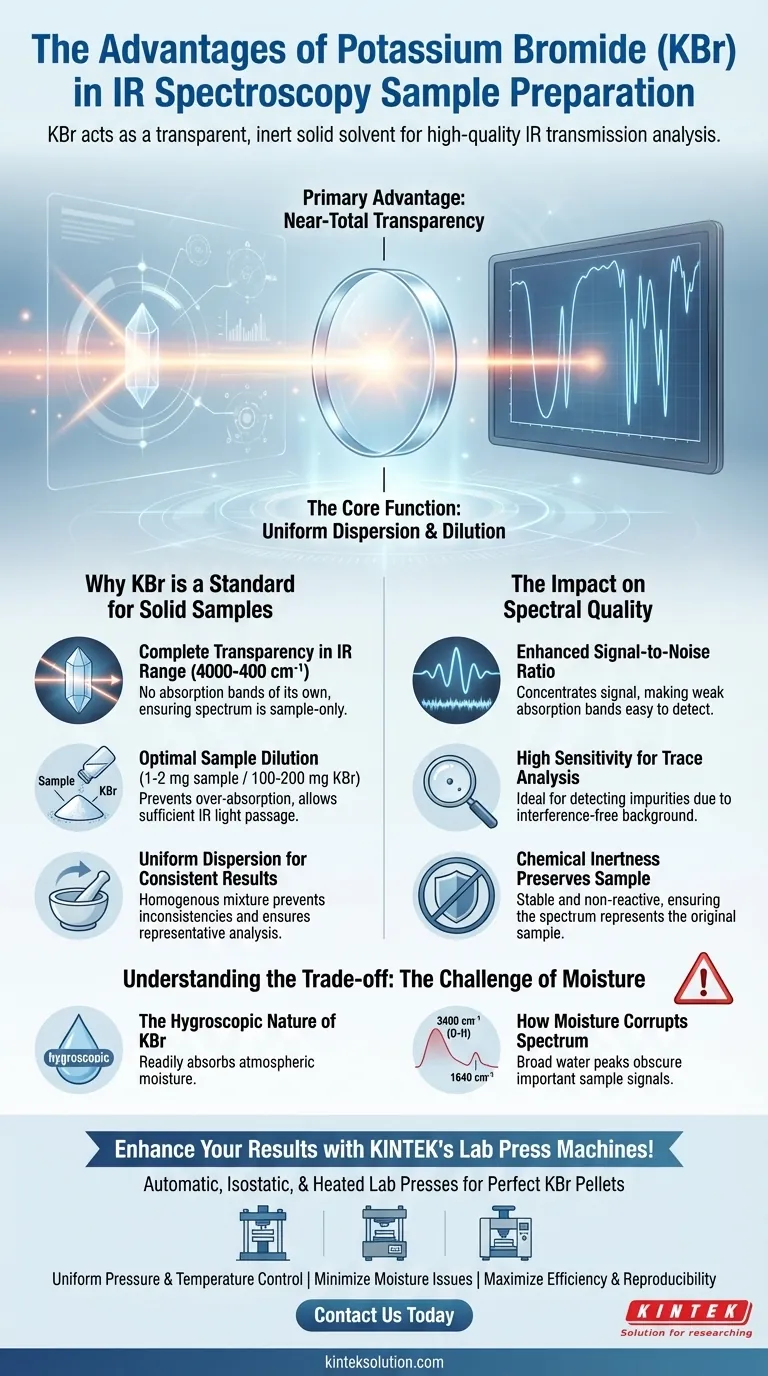
Visual Guide
Related Products
- Lab Infrared Press Mold for No Demolding
- Laboratory Hydraulic Press 2T Lab Pellet Press for KBR FTIR
- XRF KBR Plastic Ring Lab Powder Pellet Pressing Mold for FTIR
- XRF KBR Steel Ring Lab Powder Pellet Pressing Mold for FTIR
- Automatic Laboratory Hydraulic Press for XRF and KBR Pellet Pressing
People Also Ask
- What is the purpose of incorporating cartridge heaters into a lab press mold for MLCC block compression? Optimize Results
- What is the function of a pressing tool in thermoplastic panels? Master Precision Shaping & Fusion Bonding
- Why is precise cooling management of the lab press mold necessary? Protect Core Integrity in Thermoforming
- What role do precision positioning and pressure molds play in single-lap joints? Ensure 100% Data Integrity
- Why is a lab press used for KBr pellet preparation in polyurethane FTIR? Achieve High-Resolution Spectral Data