
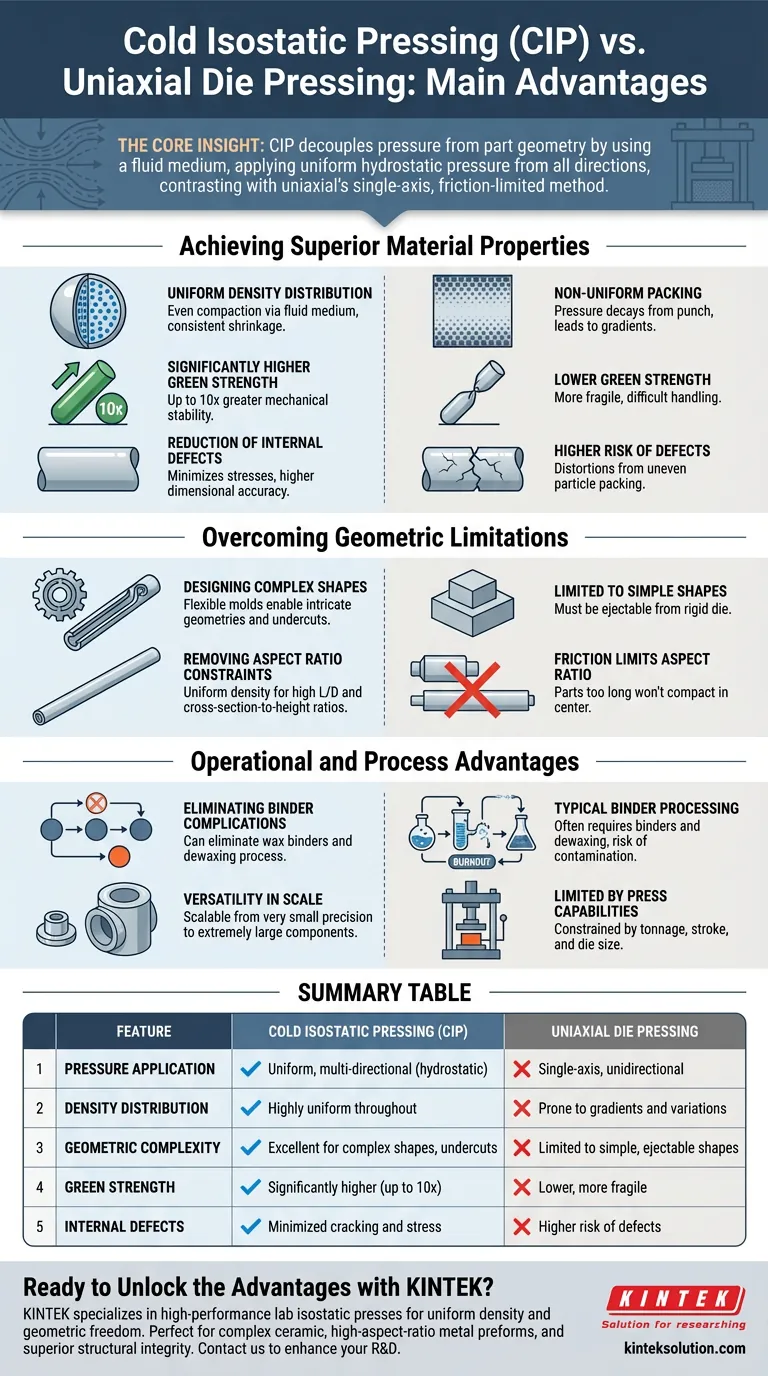
Cold Isostatic Pressing (CIP) distinguishes itself from uniaxial die pressing primarily through its ability to apply uniform hydrostatic pressure from all directions simultaneously. While uniaxial pressing is restricted to a single axis using rigid molds, CIP utilizes flexible elastomeric molds and a fluid medium to produce components with superior density uniformity, complex geometries, and significantly reduced structural defects.
The Core Insight: The fundamental advantage of CIP is the decoupling of pressure application from part geometry. By eliminating the friction and directional limitations of rigid die compaction, CIP enables the production of high-aspect-ratio parts with consistent structural integrity that uniaxial methods physically cannot achieve.
Achieving Superior Material Properties
Uniform Density Distribution
The most critical technical advantage of CIP is the elimination of density gradients. Because pressure is applied via a fluid medium (such as oil or water) surrounding a flexible mold, the force is exerted equally on every surface of the part.
In contrast, uniaxial pressing often results in non-uniform packing because pressure decays as it moves away from the punch. CIP ensures the material is compacted evenly throughout, leading to consistent shrinkage during sintering.
Significantly Higher Green Strength
Parts produced via CIP exhibit superior mechanical stability before sintering, known as "green strength."
References indicate that compacts made via CIP can possess green strengths up to 10 times greater than their die-compacted counterparts. This robustness makes handling and machining preforms significantly safer and easier prior to final sintering.
Reduction of Internal Defects
The multi-directional pressure application minimizes internal stresses that lead to failure.
Uniaxial pressing can cause distortions and cracking due to uneven particle packing. CIP significantly minimizes these issues, resulting in higher dimensional accuracy and fewer rejected parts due to structural structural defects.
Overcoming Geometric Limitations
Designing Complex Shapes
Uniaxial pressing is strictly limited to simple shapes with fixed dimensions due to the requirement of ejecting a part from a rigid die.
CIP utilizes flexible molds made of materials like urethane or rubber. This flexibility allows for the manufacturing of components with intricate geometries and undercuts that would be impossible to release from a rigid uniaxial die.
Removing Aspect Ratio Constraints
In uniaxial pressing, friction limits the length-to-diameter (L/D) and cross-section-to-height ratios; parts that are too long simply won't compact in the center.
CIP removes this limitation entirely. It enables the creation of parts with high aspect ratios, ensuring uniform density along the entire length of long rods, tubes, or complex preforms.
Operational and Process Advantages
Eliminating Binder Complications
CIP often simplifies the chemical processing of the material.
Specific applications of CIP allow for the elimination of wax binders. This consequently removes the need for a dewaxing process, streamlining the production cycle and reducing the risk of contamination or pore formation related to binder burnout.
Versatility in Scale
The process is highly scalable regarding component size.
CIP is capable of producing both very small precision parts and extremely large components that exceed the tonnage, stroke, or die capabilities of standard uniaxial hydraulic presses.
Understanding the Trade-offs
The Physics of Pressure Application
It is important to understand that the choice between these methods is a choice between isostatic and unidirectional force.
Uniaxial pressing applies force along a single axis, which creates friction against the die walls and results in density variations. CIP avoids this by using fluid mechanics to apply force perpendicular to every surface, ensuring the core of the part is as dense as the surface.
Making the Right Choice for Your Goal
To determine if Cold Isostatic Pressing is the correct solution for your manufacturing requirements, consider the following specific triggers:
- If your primary focus is Geometric Complexity: Choose CIP when your design features intricate shapes, undercuts, or non-symmetrical features that cannot be ejected from a rigid die.
- If your primary focus is Part Quality and Homogeneity: Choose CIP to achieve uniform density distribution and eliminate the risk of cracking or distortion during the sintering phase.
- If your primary focus is Component Dimensions: Choose CIP if you need to manufacture parts with high length-to-diameter ratios or exceptionally large sizes that defy standard die limitations.
Ultimately, CIP is the definitive choice when internal structural integrity and geometric freedom outrank the simplicity of the tooling.
Summary Table:
| Feature | Cold Isostatic Pressing (CIP) | Uniaxial Die Pressing |
|---|---|---|
| Pressure Application | Uniform, multi-directional (hydrostatic) | Single-axis, unidirectional |
| Density Distribution | Highly uniform throughout the part | Prone to gradients and variations |
| Geometric Complexity | Excellent for complex shapes, undercuts, and high aspect ratios | Limited to simple, easily ejected shapes |
| Green Strength | Significantly higher (up to 10x) | Lower, more fragile pre-sintering |
| Internal Defects | Minimized cracking and stress | Higher risk of defects from uneven packing |
Ready to unlock the advantages of Cold Isostatic Pressing for your laboratory?
KINTEK specializes in high-performance lab isostatic presses designed to deliver the uniform density and geometric freedom your advanced materials require. Whether you are developing complex ceramic components, high-aspect-ratio metal preforms, or any application demanding superior structural integrity, our expertise and equipment can help you achieve unparalleled results.
Contact us today to discuss how an isostatic press from KINTEK can enhance your R&D and production capabilities. Let's build the perfect solution for your lab's needs.
Get in touch with our experts now!
Visual Guide
Related Products
- Automatic Lab Cold Isostatic Pressing CIP Machine
- Electric Lab Cold Isostatic Press CIP Machine
- Electric Split Lab Cold Isostatic Pressing CIP Machine
- Manual Cold Isostatic Pressing CIP Machine Pellet Press
- Lab Isostatic Pressing Molds for Isostatic Molding
People Also Ask
- What are the key features of automated laboratory Cold Isostatic Press (CIP) systems? Achieve Precise, High-Pressure Powder Consolidation
- Why is an Isostatic Press (CIP) Necessary After Uniaxial Pressing? Achieve Transparency in Nd:Y2O3 Ceramics
- How does a Cold Isostatic Press (CIP) facilitate the preparation of CaO-doped silicon carbide (SiC) green bodies?
- How does a Cold Isostatic Press (CIP) increase Bi-2223/Ag current density? Boost Superconductivity with Uniform Pressure
- What is the primary function of a Cold Isostatic Press (CIP) in NASICON preparation? Achieve 96% Theoretical Density









