
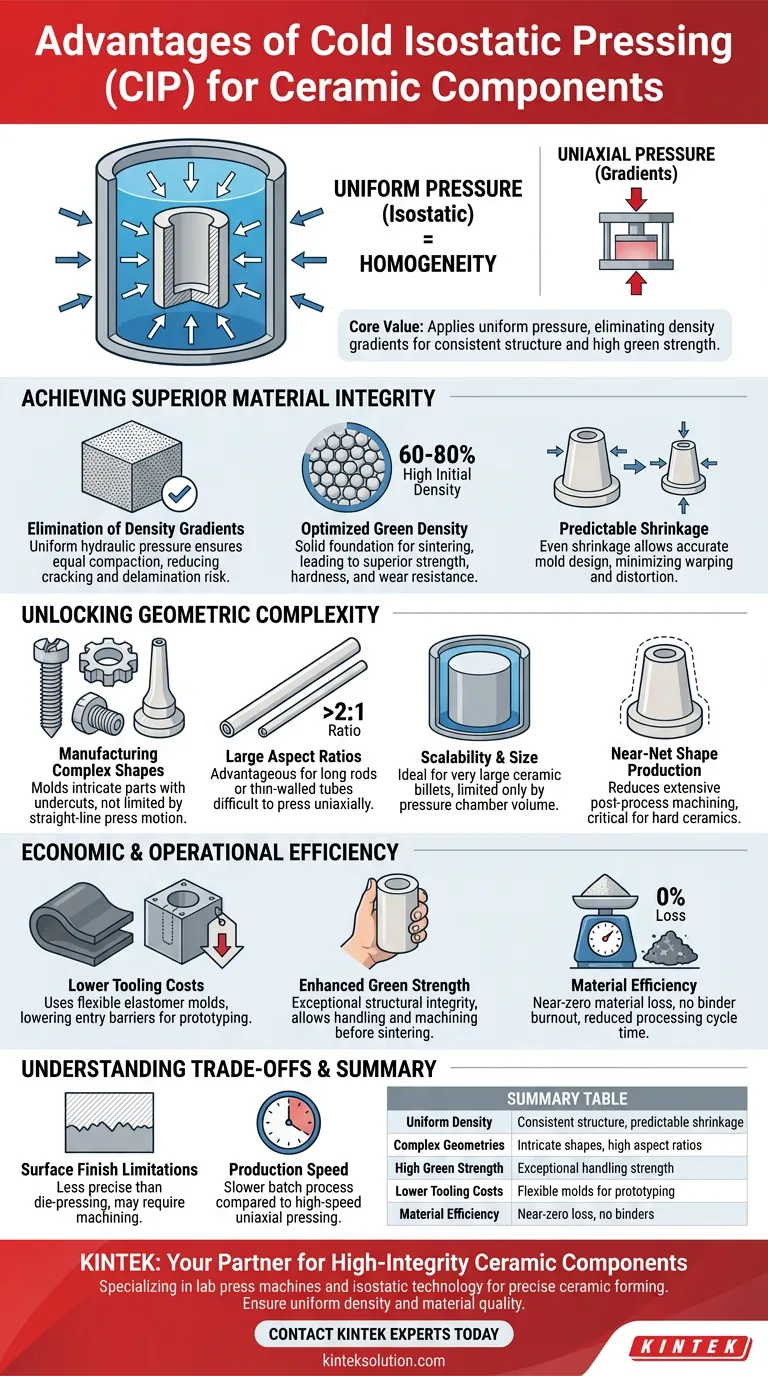
Cold Isostatic Pressing (CIP) offers a distinct advantage in manufacturing ceramic components by applying uniform pressure from all directions, rather than just one axis. This "isostatic" application eliminates the internal density gradients common in conventional pressing, resulting in parts with consistent structure, high green strength, and predictable behavior during sintering. It is particularly effective for producing large, complex, or high-aspect-ratio shapes that would crack or distort under uniaxial pressure.
The core value of CIP lies in homogeneity. By subjecting the material to equal pressure on all sides, it ensures that density is uniform throughout the entire part, which is the critical factor for preventing distortion and maximizing material strength after firing.
Achieving Superior Material Integrity
Elimination of Density Gradients
In traditional uniaxial pressing, friction creates uneven density, leading to weak spots. CIP applies hydraulic pressure uniformly through a fluid medium, ensuring every millimeter of the powder is compacted equally.
This uniformity eliminates the "pressing gradients" that often cause internal stresses. Consequently, the risk of cracking or delamination during the subsequent firing process is significantly reduced.
Optimized Green Density
CIP typically achieves a green density of 60% to 80% of the theoretical maximum. This high initial density provides a solid foundation for the sintering phase.
Because the particles are packed tightly and evenly, the final sintered component exhibits superior mechanical properties, including higher strength, hardness, and wear resistance.
Predictable Shrinkage
Ceramics shrink during sintering, and uneven shrinkage leads to warped parts. Because CIP creates a uniform density distribution, shrinkage occurs evenly in all directions.
This predictability allows engineers to design molds that accurately account for size reduction, ensuring the final component meets dimensional specifications with minimal distortion.
Unlocking Geometric Complexity
Manufacturing Complex Shapes
CIP is not restricted by the rigid straight-line motion of mechanical presses. It can effectively mold intricate shapes, such as tubes, ferrites for electronics, and components with undercuts.
It is specifically advantageous for parts with large aspect ratios (greater than 2:1), such as long rods or thin-walled tubes, which are difficult to press uniaxially without breaking.
Scalability and Size
The only limitation on part size is the volume of the pressure chamber. This makes CIP ideal for producing very large ceramic billets or preforms that exceed the tonnage capabilities of standard die presses.
Near-Net Shape Production
By forming parts that are close to their final geometry, CIP reduces the need for extensive post-process machining. This is critical when working with ceramics, which are difficult and expensive to machine once hardened.
Economic and Operational Efficiency
Lower Tooling Costs
CIP utilizes flexible molds (bags) made of elastomers rather than expensive, high-precision metal dies. This significantly lowers the barrier to entry for prototyping or small production runs.
Enhanced Green Strength
The intense pressure used in CIP results in a "green" (unsintered) body with exceptional structural integrity. These parts are strong enough to be handled, machined, or shaped further before the final sintering step, reducing breakage rates during processing.
Material Efficiency
The process avoids chemical reactions and melting, leading to near-zero material loss. Furthermore, because no binder burnout or extensive drying steps are typically required, the overall processing cycle time is reduced compared to wet forming methods.
Understanding the Trade-offs
Surface Finish Limitations
Because the molds are flexible, the surface finish of a CIP component is generally less precise than that of a die-pressed part. Manufacturers should anticipate the need for some surface machining if tight external tolerances are required.
Production Speed
While efficient for complex or large parts, CIP is generally a batch process. It may have slower cycle times compared to high-speed, automated uniaxial pressing used for simple, high-volume parts like tiles or small washers.
Making the Right Choice for Your Goal
To determine if Cold Isostatic Pressing is the correct solution for your application, consider your specific constraints:
- If your primary focus is complex geometry: Utilize CIP for parts with high aspect ratios, internal cavities, or irregular shapes that would suffer density variations in a rigid die.
- If your primary focus is material quality: Choose CIP to ensure uniform grain structure and high fatigue resistance in critical structural components.
- If your primary focus is prototyping: Leverage CIP's low tooling costs to test ceramic designs without investing in expensive hard tooling.
CIP is the definitive choice when internal structural uniformity is more critical than high-speed surface detailing.
Summary Table:
| Key Advantage | Description |
|---|---|
| Uniform Density | Eliminates internal gradients for consistent material structure and predictable shrinkage. |
| Complex Geometries | Enables production of intricate shapes, tubes, and parts with high aspect ratios. |
| High Green Strength | Provides exceptional handling strength before sintering, reducing breakage. |
| Lower Tooling Costs | Uses flexible molds, ideal for prototyping and small production runs. |
| Material Efficiency | Near-zero material loss with no binder burnout required. |
Need to produce high-integrity ceramic components with complex shapes?
KINTEK specializes in lab press machines, including advanced isostatic press technology, to serve your laboratory's precise ceramic forming needs. Our expertise ensures you achieve the uniform density and material quality critical for your application's success.
Contact our experts today to discuss how our CIP solutions can enhance your ceramic manufacturing process.
Visual Guide
Related Products
- Manual Cold Isostatic Pressing CIP Machine Pellet Press
- Automatic Lab Cold Isostatic Pressing CIP Machine
- Electric Split Lab Cold Isostatic Pressing CIP Machine
- Electric Lab Cold Isostatic Press CIP Machine
- Lab Isostatic Pressing Molds for Isostatic Molding
People Also Ask
- Why is Cold Isostatic Pressing (CIP) necessary for SBN ceramics? Achieve High-Density and Crack-Free Sintering
- What are the process advantages of using Cold Isostatic Pressing (CIP) for LSMO? Achieve Defect-Free Density
- Why is Cold Isostatic Pressing (CIP) applied after uniaxial pressing? Optimize Superconductor Precursor Density
- What types of equipment are available for cold isostatic pressing? Explore CIP Solutions for Labs and Production
- What are the technical advantages of cold isostatic pressing equipment compared to uniaxial compression equipment? Learn More!











