
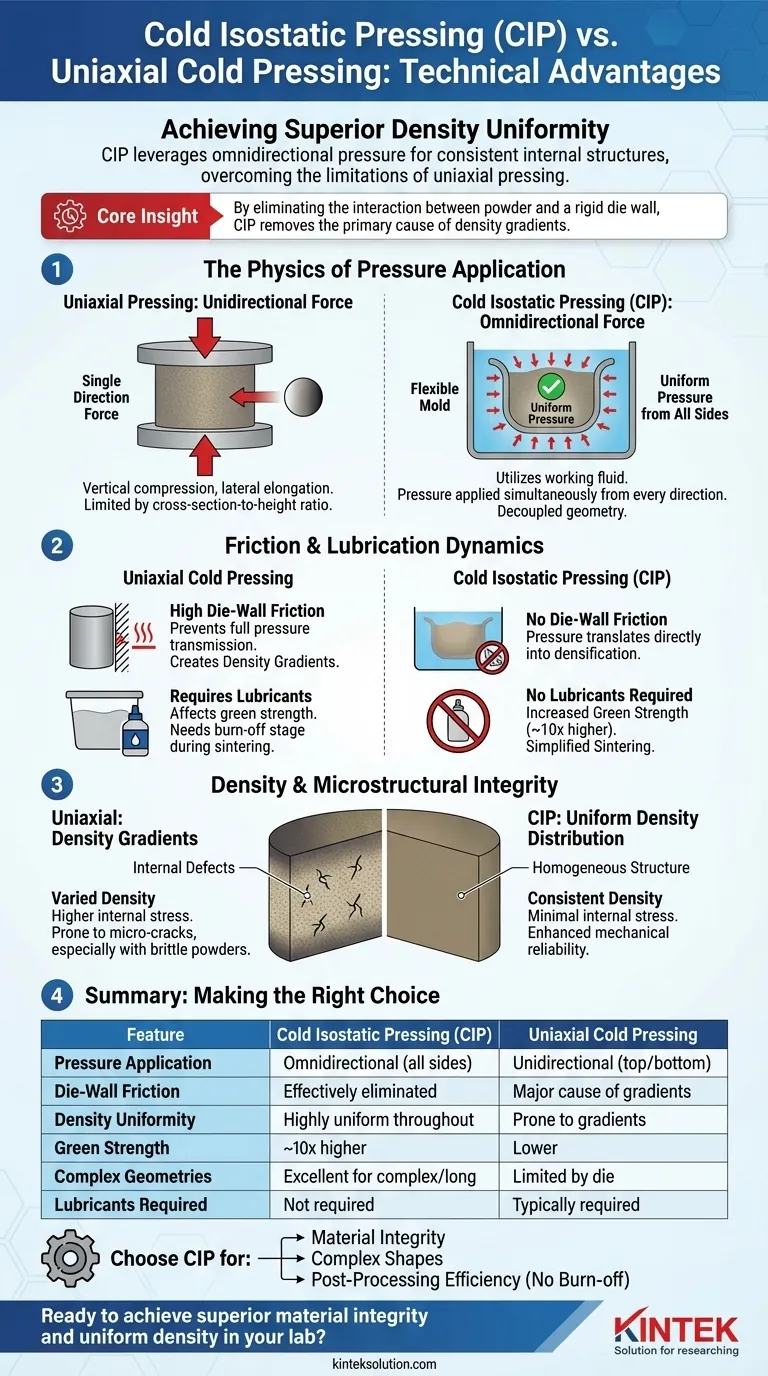
The primary technical advantage of cold isostatic pressing (CIP) is the achievement of superior density uniformity through omnidirectional pressure. Unlike uniaxial pressing, which applies force from a single direction, CIP utilizes a fluid medium to pressurize the component from all sides. This eliminates die-wall friction, resulting in a consistent internal structure, significantly higher green strength, and the ability to densify complex geometries without gradients.
Core Insight: The limitation of uniaxial pressing is not just mechanical force, but friction. By eliminating the interaction between the powder and a rigid die wall, CIP removes the primary cause of density gradients. This allows for higher material integrity and removes the need for chemical lubricants, streamlining the subsequent sintering process.
The Physics of Pressure Application
Omnidirectional vs. Unidirectional Force
Uniaxial pressing relies on rigid upper and lower dies to compress powder in a single vertical direction. This often leads to vertical compression and lateral elongation, potentially causing deformation in delicate materials like polymer films.
In contrast, CIP utilizes a working fluid (typically water with a corrosion inhibitor) within a pressurized chamber. This fluid applies pressure uniformly to the sample from every direction simultaneously.
Decoupling Geometry from Density
Because pressure is applied evenly across the entire surface, the cross-section-to-height ratio is not a limiting factor in CIP. Uniaxial pressing is constrained by how deep the die can go before pressure loss occurs. CIP allows for the compaction of complex shapes and long parts that would be impossible to fabricate with rigid dies.
Friction and Lubrication Dynamics
Eliminating Die-Wall Friction
In uniaxial pressing, friction between the powder and the rigid die wall is a major variable. It prevents pressure from transmitting fully to the center of the part, creating a "density gradient" where the ends are dense but the center is porous.
CIP uses a flexible mold submerged in fluid. Consequently, die-wall friction is effectively absent. This absence allows the applied pressure to translate directly into densification rather than overcoming mechanical resistance at the surface.
Removing the Need for Lubricants
Uniaxial pressing requires lubricants to mitigate friction. CIP does not require these additives. This offers two distinct technical benefits:
- Increased Green Strength: Parts compacted via CIP exhibit green strengths approximately 10 times greater than those compacted in metal dies with lubricant.
- Simplified Sintering: Since no lubricant is added to the powder, the "burn-off" stage typically required during sintering is eliminated, removing a common source of processing defects.
Density and Microstructural Integrity
Uniform Density Distribution
The fundamental difference in pressure application results in a more homogeneous internal structure. While uniaxial parts often suffer from density variations, CIP provides uniform density throughout the component at a given compaction pressure.
Minimizing Internal Defects
Density gradients often lead to internal stresses. By ensuring uniform compaction, CIP produces components with lower internal stress. This is particularly advantageous for brittle or fine powders, as it minimizes the formation of micro-cracks and enhances the mechanical reliability of the finished part.
Understanding the Trade-offs
Process Complexity and Equipment
While CIP offers superior material properties, the references highlight that uniaxial pressing is a "common and straightforward" method. CIP introduces operational complexity, requiring vacuuming of samples, management of working fluids, and the use of high-pressure pumps and chambers.
Efficiency vs. Quality
Uniaxial pressing is often faster for simple shapes like discs. CIP is a more involved process reserved for when material uniformity, complex geometry, or high green strength are non-negotiable requirements.
Making the Right Choice for Your Goal
To select the correct method, evaluate your primary constraints:
- If your primary focus is simple geometry and speed: Uniaxial pressing provides a straightforward solution for basic shapes like electrode discs where minor density gradients may be acceptable.
- If your primary focus is material integrity and complex shapes: Cold Isostatic Pressing is required to achieve uniform density, eliminate micro-cracks, and process parts with high aspect ratios.
- If your primary focus is post-processing efficiency: Choose CIP to eliminate the lubricant burn-off stage and achieve significantly higher green strength for easier handling before sintering.
Ultimately, CIP is the superior choice when the mechanical reliability and internal uniformity of the component outweigh the need for a simple, low-maintenance equipment setup.
Summary Table:
| Feature | Cold Isostatic Pressing (CIP) | Uniaxial Cold Pressing |
|---|---|---|
| Pressure Application | Omnidirectional (from all sides) | Unidirectional (top and bottom) |
| Die-Wall Friction | Effectively eliminated | A major cause of density gradients |
| Density Uniformity | Highly uniform throughout the part | Prone to gradients (dense ends, porous center) |
| Green Strength | ~10x higher | Lower |
| Complex Geometries | Excellent for complex/long parts | Limited by die constraints |
| Lubricants Required | Not required | Typically required |
Ready to achieve superior material integrity and uniform density in your lab?
If your research or production demands high green strength, complex geometries, and flawless material uniformity, KINTEK's advanced Cold Isostatic Presses are the solution. Our lab presses are designed to eliminate the limitations of uniaxial pressing, providing the omnidirectional pressure needed for reliable, high-performance components.
KINTEK specializes in lab press machines (including automatic lab presses, isostatic presses, and heated lab presses), serving the precise needs of laboratories worldwide.
Contact us today to discuss how our CIP technology can streamline your process and enhance your results.
Visual Guide
Related Products
- Electric Lab Cold Isostatic Press CIP Machine
- Electric Split Lab Cold Isostatic Pressing CIP Machine
- Automatic Lab Cold Isostatic Pressing CIP Machine
- Manual Cold Isostatic Pressing CIP Machine Pellet Press
- Warm Isostatic Press for Solid State Battery Research Warm Isostatic Press
People Also Ask
- What role do electric lab cold isostatic presses play in industrial contexts? Bridge R&D and Manufacturing with Precision
- What are the applications of electric lab cold isostatic presses in research settings? Advance Material R&D with High-Pressure CIPs
- How does electrical Cold Isostatic Pressing (CIP) contribute to cost savings? Unlock Efficiency and Reduce Expenses
- What are some research applications of electric lab CIPs? Unlock Uniform Powder Densification for Advanced Materials
- What are the characteristics of standard off-the-shelf electric lab CIP solutions? Achieve Immediate, Cost-Effective Processing















