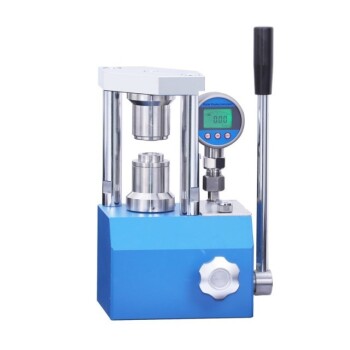
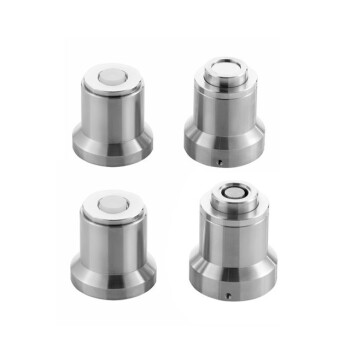
Stainless steel punches act as the functional heart of the in situ observation apparatus. They simultaneously serve as current collectors to facilitate electrochemical reactions and as mechanical transmitters to maintain the physical structural integrity of the battery cell.
Core Takeaway Reliable analysis of all-solid-state lithium-sulfur batteries requires a setup that ensures zero compromise between electrical flow and physical stability. The stainless steel punch solves this by bridging the gap between the external electrochemical workstation and the internal requirement for high-pressure clamping.
The Intersection of Electrical and Mechanical Requirements
In solid-state battery research, the interface between components is the most critical variable. The stainless steel punches are engineered to manage this interface through two distinct but interdependent functions.
Role 1: The Electrical Pathway
The first primary function of the punch is to act as a current collector.
In this capacity, the punch serves as the direct link between the internal battery components and the external electrochemical workstation. It allows for the precise execution of charge-discharge cycles during observation. By utilizing the inherent conductivity of stainless steel, the punch ensures the electrochemical data collected is accurate and free from significant resistance interference.
Role 2: Mechanical Stability and Pressure
The second function is the transmission of mechanical pressure.
All-solid-state batteries rely heavily on tight contact between layers to function correctly. The punches transmit force from fastening bolts directly onto the battery components. This "clamping" action is vital for ensuring stable interface contact throughout the reaction, preventing the delamination or gapping that can occur during the volume changes associated with Lithium-Sulfur chemistry.
Understanding the Trade-offs
While the dual-role design is efficient, it introduces specific challenges that must be managed.
The Dependency of Conductivity on Pressure
The effectiveness of the punch as a current collector is directly tied to its mechanical role. If the mechanical pressure is insufficient, the electrical contact resistance will spike, rendering the data noisy or unusable. Conversely, the punch must be robust enough to withstand the intense axial pressure required to densify the layers without deforming, as deformation would compromise the geometry of the cell.
Making the Right Choice for Your Goal
When designing or utilizing an in situ observation setup, consider which aspect of the punch's role is most critical for your specific experiment.
- If your primary focus is Electrochemical Impedance: Prioritize the surface finish and conductivity of the punch to minimize contact resistance, ensuring the pressure applied is sufficient to lower interfacial impedance.
- If your primary focus is Visualizing Volume Expansion: Ensure the punch assembly is mechanically rigid and the fastening bolts are torqued precisely to maintain constant pressure despite the internal expansion of the sulfur cathode.
The stainless steel punch is not just a passive tool; it is the active guarantor of both signal quality and structural fidelity in your experiment.
Summary Table:
| Feature | Function as Current Collector | Function as Mechanical Transmitter |
|---|---|---|
| Primary Goal | Facilitates electrical flow & data collection | Maintains structural integrity & layer contact |
| Key Component | Connects cell to electrochemical workstation | Transmits force from fastening bolts to layers |
| Impact on Data | Minimizes resistance for accurate cycles | Prevents delamination during volume changes |
| Success Factor | High conductivity and surface finish | Mechanical rigidity under high axial pressure |
Elevate Your Battery Research with KINTEK Precision
Are you looking to achieve flawless data in your solid-state battery experiments? KINTEK specializes in comprehensive laboratory pressing solutions, offering a wide range of manual, automatic, heated, and multifunctional models, as well as glovebox-compatible cold and warm isostatic presses.
Whether you are studying interface impedance or visualizing volume expansion in lithium-sulfur batteries, our high-performance equipment provides the stable pressure and reliable conductivity your research demands. Don't let mechanical instability compromise your results.
Contact KINTEK today to find the perfect pressing solution for your lab!
References
- Yuta Kimura, Saneyuki Ohno. Unraveling Asymmetric Macroscopic Reaction Dynamics in Solid‐State Li–S Batteries During Charge–Discharge Cycles: Visualizing Ionic Transport Limitations with <i>Operando</i> X‐Ray Computed Tomography. DOI: 10.1002/aenm.202503863
This article is also based on technical information from Kintek Solution Knowledge Base .
Related Products
- Laboratory Hydraulic Press Lab Pellet Press Machine for Glove Box
- Manual Laboratory Hydraulic Press Lab Pellet Press
- Laboratory Hydraulic Split Electric Lab Pellet Press
- Split Automatic Heated Hydraulic Press Machine with Heated Plates
- Lab Cylindrical Press Mold for Laboratory Use
People Also Ask
- How does a laboratory hydraulic press contribute to the preparation of Li3-3xScxSb samples? Optimize Ionic Conductivity
- What is the function of a laboratory hydraulic press in FT-IR of curcumin-coated MWCNTs? Achieve Optical Clarity.
- Why is a laboratory hydraulic press required for compression molding boron-siloxane? Solve High-Loading Density Challenges
- What role does a laboratory hydraulic press play in reaction pellets? Optimizing Lunar Soil and Metal Fuel Density
- What role does a laboratory hydraulic press play in the preparation of piezoelectric ceramic discs for DC-PG? | KINTEK