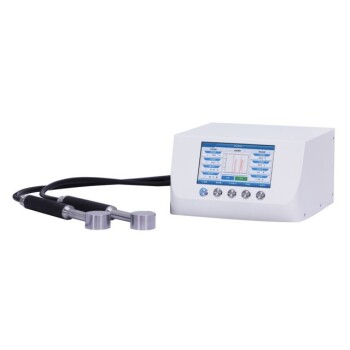
The primary technical advantages of using stainless steel cooling plates in the molding of PEO-based electrolyte films are superior dimensional precision and efficient thermal management. Specifically, these plates provide the ultra-flat surface necessary for controlling film thickness, while their thermal conductivity enables rapid cooling to prevent adhesion and preserve the sample's structural integrity.
Successful fabrication of 98[70PEO:30NaCl] + 2PVP films requires balancing mechanical precision with thermal control. Stainless steel plates serve as the critical interface that ensures both surface flatness and the rapid heat dissipation needed to cleanly release the delicate polymer film.
Precision Control of Film Geometry
Achieving Uniform Thickness
For solid polymer electrolytes, consistent thickness is vital for reliable electrochemical performance.
Stainless steel plates provide an extremely flat surface that resists deformation under the high pressure of the hot-pressing process.
This rigidity ensures that the gap between the plates remains constant, allowing you to maintain tight thickness tolerances across the entire film area.
Optimizing Surface Finish
The surface quality of your electrolyte film is a direct reflection of the mold it is pressed against.
Using polished stainless steel transfers a smooth finish to the PEO/PVP composite.
This smoothness is essential for maximizing contact area at the electrode-electrolyte interface in subsequent cell assembly steps.
Managing Thermal Dynamics
Rapid Cooling and Setting
The cooling phase is just as critical as the heating phase in hot-pressing.
Stainless steel possesses high thermal conductivity, which facilitates the rapid dissipation of heat once the heating cycle is complete.
This capability allows the molten polymer matrix to "set" quickly, locking in the dimensional properties achieved during the pressing stage.
Preventing Mold Adhesion
One of the most common failure modes in film fabrication is the polymer sticking to the hot plates.
The rapid cooling facilitated by stainless steel effectively prevents the PEO-based polymer from adhering to the mold surface.
By lowering the temperature of the interface quickly, you reduce the tackiness of the polymer before the pressure is released.
Ensuring Sample Integrity
Removing a thin, flexible film from a press without tearing it is a delicate operation.
Because the stainless steel plates prevent sticking and harden the film quickly, the physical integrity of the sample is preserved during removal.
This leads to higher yields of usable film and reduces waste caused by tearing or warping during extraction.
Understanding the Trade-offs
Thermal Inertia Considerations
While stainless steel conducts heat well, it also has significant thermal mass compared to thinner or lighter materials.
This means that while it maintains temperature stability well, it may require slightly longer to heat up initially compared to materials like aluminum.
Surface Maintenance is Critical
The advantage of a high-quality surface finish is lost if the plates become damaged.
Stainless steel is durable, but any scratches or dents on the plate will be permanently embossed onto every subsequent film you press.
You must handle these plates with care, ensuring they are perfectly clean and free of particulate matter before every pressing cycle.
Achieving Consistent Film Fabrication
If your primary focus is Dimensional Accuracy:
- Prioritize the rigidity and flatness of stainless steel to ensure uniform ionic conductivity across the film surface.
If your primary focus is Process Efficiency:
- Leverage the thermal conductivity of the plates to shorten cooling cycles and ensure quick, non-stick release of the finished films.
By utilizing stainless steel cooling plates, you transform the variable risks of hot-pressing into a controlled, repeatable manufacturing step.
Summary Table:
| Feature | Technical Advantage | Benefit to PEO/PVP Films |
|---|---|---|
| Surface Flatness | High Rigidity | Ensures uniform film thickness and ionic conductivity |
| Thermal Conductivity | Rapid Heat Dissipation | Enables quick 'setting' and prevents polymer adhesion |
| Surface Finish | Polished Mirror Effect | Maximizes contact area for electrode-electrolyte interface |
| Material Durability | Resistance to Deformation | Maintains long-term precision during high-pressure pressing |
Elevate Your Battery Research with KINTEK Precision
Consistency is the backbone of electrochemical performance. KINTEK specializes in comprehensive laboratory pressing solutions designed to meet the rigorous demands of material science. Whether you are developing solid polymer electrolytes or advanced thin films, our range of manual, automatic, heated, and multifunctional presses—including glovebox-compatible and isostatic models—provides the thermal control and mechanical precision your research requires.
Why choose KINTEK?
- Superior Thermal Management: Optimize cooling cycles for non-stick film release.
- Unmatched Precision: Achieve uniform thickness across every sample.
- Versatile Solutions: From battery research to cold and warm isostatic pressing.
Ready to transform your film fabrication process? Contact KINTEK today to find the perfect pressing solution for your lab!
References
- Angesh Chandra, Archana Chandra. Thermal Effects on Ionic Transport and Solid-State Battery Design with a New Blended Polymer Electrolyte: 98[70PEO:30NaCl] +2PVP. DOI: 10.13005/msri/220205
This article is also based on technical information from Kintek Solution Knowledge Base .
Related Products
- Lab Double Plate Heating Mold for Laboratory Use
- Infrared Heating Quantitative Flat Plate Mold for Precise Temperature Control
- Split Automatic Heated Hydraulic Press Machine with Heated Plates
- Automatic High Temperature Heated Hydraulic Press Machine with Heated Plates for Lab
- Automatic Heated Hydraulic Press Machine with Heated Plates for Laboratory
People Also Ask
- How does the geometry of laboratory molds influence mycelium-based composites? Optimize Density and Strength
- Why are precision laboratory molds essential for forming basalt-reinforced lightweight concrete specimens?
- Why are high-precision laboratory molds and specific compaction processes required? Ensure Data Integrity in Soil Research
- Why is low-temperature pre-drying on a laboratory hot plate necessary? Stabilize Silver Ink for Better Conductivity
- How is a laboratory hot plate utilized in Li-Si alloy electrode preparation? Achieve High-Activity Battery Materials