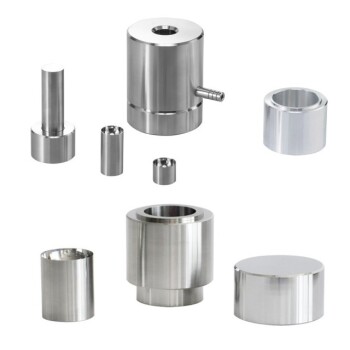
High-precision molds are an absolute necessity for ensuring uniform pressure distribution and exact dimensional control during the fabrication of Metal-Organic Framework (MOF)-polymer composite electrolytes. By providing a fixed, rigorous geometric constraint, these molds allow for the production of electrolyte bodies that are structurally homogeneous and free from critical physical inconsistencies.
The primary function of a high-precision mold goes beyond simple shaping; it acts as a stabilizing mechanism that prevents density gradients and micro-cracks, which are the root causes of failure in high-performance batteries.
Achieving Structural Integrity
Preventing Physical Defects
The pressing or casting process is the most vulnerable stage in electrolyte fabrication. Without the confinement of a high-precision mold, the material is susceptible to uneven thickness and surface irregularities.
A precision mold ensures that the force applied—whether through a laboratory press or isostatic means—is transmitted uniformly across the entire sample. This uniformity is the only way to prevent the formation of physical defects like micro-cracks.
Eliminating Density Gradients
A common failure point in composite electrolytes is a variation in internal density. If the pressure is not applied evenly, some areas of the electrolyte becomes denser than others.
High-precision molds constrain the powder or slurry, forcing the material to compact consistently. This results in a "green body" or film with a uniform internal structure, avoiding stress concentrations that could lead to mechanical failure later.
Enhancing Interfacial Tightness
For MOF-polymer composites, the bond between the host (MOF) and the guest (polymer) is vital.
Using a mold under stable pressure helps solidify the mixture into a dense film. This process eliminates internal micropores and enhances the interfacial tightness between the components, directly improving the material's mechanical strength.
The Link to Electrochemical Performance
Ensuring Uniform Ion Transport
Structural uniformity dictates electrochemical performance. If the electrolyte has varying thickness or density, ions will not move through it at a constant rate.
Defects created during the pressing stage result in non-uniform ion transport channels. The high-precision mold ensures the "road" for the ions is consistent throughout the entire volume of the electrolyte.
Mitigating Lithium Dendrite Growth
The most critical safety risk in these batteries is the growth of lithium dendrites—needle-like structures that can pierce the electrolyte and cause short circuits.
Dendrites thrive in areas of non-uniform ion flux. By preventing density gradients and ensuring uniform ion transport, high-precision molds effectively remove the conditions that induce dendrite growth, thereby extending the battery's cycle life.
Common Pitfalls to Avoid
Overlooking Mold Maintenance
Precision is not a permanent state. Metal molds, particularly those used for pressing powders, can suffer from wear or surface scratching over time.
Even minor imperfections on the mold surface can transfer to the electrolyte, creating stress risers. Regular inspection of the mold's surface finish is as important as the pressing parameters themselves.
Misinterpreting Pressure Distribution
It is a mistake to assume that high pressure alone solves density issues.
If the mold geometry is not precise, high pressure will simply lock in a density gradient more aggressively. The geometric constraint must be perfect to ensure the pressure leads to homogenization rather than stratification.
Making the Right Choice for Your Goal
To maximize the performance of your MOF-polymer composite electrolyte, align your fabrication approach with your specific performance targets:
- If your primary focus is Cycle Life and Safety: Prioritize mold precision to ensure absolute thickness uniformity, as this is the primary defense against lithium dendrite formation.
- If your primary focus is Mechanical Strength: Focus on the mold's ability to maintain high, stable pressure to maximize interfacial tightness and eliminate micropores.
The quality of your mold is the upper limit of your electrolyte's quality; no amount of chemical optimization can correct a physically defective structure.
Summary Table:
| Key Benefit | Impact on Electrolyte | Performance Outcome |
|---|---|---|
| Dimensional Control | Uniform thickness and surface regularity | Consistent ion transport channels |
| Uniform Pressure | Elimination of density gradients | Prevention of structural stress and cracks |
| Interfacial Tightness | Enhanced MOF-polymer bonding | Higher mechanical strength and zero micropores |
| Structural Integrity | Prevention of physical defects | Mitigation of hazardous lithium dendrite growth |
Elevate Your Battery Research with KINTEK Precision Solutions
Don't let physical defects limit your chemical innovation. KINTEK specializes in comprehensive laboratory pressing solutions designed for high-stakes material science. Whether you are developing next-generation MOF-polymer composites or advanced solid-state batteries, our equipment ensures the structural integrity your research demands.
Our value to your laboratory:
- Precision Tooling: High-tolerance molds designed to eliminate density gradients.
- Versatile Pressing: A full range of manual, automatic, and heated models for any scale.
- Advanced Isostatic Options: Cold and warm isostatic presses for perfectly uniform compaction.
- Specialized Environments: Glovebox-compatible models for moisture-sensitive electrolyte fabrication.
Ready to achieve flawless electrolyte structures? Contact us today to find your perfect pressing solution!
References
- Tao Chen. Enhancing Solid-State Li-Ion Batteries with MOF–Polymer Composite Electrolytes—Effect Mechanisms and Interface Engineering. DOI: 10.3390/gels11120946
This article is also based on technical information from Kintek Solution Knowledge Base .
Related Products
- Lab Polygon Press Mold
- Infrared Heating Quantitative Flat Plate Mold for Precise Temperature Control
- Special Shape Lab Press Mold for Laboratory Applications
- Lab Round Bidirectional Press Mold
- Lab Button Battery Tablet Press Sealing Mold
People Also Ask
- What is the purpose of incorporating cartridge heaters into a lab press mold for MLCC block compression? Optimize Results
- How do the design and geometric precision of pressing molds and mandrels affect the quality of PTFE composite samples?
- What role do precision positioning and pressure molds play in single-lap joints? Ensure 100% Data Integrity
- What are the requirements for pressing molds when using SSCG? Key Materials for Complex Single Crystal Production
- How do industrial-grade pressure molds affect zinc metal pouch cells? Maximize Energy Density & Performance