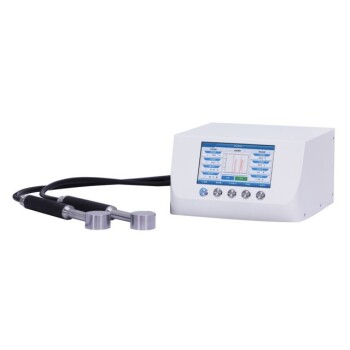
High-precision thermal control is mandatory to ensure the complete and uniform dissolution of amphiphilic polymers, such as PSar-PLLA. By maintaining a stable temperature of approximately 70 °C, the module facilitates the creation of a truly homogeneous solution. This step is the foundational requirement for generating consistent nanofiber coatings necessary for advanced cell culture applications.
The uniformity of the polymer solution directly dictates the quality of the final nanofiber film; without precise heating, the scaffold cannot support the specific adhesion and differentiation requirements of liver organoids.
The Science of Polymer Dissolution
Overcoming Solubility Barriers
Amphiphilic polymers present unique challenges when introduced to solvents. A high-precision heating module provides the necessary thermal energy to break down polymer particles completely.
The Necessity of Thermal Stability
It is not enough to simply warm the solution; the temperature must be held stable, typically at 70 °C. This precision prevents temperature gradients that could lead to uneven dissolving rates or partial separation.
Impact on Biological Performance
Creating a Consistent Nanofiber Film
The physical quality of the coating on culture plates is determined by the homogeneity of the precursor solution. A uniform solution ensures that the resulting nanofiber film is consistent across the entire surface.
Facilitating Organoid Development
The consistency of the film is not merely aesthetic; it is functional. Liver organoids require a specific, uniform surface structure to adhere properly to the scaffold.
Driving Cellular Differentiation
Beyond simple adhesion, the quality of the nanofiber coating influences how cells behave. A consistent scaffold environment is critical for triggering the correct differentiation pathways in liver organoids.
Risks of Inadequate Thermal Control
Heterogeneous Solutions
If the heating is imprecise or fluctuates, polymer particles may not dissolve completely. This results in a heterogeneous mixture containing undissolved solids, which compromises the integrity of the coating.
Unreliable Biological Data
Variations in the nanofiber film lead to variations in cell response. If the scaffold is inconsistent due to poor heating, data regarding organoid growth and differentiation becomes unreliable and difficult to reproduce.
Making the Right Choice for Your Goal
To ensure the success of your nanofiber coatings, consider the following based on your specific objectives:
- If your primary focus is Solution Chemistry: Prioritize equipment that maintains a strict 70 °C to guarantee a homogeneous mixture free of undissolved particles.
- If your primary focus is Tissue Engineering: Focus on solution uniformity to create reliable scaffolds that support consistent liver organoid adhesion and differentiation.
Precision at the heating stage is the invisible variable that secures the validity of your biological results.
Summary Table:
| Feature | Requirement | Impact on Final Coating |
|---|---|---|
| Temperature Stability | Constant 70 °C | Prevents undissolved particles and gradients |
| Solution Homogeneity | High-Precision Dissolution | Ensures uniform nanofiber film thickness |
| Scaffold Integrity | Consistent Surface Structure | Supports reliable organoid adhesion and growth |
| Biological Reliability | Thermal Precision | Guarantees reproducible cellular differentiation data |
Elevate Your Nanofiber Research with KINTEK Precision
Achieving the perfect 3D nanofiber coating requires more than just heat; it requires absolute thermal stability. KINTEK specializes in comprehensive laboratory solutions, offering the high-precision heating and pressing equipment necessary for advanced battery research and tissue engineering applications.
Whether you need manual, automatic, or specialized glovebox-compatible models, our technology ensures your amphiphilic polymers dissolve perfectly every time. Don't let thermal fluctuations compromise your liver organoid differentiation.
Contact KINTEK today to find your precision solution
References
- Yanran Tong, Hiroyuki Mizuguchi. Efficient hepatocyte differentiation of primary human hepatocyte-derived organoids using three dimensional nanofibers (HYDROX) and their possible application in hepatotoxicity research. DOI: 10.1038/s41598-024-61544-y
This article is also based on technical information from Kintek Solution Knowledge Base .
Related Products
- Lab Double Plate Heating Mold for Laboratory Use
- Infrared Heating Quantitative Flat Plate Mold for Precise Temperature Control
- Cylindrical Lab Electric Heating Press Mold for Laboratory Use
- Automatic Heated Hydraulic Press Machine with Heated Plates for Laboratory
- Automatic High Temperature Heated Hydraulic Press Machine with Heated Plates for Lab
People Also Ask
- How does the geometry of laboratory molds influence mycelium-based composites? Optimize Density and Strength
- Why are precision laboratory molds essential for forming basalt-reinforced lightweight concrete specimens?
- Why are high-precision laboratory molds and specific compaction processes required? Ensure Data Integrity in Soil Research
- What is the purpose of using a laboratory hot plate and weight pressing? Mastering Cellulose Filament Bond Strength
- How is a laboratory hot plate utilized in Li-Si alloy electrode preparation? Achieve High-Activity Battery Materials