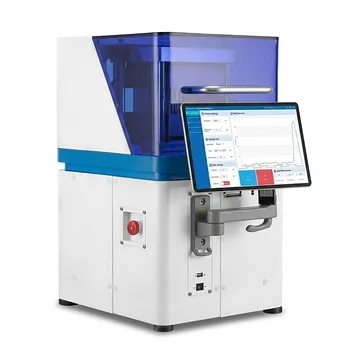
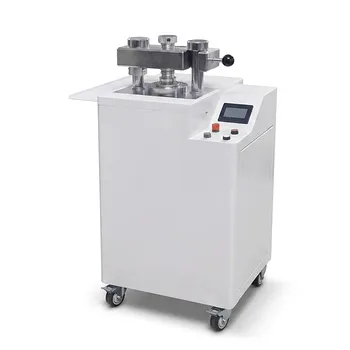
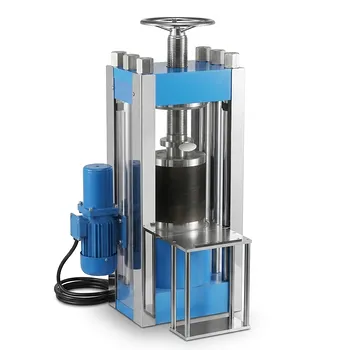
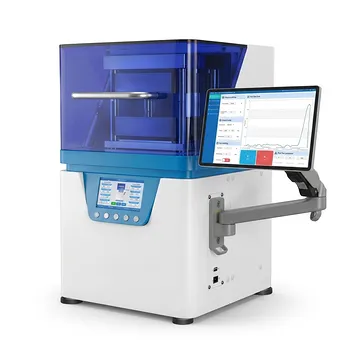
Applying ultra-high pressure during the fabrication of sulfide solid-state battery electrodes is essential to achieve the density required for efficient ion transport. A laboratory hydraulic press provides the necessary force—often exceeding 375 MPa—to exploit the unique mechanical ductility of sulfide electrolytes, physically deforming the particles until they fuse into a dense, low-resistance network.
Core Takeaway: High-pressure "cold pressing" is the fundamental mechanism used to eliminate internal porosity and establish seamless interfacial contact between sulfide electrolytes and active materials, ensuring high ionic conductivity without the need for high-temperature sintering.
Leveraging Mechanical Ductility for Densification
The Role of Plastic Deformation
Unlike oxide-based electrolytes which are rigid and brittle, sulfide solid electrolytes possess high mechanical plasticity. When subjected to pressures like 375 MPa, these powder particles do not simply pack together; they undergo significant plastic deformation.
Encapsulation of Active Materials
The high pressure forces the ductile sulfide electrolyte to flow around and tightly encapsulate active material particles. This creates a continuous physical interface that is critical for the movement of ions and electrons during charge and discharge cycles.
Elimination of Internal Porosity
Microscopic pores act as barriers to ion flow and increase the battery's internal resistance. A hydraulic press provides the high-precision pressure control needed to rearrange powders and eliminate these voids, maximizing the material's compaction density.
Optimizing Electrochemical Performance
Reducing Interfacial and Grain Boundary Resistance
The ionic conductivity of sulfide electrolytes depends heavily on the quality of physical contact between particles. High pressure reduces grain boundary impedance by merging individual particles into a quasi-solid pellet, facilitating faster ion transport channels.
Suppressing Lithium Dendrite Growth
A highly densified electrode sheet, achieved through extreme pressure, creates a more uniform mechanical barrier. This structural integrity is vital for mitigating volume expansion and suppressing the growth of lithium dendrites that could otherwise cause short circuits.
Improving Volumetric Energy Density
By removing the "dead space" represented by air pockets, the hydraulic press increases the volumetric energy density of the electrode. This ensures that more active material can be packed into a smaller volume, which is a primary goal of solid-state battery design.
The Advantages of Cold Pressing
Avoiding High-Temperature Sintering
Sulfide materials are chemically sensitive and can decompose or release toxic hydrogen sulfide gas when heated. The use of a hydraulic press allows for "cold pressing" at room temperature, achieving ceramic-like density without the risks associated with thermal processing.
Maintaining Chemical Stability
High-temperature sintering often leads to unwanted side reactions between the electrolyte and the active materials. Mechanical pressing at high MPa levels preserves the chemical identity of the components while still establishing the necessary physical bonds for electrochemical stability.
Understanding the Trade-offs
Equipment Limitations and Safety
Applying pressures as high as 375 MPa to 675 MPa requires specialized laboratory equipment and robust pellet dies. Using inferior molds can lead to mechanical failure or uneven pressure distribution, resulting in "gradient density" where the center of the pellet is denser than the edges.
Risk of Microcracking
While high pressure is necessary, excessive or unevenly applied force can lead to internal stress concentration. If the pressure is released too quickly or applied inconsistently, it can cause microcracks in the electrode sheet, compromising its long-term mechanical and electrochemical integrity.
How to Apply This to Your Project
Recommendations Based on Research Goals
- If your primary focus is maximizing ionic conductivity: Use a hydraulic press to apply pressures near the upper limit (e.g., 600+ MPa) to eliminate grain boundary resistance entirely.
- If your primary focus is preventing electrode cracking: Ensure the hydraulic press offers slow-release pressure valves to allow the internal stresses of the sulfide material to stabilize during decompression.
- If your primary focus is high-throughput testing: Standardize your molding process at 375-400 MPa to ensure consistent, repeatable density across all test samples for accurate data comparison.
Ultimately, the laboratory hydraulic press serves as the bridge between raw powder materials and a high-performance, functionally dense solid-state battery component.
Summary Table:
| Process Feature | Impact on Sulfide Electrolyte | Battery Performance Benefit |
|---|---|---|
| Plastic Deformation | Eliminates pores; encapsulates active materials | Creates seamless ion/electron transport |
| Cold Pressing | Achieves density without high-heat sintering | Preserves chemical stability and safety |
| High Pressurization | Minimizes grain boundary resistance | Increases volumetric energy density |
| Uniform Compression | Suppresses lithium dendrite growth | Enhances structural integrity and lifespan |
Optimize Your Solid-State Battery Research with KINTEK
Achieving the perfect 375 MPa density requires precision and reliability. KINTEK specializes in comprehensive laboratory pressing solutions tailored for advanced material science. We offer a wide range of equipment, including:
- Manual & Automatic Hydraulic Presses for precise pressure control.
- Heated & Multifunctional Models for varied experimental conditions.
- Glovebox-Compatible Solutions for moisture-sensitive sulfide electrolytes.
- Cold and Warm Isostatic Presses (CIP/WIP) for uniform material compaction.
Ready to enhance your electrode fabrication and ensure high ionic conductivity? Our expert team is here to help you select the ideal pressing system for your battery research needs.
Contact KINTEK today to discover our laboratory pressing solutions!
References
- Nikolaos Papadopoulos, Volker Knoblauch. Evolution, Collapse, and Recovery of Electronically Conductive Networks in Sulfide‐Based All‐Solid‐State Batteries Using Passivation‐Coated NMC and C65. DOI: 10.1002/batt.202500321
This article is also based on technical information from Kintek Solution Knowledge Base .
Related Products
- Warm Isostatic Press for Solid State Battery Research Warm Isostatic Press
- Laboratory Hydraulic Press Lab Pellet Press Button Battery Press
- Automatic Heated Hydraulic Lab Press Machine 200x200 Plate Size for Battery Research and Materials Science
- Automatic XRF Pellet Press for Laboratory Spectrometry Sample Preparation
- Automatic Laboratory Hydraulic Press for XRF and KBR Pellet Pressing
People Also Ask
- Why must composite cathodes be sealed in vacuum lamination bags for WIP? Ensure Battery Stability and Density
- How do sacrificial volume materials (SVM) maintain microchannels in isostatic pressing? Ensure Structural Integrity
- What is the function of elastic molds in warm isostatic pressing? Achieve Uniform Density in Composite Particles
- What are the advantages of using a Warm Isostatic Press (WIP) for batteries? Achieve Superior Interface Contact
- What is the function of hydraulic pressure in warm isostatic pressing? Achieve Uniform Material Density