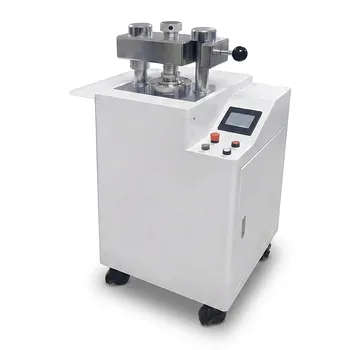
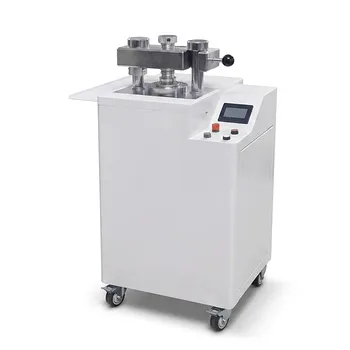
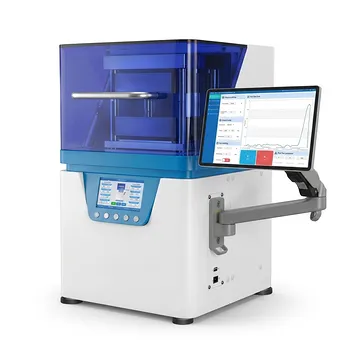
High-pressure molding is the definitive method for transforming loose cathode powders into dense, structurally sound pellets required for analytical testing. By applying significant force—often reaching 8 tons or pressures up to 360 MPa—a laboratory hydraulic press eliminates the voids between particles, ensuring the intimate physical contact necessary for ions and electrons to move freely across the material.
Core Takeaway: High-pressure molding is essential because it eliminates porosity and contact resistance, ensuring that conductivity measurements reflect the material's intrinsic electrochemical properties rather than the air gaps between loose powder grains.
Optimizing Particle Connectivity and Charge Transport
Eliminating Interstitial Voids
Loose powder contains significant air gaps that act as insulators, blocking the flow of ions and electrons. The hydraulic press applies uniaxial pressure to collapse these voids, creating a dense "green pellet" where particles are packed tightly together.
Promoting Plastic Deformation
Under high pressure, solid particles can undergo plastic deformation, essentially molding into one another. This physical bonding constructs continuous conduction paths, which are critical for reducing interface impedance and ensuring high ionic conductivity.
Minimizing Contact Resistance
Conductivity testing relies on the seamless transfer of energy between the material and the testing electrodes. High-pressure molding ensures optimal mechanical contact throughout the bulk of the sample, preventing "bottlenecks" that would otherwise result in inaccurately low conductivity readings.
Ensuring Geometric and Analytical Accuracy
Standardizing Sample Dimensions
For calculations in techniques like Electrochemical Impedance Spectroscopy (EIS), the exact surface area and thickness of the sample must be known. A hydraulic press and precision mold produce pellets with uniform dimensions (such as a standard 12 mm diameter), allowing for reproducible and mathematically sound data.
Achieving Uniform Density Distribution
Precise pressure control ensures the powder reaches a uniform density throughout the pellet. This eliminates "porosity gradients," ensuring that the sample’s internal structure is consistent and that experimental measurements can be reliably compared to theoretical models.
Preparation for Advanced Thermal Treatment
The "green pellet" produced by the press serves as the foundation for subsequent steps like high-temperature sintering. Without this initial densification, the material would lack the structural integrity to survive further processing or would fail to achieve the required final density during heat treatment.
Understanding the Trade-offs and Pitfalls
The Risk of Over-Compression
While high pressure is necessary, exceeding the material's structural limits can lead to micro-cracking or "capping," where the pellet delaminates upon release from the mold. It is vital to determine the specific pressure (e.g., 360 MPa vs. 0.8 MPa) that balances density with structural stability.
Managing Internal Stresses
Uniaxial pressing can sometimes create uneven stress distributions compared to cold isostatic pressing (CIP). If the pressure is applied too rapidly, air can become trapped within the pellet, leading to internal flaws that may compromise the accuracy of conductivity testing.
How to Apply This to Your Research
Making the Right Choice for Your Goal
- If your primary focus is intrinsic conductivity data: Utilize high uniaxial pressure (reaching 360 MPa) to ensure maximum particle-to-particle contact and the total elimination of porosity.
- If your primary focus is subsequent sintering performance: Focus on achieving a uniform "green density" to prevent warping or cracking during high-temperature ceramic processing.
- If your primary focus is reproducibility in EIS testing: Use a precision mold and a press with a digital pressure gauge to ensure every pellet has identical geometric dimensions and density.
By mastering the transition from powder to pellet through controlled high-pressure molding, researchers can ensure their electrochemical data is a true reflection of material innovation rather than a result of physical sample inconsistency.
Summary Table:
| Key Benefit | Mechanism | Impact on conductivity Testing |
|---|---|---|
| Porosity Elimination | Collapses interstitial voids/air gaps | Removes insulating barriers for free ion/electron flow |
| Enhanced Connectivity | Promotes plastic deformation & bonding | Reduces interface impedance and contact resistance |
| Geometric Precision | Standardized 12mm (or custom) molds | Enables accurate calculations for EIS and conductivity |
| Uniform Density | Precise pressure control (up to 360 MPa) | Ensures reproducible data & reliable theoretical comparison |
| Structural Stability | High-density "green pellet" formation | Prevents delamination or cracking during thermal treatment |
Optimize Your Battery Research with KINTEK Precision Pressing Solutions
Don't let physical sample inconsistencies compromise your electrochemical data. KINTEK specializes in comprehensive laboratory pressing solutions designed to help researchers achieve the ultra-dense, uniform pellets required for advanced battery material analysis.
Whether you are performing Electrochemical Impedance Spectroscopy (EIS) or investigating new cathode chemistries, our expertise ensures your material is prepared to its highest potential. Our product range includes:
- Manual & Automatic Hydraulic Presses for versatile lab use.
- Heated & Multifunctional Models for advanced material processing.
- Glovebox-Compatible Systems for air-sensitive battery research.
- Cold & Warm Isostatic Presses (CIP/WIP) for maximum density uniformity.
Ready to enhance your lab's efficiency and data accuracy? Contact KINTEK today to find your perfect pressing solution!
References
- Xinglong Chen, Shan Gao. Structure, Electrochemical, and Transport Properties of Li- and F-Modified P2-Na2/3Ni1/3Mn2/3O2 Cathode Materials for Na-Ion Batteries. DOI: 10.3390/coatings13030626
This article is also based on technical information from Kintek Solution Knowledge Base .
Related Products
- Automatic Laboratory Hydraulic Press for XRF and KBR Pellet Pressing
- Laboratory Hydraulic Press 2T Lab Pellet Press for KBR FTIR
- Laboratory Hydraulic Pellet Press for XRF KBR FTIR Lab Press
- Laboratory Hydraulic Press Lab Pellet Press Button Battery Press
- Manual Laboratory Hydraulic Pellet Press Lab Hydraulic Press
People Also Ask
- Why is pressing powder into a pellet critical before sintering? Ensure Dense, Conductive Solid-State Electrolytes
- What is the role of a laboratory pressure machine and KBr in FTIR? Master Sample Preparation for Flame Retardants
- What are the advantages of using a laboratory automatic hydraulic press for HEA green compact forming?
- What are the advantages of using a lab automatic hydraulic press for HEA green body molding? Ensure Material Integrity
- How does an automatic laboratory hydraulic press improve KBr pellet preparation? Achieve Precision IR Spectroscopy