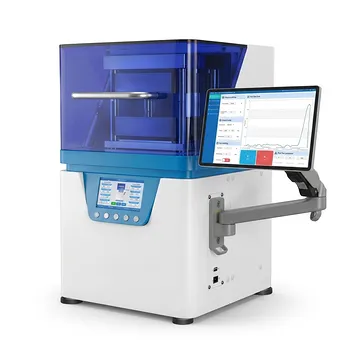
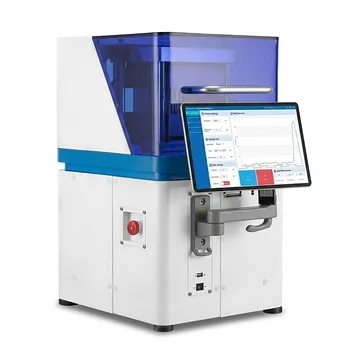
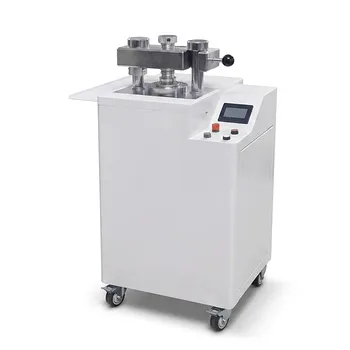
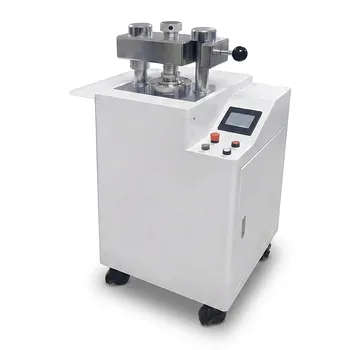
Automatic laboratory hydraulic presses provide the essential precision required for High-Entropy Alloy (HEA) synthesis. By delivering stable and uniform pressure, these machines compress mixed alloy powders into green bodies with consistent density and high structural integrity. This uniformity is critical because it minimizes internal density gradients and experimental errors, ensuring that the samples remain consistent through subsequent sintering or melting stages.
The core advantage of an automatic hydraulic press lies in its ability to transform powder molding from a manual variable into a controlled, repeatable process. This precision ensures uniform physical foundations for HEAs, which is vital for preventing defects during high-temperature densification.
Enhancing Structural Integrity and Density
Overcoming the Powder Bridging Effect
Laboratory hydraulic presses provide the adjustable pressure necessary to overcome the "bridging effect," where particles resist packing. By forcing a dense rearrangement of particles, the press ensures the green body has sufficient strength for handling without crumbling.
Maximizing Particle Contact Area
Applying precise pressure (often around 100 MPa) increases the contact area between the diverse metal powders in an HEA mix. This tight contact expels trapped air and creates a uniform microstructure, which is a prerequisite for successful subsequent processes like hot isostatic pressing.
Eliminating Internal Density Gradients
Manual pressing often results in "soft spots" or uneven density within a single sample. An automatic press ensures the pressure is distributed evenly, eliminating these gradients and preventing the formation of micro-cracks during the expansion and contraction of sintering.
Precision and Data Reliability in HEA Research
Controlled Pressure and Holding Times
Unlike manual units, automatic presses offer constant control over both the pressure level and the holding time. This level of precision is critical when studying the surface morphology of HEAs, as minor fluctuations in pressure can significantly alter porosity and surface characteristics.
Facilitating High-Throughput Screening
The discovery of new HEA compositions requires the rapid preparation of numerous samples. Automatic presses enable high-throughput screening by allowing researchers to repeat the molding process quickly and identically, accelerating the validation cycle for new alloys.
Minimizing Human-Induced Experimental Error
Automation removes the variability inherent in manual operation. By standardizing the molding phase, researchers can be certain that any variations observed in the final alloy are due to the material composition rather than inconsistencies in how the sample was pressed.
Impact on Subsequent Thermal Processes
Reducing Macroscopic Deformation
A high-quality green body, formed under uniform pressure, undergoes predictable and uniform shrinkage during sintering. This ensures the dimensional accuracy of the final alloy product and reduces the need for extensive post-process machining.
Promoting Uniform Phase Formation
Because the hydraulic press ensures tight and uniform contact between the multi-element powders, it facilitates the uniform formation of intermetallic compound phases. This leads to a more homogenous final microstructure, which is the defining characteristic of a successful high-entropy alloy.
Preventing Sintering Defects
By eliminating residual pores and ensuring initial densification, the press minimizes the risk of non-uniform shrinkage or "warping" at high temperatures. This structural integrity is vital for the yield and reliability of complex alloy components.
Understanding the Trade-offs
Limitations in Sample Size and Geometry
Laboratory presses are typically designed for small-scale research, meaning they are limited by the size of the steel molds used. Producing very large or highly complex 3D geometries may require different industrial forming techniques beyond the scope of a standard lab press.
Risk of Over-Compaction
Applying excessive pressure can lead to "capping" or laminations, where the green body splits into layers upon release from the mold. Researchers must carefully calibrate the pressure settings to the specific powder characteristics to avoid compromising the sample's structural integrity.
Maintenance and Tooling Wear
The high-precision nature of automatic presses requires regular maintenance and the use of high-quality steel molds. Over time, the repeated high-pressure cycles can lead to mold wear, which, if not monitored, can reintroduce the very density variations the press was intended to eliminate.
How to Apply This to Your Project
Recommendations for HEA Preparation
- If your primary focus is material discovery: Use an automatic press to standardize your molding process, ensuring that your high-throughput screening results are statistically valid and reproducible.
- If your primary focus is structural integrity: Prioritize precise control over holding times to maximize particle contact and air expulsion, which will minimize pores in the final sintered alloy.
- If your primary focus is dimensional accuracy: Ensure the use of precision-ground steel molds in conjunction with the hydraulic press to achieve the highest possible green body density and minimize shrinkage.
The laboratory automatic hydraulic press is a foundational tool that bridges the gap between loose alloy powders and high-performance, fully densified High-Entropy Alloys.
Summary Table:
| Feature | Benefit for HEA Preparation | Impact on Research |
|---|---|---|
| Uniform Pressure | Eliminates internal density gradients and "soft spots." | Prevents warping and cracks during sintering. |
| Automated Control | Standardizes pressure levels and holding times. | Removes human error; ensures data reproducibility. |
| High Compaction | Overcomes particle bridging and expels trapped air. | Maximizes contact area for uniform phase formation. |
| Repeatability | Fast, identical molding cycles for multiple samples. | Accelerates high-throughput screening of new alloys. |
Optimize Your Material Synthesis with KINTEK Precision
Achieving the perfect High-Entropy Alloy starts with a flawless green body. KINTEK specializes in comprehensive laboratory pressing solutions designed to eliminate experimental variables and ensure peak structural integrity.
Our range includes:
- Manual & Automatic Presses for routine and precision molding.
- Heated & Multifunctional Models for complex material requirements.
- Glovebox-Compatible Units for sensitive battery research.
- Cold and Warm Isostatic Presses for superior density uniformity.
Ready to enhance your lab's throughput and sample reliability? Contact our technical experts today to find the perfect pressing solution for your research goals!
References
- Yuehui Xian, Dezhen Xue. Leveraging feature gradient for efficient acquisition function maximization in material composition design. DOI: 10.1039/d5dd00080g
This article is also based on technical information from Kintek Solution Knowledge Base .
Related Products
- Automatic Laboratory Hydraulic Press Lab Pellet Press Machine
- Automatic Laboratory Hydraulic Press for XRF and KBR Pellet Pressing
- Automatic Heated Hydraulic Lab Press with Programmable Touch Screen Controls and Precision Temperature Regulation
- Automatic Heated Hydraulic Lab Press 120x120mm Plate Fully Automated Material Research Press
- Automatic Large Format Laboratory Heated Hydraulic Press 400x400mm Plate Capacity
People Also Ask
- What is the primary purpose of a manual lab hydraulic pellet press? Ensure Accurate Sample Prep for XRF and FTIR
- What is the primary purpose of manual lab hydraulic pellet presses? Achieve High-Precision Sample Preparation for Spectroscopy
- What are the advantages of using an automatic laboratory hydraulic press? Enhance Precision in Sample Preparation
- Why are high-precision automatic hydraulic presses required for Martian ISRU? Ensure Reliable Regolith Forming
- What are the advantages of an automatic lab hydraulic press for Na-ion/Mg-ion battery development?