
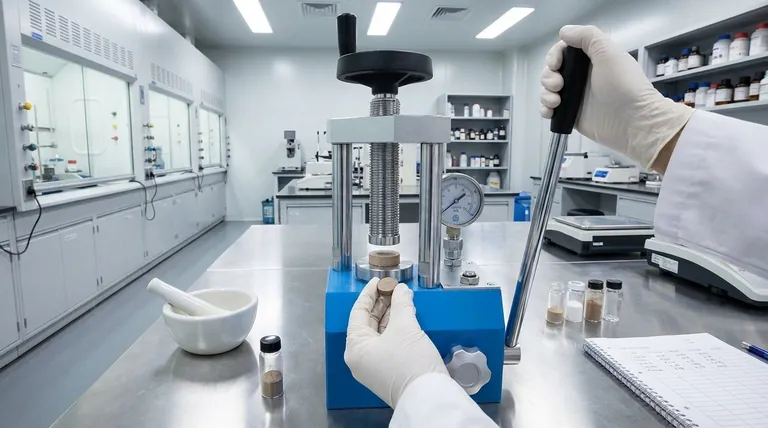
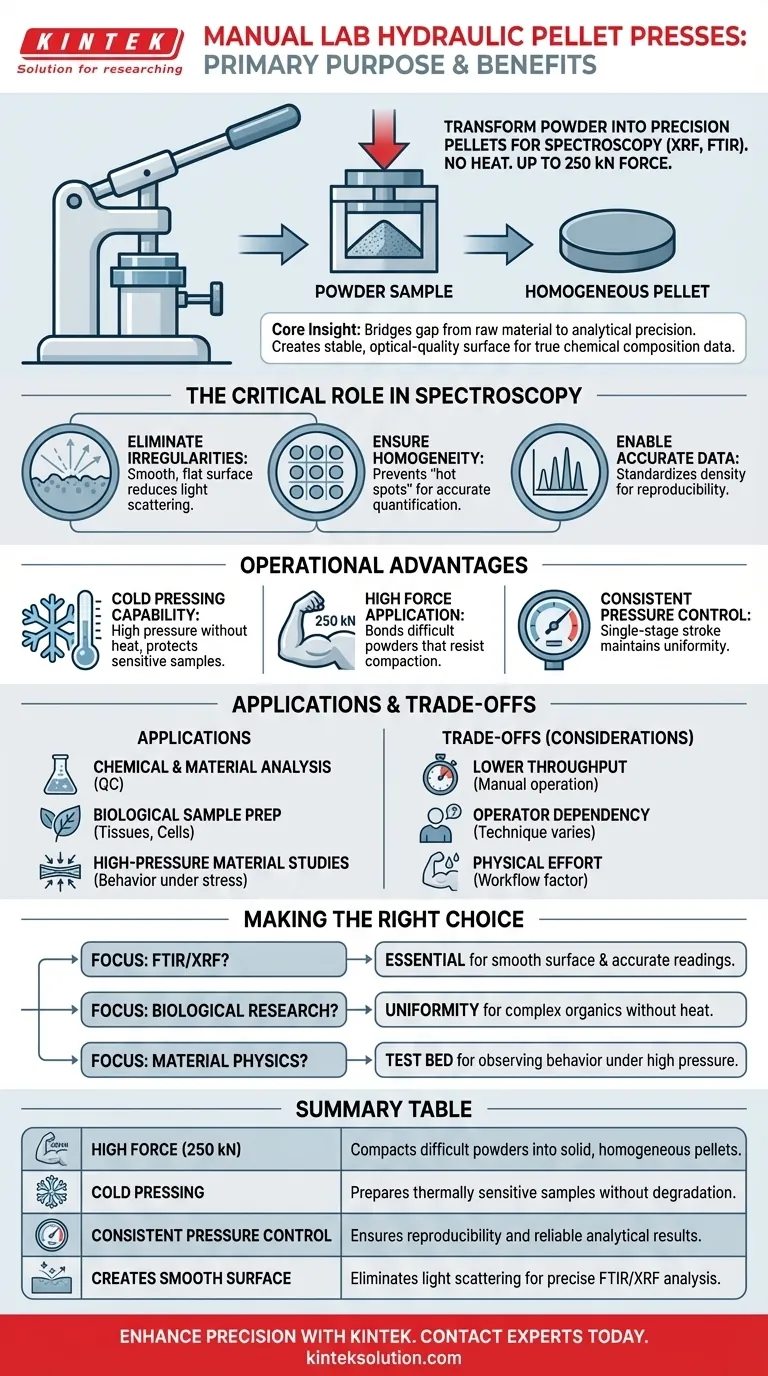
The primary purpose of a manual lab hydraulic pellet press is to transform powdered samples into solid, homogeneous pellets required for high-precision spectroscopic analysis. By applying significant force—often up to 250 kN—these devices consolidate loose powders into flat, uniform discs without the application of heat.
This mechanical consolidation is the critical first step in analytical techniques such as X-ray fluorescence (XRF) and Fourier-transform infrared spectroscopy (FTIR). Without this preparation, loose powders would cause irregular light scattering, leading to unreliable data and inaccurate chemical profiling.
Core Insight: The manual hydraulic press bridges the gap between raw material and analytical precision. It creates a stable, optical-quality surface from loose powders, ensuring that the data collected during spectral analysis reflects the true chemical composition of the sample rather than physical inconsistencies.
The Critical Role in Spectroscopy
Eliminating Surface Irregularities
Analytical instruments like XRF and FTIR spectrometers require samples with a smooth, flat surface. A manual press compresses particles tightly to reduce void spaces and surface roughness.
Ensuring Homogeneity
For accurate quantification, the sample must be uniform throughout. The press creates a homogeneous pellet, which prevents "hot spots" in the data where particle concentration might otherwise vary.
Enabling Accurate Data Collection
By standardizing the density and surface of the sample, the press ensures reproducibility. This allows researchers to compare results across different batches or experiments with confidence.
Operational Advantages of Manual Systems
Cold Pressing Capability
These presses exert high pressure without applying additional heat. This is vital for samples that are thermally unstable or might degrade if heated during the preparation process.
High Force Application
Despite being manual, these units can generate substantial force, typically up to 250 kN. This level of pressure is necessary to bond difficult powders that resist compaction.
Consistent Pressure Control
Many units feature a single-stage piston stroke and integrated pressure displays. This design allows the operator to apply consistent pressure, which is essential for maintaining sample uniformity.
Applications Across Scientific Fields
Chemical and Material Analysis
The most common application is preparing powder samples for elemental analysis. This is standard practice in quality control and industrial research to verify material composition.
Biological Sample Preparation
In fields such as plant physiology, microbiology, and biochemistry, presses are used to compact tissues, cells, and microbial cultures. These uniform samples are crucial for techniques like X-ray diffraction and high-throughput drug discovery screening.
High-Pressure Material Studies
Beyond simple preparation, these presses are used to study how materials behave under stress. Researchers use the hydraulic force to simulate high-pressure conditions to observe physical changes in the material structure.
Understanding the Trade-offs
Throughput Limitations
Because the operation is manual, the process is inherently slower than automated systems. This makes manual presses less ideal for laboratories requiring high-volume, rapid-fire sample processing.
Operator Dependency
While pressure displays help, the quality of the pellet relies partially on the operator's technique. Differences in how quickly pressure is applied or released can introduce slight variations between users.
Physical Effort
Generating 250 kN of force manually requires physical exertion. For occasional use, this is negligible, but for continuous daily operation, it can become a factor in workflow efficiency.
Making the Right Choice for Your Goal
When integrating a manual hydraulic press into your laboratory workflow, consider your specific analytical requirements:
- If your primary focus is FTIR or XRF Analysis: The press is essential for eliminating light scattering and ensuring the smooth surface required for accurate spectral readings.
- If your primary focus is Biological Research: The press provides the uniformity needed to analyze complex organic materials like tissues and cell cultures without thermal degradation.
- If your primary focus is Material Physics: The tool serves as a test bed for observing material behavior and structural integrity under high-pressure environments.
Ultimately, the manual hydraulic pellet press remains the industry standard for cost-effective, reliable sample preparation where precision and sample integrity outweigh the need for automation.
Summary Table:
| Feature | Benefit |
|---|---|
| High Force (up to 250 kN) | Compacts difficult powders into solid, homogeneous pellets. |
| Cold Pressing | Prepares thermally sensitive samples without degradation. |
| Consistent Pressure Control | Ensures reproducibility and reliable analytical results. |
| Creates Smooth Surface | Eliminates light scattering for precise FTIR/XRF analysis. |
Ready to enhance the precision of your spectroscopic analysis? KINTEK's manual lab hydraulic presses are engineered for reliability and accuracy in sample preparation. Whether you're in quality control, material science, or biological research, our presses deliver the uniform pellets essential for trustworthy data. Contact our experts today to find the perfect press for your laboratory's needs and ensure your sample integrity.
Visual Guide
Related Products
- Manual Laboratory Hydraulic Pellet Press Lab Hydraulic Press
- Automatic Laboratory Hydraulic Press Lab Pellet Press Machine
- Manual Laboratory Hydraulic Press Lab Pellet Press
- Automatic Laboratory Hydraulic Press for XRF and KBR Pellet Pressing
- Manual Heated Hydraulic Lab Press with Integrated Hot Plates Hydraulic Press Machine
People Also Ask
- What is the primary purpose of a manual lab hydraulic pellet press? Ensure Accurate Sample Prep for XRF and FTIR
- What role does a lab hydraulic press play in researching squishy granular matter? Expert Insights into Material Physics
- What is the primary function of a laboratory hydraulic press in evaluating the ionic conductivity of Li6PS5X (LMSX)?
- What is the purpose of initial axial molding using a lab hydraulic press? Optimizing Electrolyte Green Bodies
- What role does a lab hydraulic press play in molding recycled bricks? Achieve High-Density Material Structural Integrity



















