
Precision pressure application is the critical first step in determining the structural integrity and performance of solid-state battery materials. Specifically, applying 98 MPa serves to compact loose LLZ-CaBi powder into a cohesive "green body," maximizing particle-to-particle contact and establishing the necessary initial density required for successful high-temperature sintering.
Core Takeaway The application of 98 MPa is not merely about shaping the powder; it is a densification mechanism that minimizes interstitial voids to create continuous ionic pathways. This step creates a uniform "green pellet" that ensures the final ceramic achieves the high ionic conductivity and mechanical stability required for solid-state batteries.
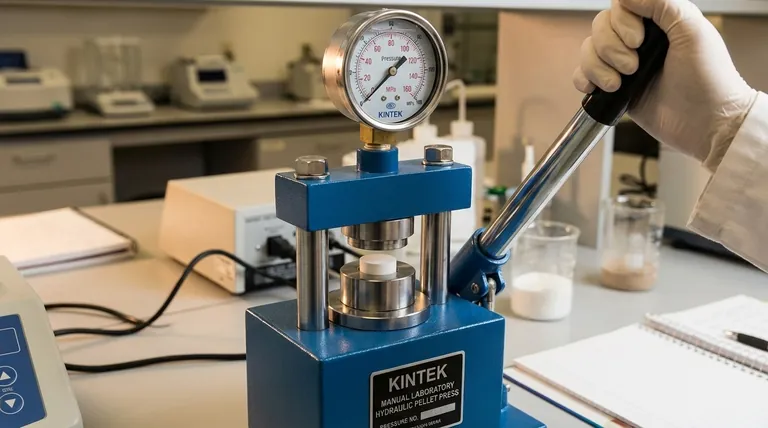
Creating the "Green Body" Foundation
The Transition from Powder to Solid
The primary function of the hydraulic press is to transform loose, disordered powder into a solid geometric shape known as a green body.
Without this mechanical compaction, the powder lacks the physical cohesion to withstand handling or the subsequent thermal processing.
Maximizing Particle Contact
At 98 MPa, the force is sufficient to overcome the friction between powder particles.
This rearranges the particles, significantly increasing the contact area between them.
These intimate contact points are physically necessary for diffusion to occur effectively during the next stage of processing.
Reducing Interstitial Voids
Loose powder contains a significant amount of empty space, or "interstitial gaps."
The 98 MPa pressure forces particles into these gaps, drastically reducing the porosity of the material before heat is ever applied.
Optimizing for Sintering
Facilitating Densification
The "green density" achieved at 98 MPa is directly correlated to the final density of the ceramic.
A denser green body undergoes better shrinkage behavior during the high-temperature sintering phase.
This leads to a final ceramic pellet that has high relative density, which is the industry standard for quality.
Ensuring Uniform Pore Distribution
It is not enough to simply compress the material; the pressure must create a uniform pore distribution.
If the pressure is applied incorrectly or is insufficient, the green body may have inconsistent density gradients.
Uniform compaction ensures that when the material is sintered, it densifies evenly, preventing the formation of structural defects like cracks or warping.
The Impact on Battery Performance
Establishing Ionic Pathways
The ultimate goal of the electrolyte is to transport ions.
By reducing voids and maximizing contact at the green stage, you create continuous pathways for lithium-ion transport in the final product.
High porosity interrupts these pathways, increasing resistance and lowering the overall ionic conductivity of the cell.
Mechanical Stability and Safety
A dense ceramic structure provides the mechanical strength necessary to withstand the physical stresses of battery operation.
Furthermore, a high-density electrolyte acts as a physical barrier.
This density is crucial for preventing the penetration of lithium dendrites, which are a primary cause of short circuits and safety failures in solid-state batteries.
Understanding the Trade-offs
The Risk of Insufficient Pressure
If the pressure is significantly lower than 98 MPa, the green body will be too porous.
During sintering, these large pores often fail to close completely, resulting in a low-density ceramic with poor conductivity and weak mechanical structure.
The Necessity of Uniformity
While the magnitude of pressure (98 MPa) is critical, the uniformity of that pressure is equally important.
The hydraulic press must apply uniaxial pressure evenly across the entire surface.
Non-uniform pressure leads to density gradients, which cause differential shrinkage during sintering—the primary culprit behind cracked or distorted pellets.
Making the Right Choice for Your Goal
To maximize the effectiveness of your laboratory hydraulic press during pellet preparation, focus on the following outcomes:
- If your primary focus is Ionic Conductivity: Ensure the pressure is held precisely to maximize particle contact, as this defines the continuity of ion transport channels.
- If your primary focus is Mechanical Integrity: Prioritize the uniformity of the pressure application to prevent density gradients that lead to cracking during sintering.
By strictly controlling the compaction pressure at 98 MPa, you convert a loose collection of particles into a high-performance, conductive ceramic capable of powering next-generation energy storage.
Summary Table:
| Aspect | Role of 98 MPa Pressure |
|---|---|
| Primary Goal | Transform loose powder into a cohesive 'green body' for sintering. |
| Particle Contact | Maximizes particle-to-particle contact area for effective diffusion. |
| Porosity Reduction | Drastically minimizes interstitial voids to create continuous ionic pathways. |
| Sintering Outcome | Ensures uniform densification, leading to a high-density final ceramic. |
| Battery Performance | Directly impacts ionic conductivity and prevents lithium dendrite penetration. |
Achieve Precise and Uniform Pellet Preparation with KINTEK
Are you developing next-generation solid-state batteries like LLZ-CaBi electrolytes? The precise application of 98 MPa pressure is a critical step that defines the success of your final ceramic's performance. KINTEK specializes in laboratory press machines, including automatic and heated lab presses, designed to deliver the exact, uniform pressure required for reproducible and high-quality pellet preparation.
Our presses help researchers like you:
- Ensure Uniform Densification: Avoid cracks and defects by achieving consistent pressure distribution.
- Maximize Ionic Conductivity: Create the optimal green body density for continuous ion transport pathways.
- Enhance Mechanical Stability: Build a dense ceramic structure capable of preventing dendrite penetration.
Don't let inconsistent compaction compromise your battery material research.
Contact KINTEK today to find the perfect lab press for your specific pellet preparation needs and elevate the quality of your solid-state battery materials.
Visual Guide

References
- Naohiro Hayashi, Ken Watanabe. Reaction Suppression Between a High‐Ni Cathode Material (NMC622) and Li <sub>7</sub> La <sub>3</sub> Zr <sub>2</sub> O <sub>12</sub> on Co‐Sintering for Manufacturing Bulk‐Type All‐Solid‐State Batteries: A New Method and Its Mechanism. DOI: 10.1002/advs.202512219
This article is also based on technical information from Kintek Solution Knowledge Base .
Related Products
- Laboratory Hydraulic Press Lab Pellet Press Machine for Glove Box
- Laboratory Hydraulic Press 2T Lab Pellet Press for KBR FTIR
- 24T 30T 60T Heated Hydraulic Lab Press Machine with Hot Plates for Laboratory
- Laboratory Hydraulic Press Lab Pellet Press Button Battery Press
- Laboratory Hydraulic Pellet Press for XRF KBR FTIR Lab Press
People Also Ask
- How does a laboratory hydraulic press contribute to the preparation of Li3-3xScxSb samples? Optimize Ionic Conductivity
- What is the function of a laboratory hydraulic press in FT-IR of curcumin-coated MWCNTs? Achieve Optical Clarity.
- Why is a laboratory hydraulic press required for compression molding boron-siloxane? Solve High-Loading Density Challenges
- What role does a laboratory hydraulic press play in the preparation of piezoelectric ceramic discs for DC-PG? | KINTEK
- What role does a laboratory hydraulic press play in reaction pellets? Optimizing Lunar Soil and Metal Fuel Density



















