
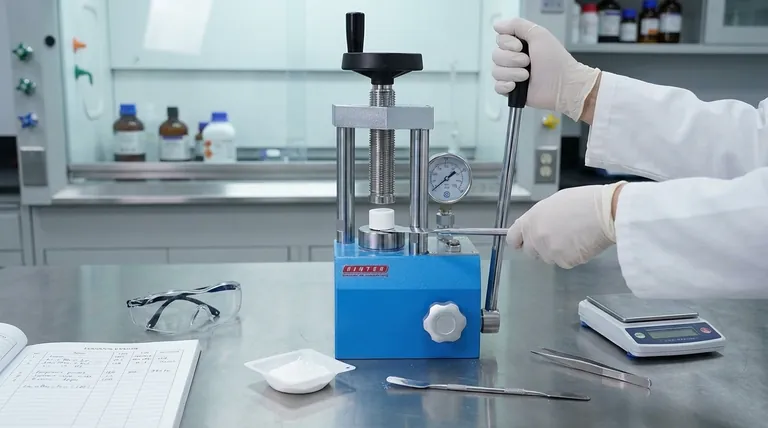
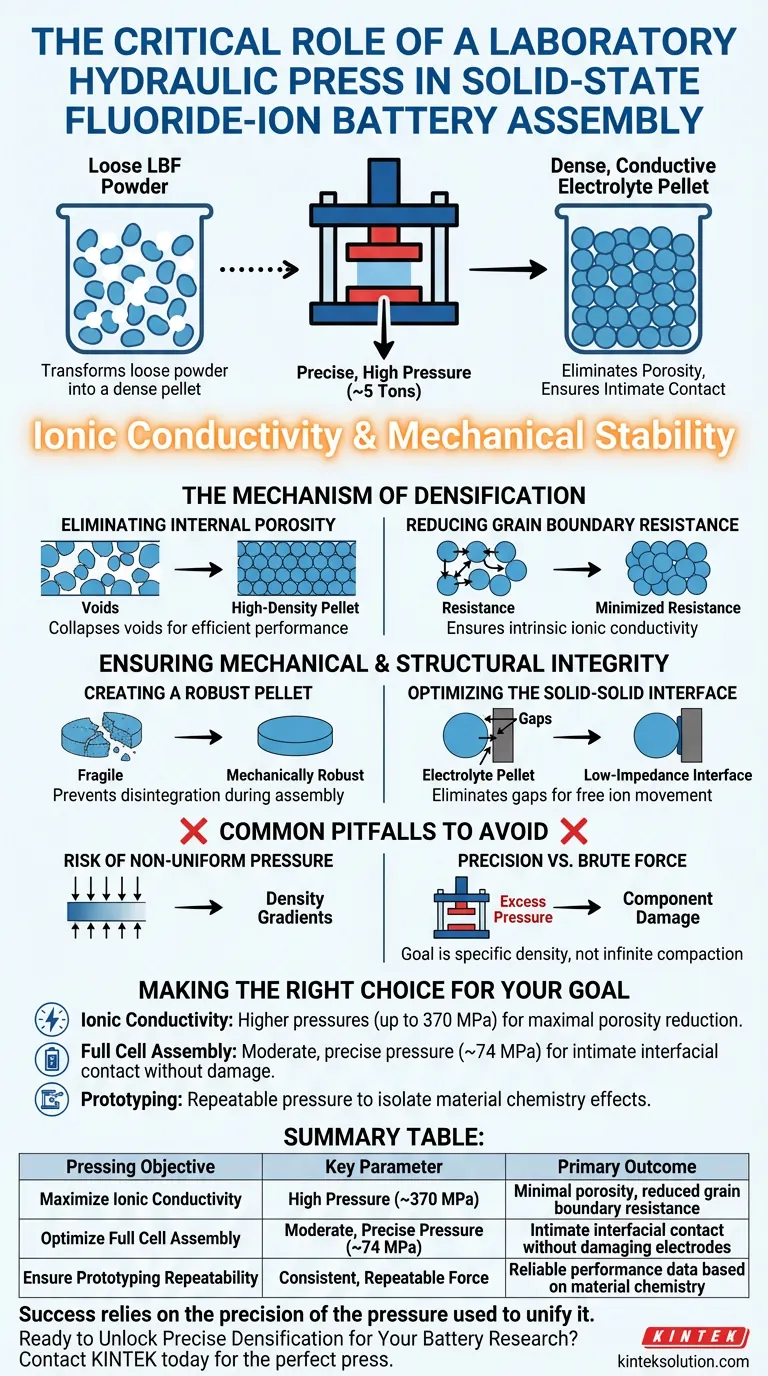
The critical role of the laboratory hydraulic press is to transform loose La0.95Ba0.05F2.95 (LBF) powder into a dense, conductive electrolyte pellet through the application of precise, high pressure (typically around 5 tons). This compaction process eliminates internal porosity and forces powder particles into intimate contact. Consequently, it establishes the necessary density for high ionic conductivity and ensures the mechanical stability required for the battery's operation.
The press converts a collection of insulated particles into a unified ionic highway; without this high-pressure densification, the electrolyte would suffer from high internal resistance and structural failure, rendering the solid-state fluoride-ion battery non-functional.
The Mechanism of Densification
Eliminating Internal Porosity
The primary function of the hydraulic press is to act as a densification tool. Loose LBF powder naturally contains significant voids and air gaps between particles.
By applying high pressure (e.g., 5 tons or approximately 360-370 MPa depending on the specific protocol), the press collapses these voids. This results in a high-density pellet with minimal internal porosity, which is a fundamental requirement for efficient electrochemical performance.
Reducing Grain Boundary Resistance
Densification is not merely about structural packing; it is about electrochemical connectivity. The press forces individual powder particles into intimate physical contact.
This close contact minimizes the resistance found at the grain boundaries (the interfaces between particles). By reducing this grain boundary resistance, the press ensures the material exhibits its intrinsic ionic conductivity rather than being limited by poor inter-particle connections.
Ensuring Mechanical and Structural Integrity
Creating a Robust Electrolyte Pellet
Solid-state batteries rely on the electrolyte acting as a solid separator. The hydraulic press compacts the powder into a mechanically robust form that can be handled and assembled without disintegrating.
This mechanical stability is vital for the subsequent assembly steps. A fragile or loosely packed pellet would crack or crumble, causing immediate cell failure or short circuits.
Optimizing the Solid-Solid Interface
Beyond the internal structure of the pellet, the press is often used to ensure contact between the electrolyte and the electrodes (anode/cathode).
High pressure creates a low-impedance solid-solid interface by eliminating microscopic gaps caused by surface roughness. This ensures that ions can move freely across the layers, which is indispensable for activating the battery and achieving high-rate performance.
Common Pitfalls to Avoid
The Risk of Non-Uniform Pressure
While high pressure is necessary, the uniformity of that pressure is equally critical. A laboratory press must apply force evenly across the entire surface area of the pellet.
If pressure is uneven, it can lead to density gradients within the pellet. This results in localized areas of high resistance or mechanical weak points, which can cause dendrite growth or structural cracking during battery cycling.
Precision vs. Brute Force
It is a mistake to assume that "more pressure is always better." The goal is a specific target density, not infinite compaction.
The press provides repeatable, precise mechanical pressure, allowing researchers to adhere to exact specifications (e.g., 74 MPa for stacking vs. 360 MPa for pelletizing). Deviating from these specific parameters can damage cell components or fail to achieve the necessary interfacial contact.
Making the Right Choice for Your Goal
To maximize the effectiveness of your hydraulic press in fluoride-ion battery assembly, align your pressing strategy with your specific experimental objectives:
- If your primary focus is Ionic Conductivity: Prioritize higher pressures (up to 360-370 MPa) to maximally reduce porosity and grain boundary resistance within the pellet.
- If your primary focus is Full Cell Assembly: Use moderate, highly precise pressure (around 74 MPa) to ensure intimate interfacial contact between layers without damaging the electrode structures.
- If your primary focus is Prototyping: Focus on the repeatability of the press to ensure that variations in performance are due to material chemistry, not inconsistent assembly forces.
Success in solid-state battery fabrication relies not just on the chemistry of the powder, but on the precision of the pressure used to unify it.
Summary Table:
| Pressing Objective | Key Parameter | Primary Outcome |
|---|---|---|
| Maximize Ionic Conductivity | High Pressure (~370 MPa) | Minimal porosity, reduced grain boundary resistance |
| Optimize Full Cell Assembly | Moderate, Precise Pressure (~74 MPa) | Intimate interfacial contact without damaging electrodes |
| Ensure Prototyping Repeatability | Consistent, Repeatable Force | Reliable performance data based on material chemistry |
Ready to Unlock Precise Densification for Your Battery Research?
Achieving the critical density and conductivity for your solid-state electrolyte pellets requires a press that delivers repeatable, uniform pressure every time. KINTEK specializes in laboratory press machines—including automatic, isostatic, and heated lab presses—designed to meet the exacting demands of battery development.
Let our expertise help you eliminate porosity, ensure mechanical stability, and optimize interfacial contact in your fluoride-ion battery assembly. Contact our team today to find the perfect press for your specific research goals and accelerate your path to a functional prototype.
➡️ Get in Touch Now to Discuss Your Application
Visual Guide
Related Products
- Laboratory Hydraulic Press Lab Pellet Press Machine for Glove Box
- Laboratory Hydraulic Press 2T Lab Pellet Press for KBR FTIR
- 24T 30T 60T Heated Hydraulic Lab Press Machine with Hot Plates for Laboratory
- Laboratory Hydraulic Press Lab Pellet Press Button Battery Press
- Laboratory Hydraulic Pellet Press for XRF KBR FTIR Lab Press
People Also Ask
- How does a laboratory hydraulic press contribute to the preparation of Li3-3xScxSb samples? Optimize Ionic Conductivity
- What is the function of a laboratory hydraulic press in FT-IR of curcumin-coated MWCNTs? Achieve Optical Clarity.
- Why is a laboratory hydraulic press required for compression molding boron-siloxane? Solve High-Loading Density Challenges
- What role does a laboratory hydraulic press play in reaction pellets? Optimizing Lunar Soil and Metal Fuel Density
- What role does a laboratory hydraulic press play in the preparation of piezoelectric ceramic discs for DC-PG? | KINTEK



















