
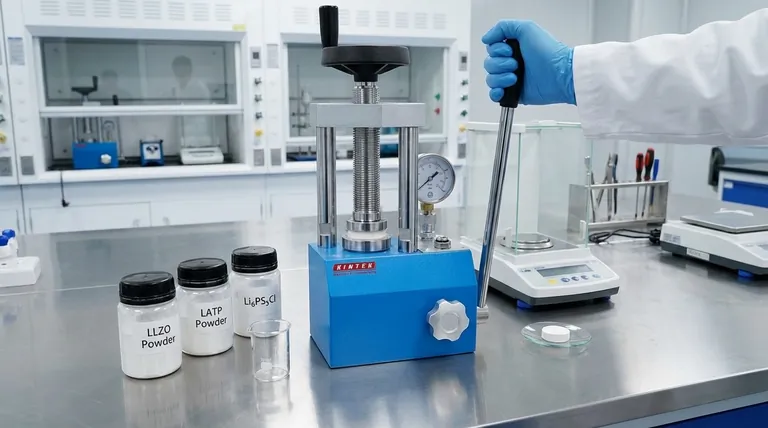
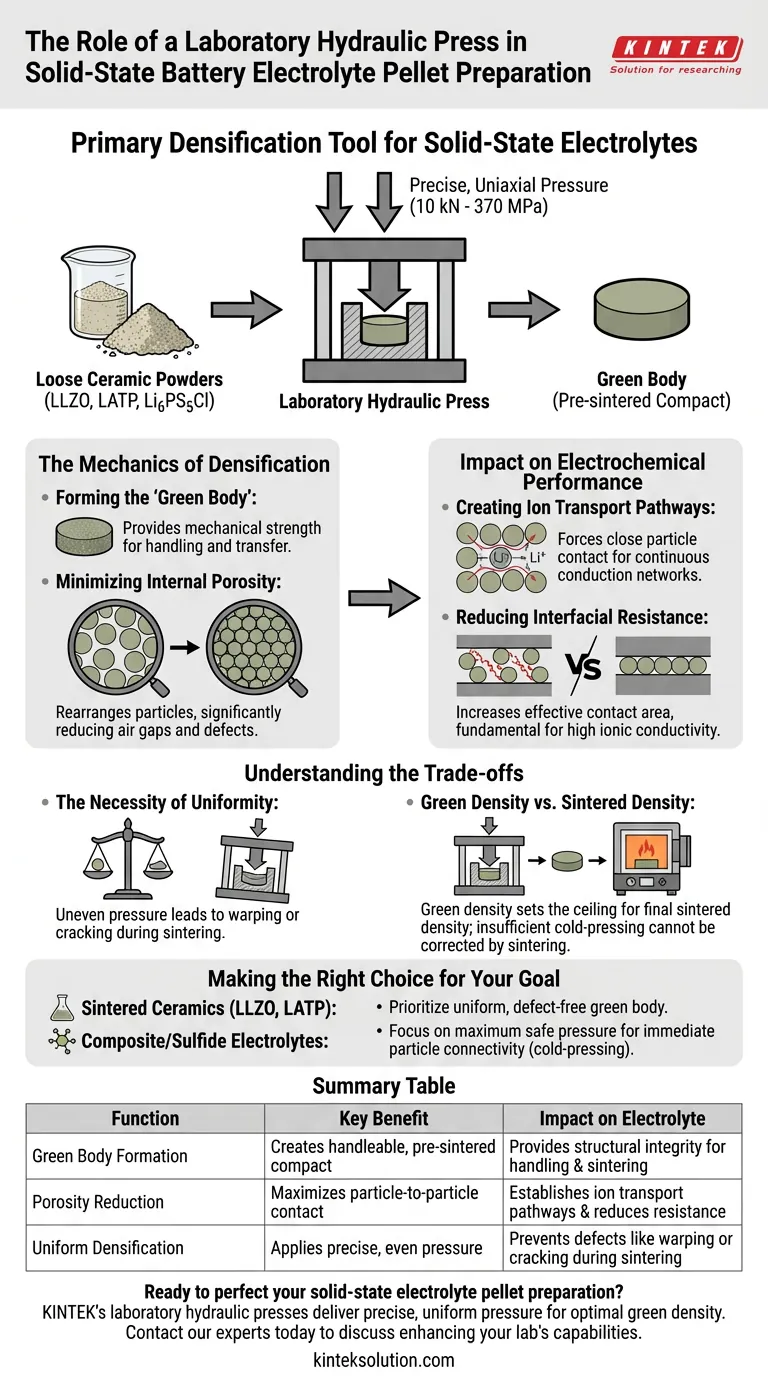
A laboratory hydraulic press functions as the primary densification tool in the traditional preparation of solid-state battery electrolytes. Its immediate role is to apply precise, uniaxial pressure to loose ceramic powders—such as LLZO, LATP, or Li6PS5Cl—transforming them into a compact, solid form known as a "green body." This step is the fundamental shaping process that determines the initial structural integrity of the pellet before any thermal treatment occurs.
The press does more than simply shape the material; it dictates the connectivity of the microstructure. By maximizing particle-to-particle contact prior to sintering, the hydraulic press establishes the physical foundation required for efficient lithium-ion transport and mechanical stability.
The Mechanics of Densification
Forming the "Green Body"
The initial output of the hydraulic press is a "green body" or "green pellet." This is a pre-sintered compact that possesses sufficient mechanical strength to be handled and transferred without crumbling.
Without this shaping step, loose powders would lack the cohesion necessary to undergo high-temperature sintering or subsequent performance testing.
Minimizing Internal Porosity
The press applies significant force, often ranging from 10 kN to pressures as high as 370 MPa. This force physically rearranges the powder particles, significantly reducing the voids (air gaps) between them.
Achieving a high initial packing density is a critical prerequisite. It minimizes defects that could evolve into cracks or structural failures during the final densification stages.
Impact on Electrochemical Performance
Creating Ion Transport Pathways
For a solid-state battery to function, lithium ions must move physically from one particle to the next. The hydraulic press forces particles into close contact, creating continuous conduction networks.
This is particularly vital for composite electrolytes (like LLZTO@Polymer), where the press establishes the conduction path without the need for sintering.
Reducing Interfacial Resistance
Loose connections between particles create high resistance, acting as a bottleneck for energy flow. By tightly compacting the material, the press increases the effective contact area between electrolyte particles.
This reduction in interfacial resistance is fundamental to obtaining an electrolyte pellet with high ionic conductivity and superior overall battery performance.
Understanding the Trade-offs
The Necessity of Uniformity
While pressure is essential, the uniformity of that pressure is equally critical. If the hydraulic press applies force unevenly, it creates density gradients within the pellet.
These gradients often lead to warping or cracking during the subsequent high-temperature sintering phase, rendering the pellet unusable.
Green Density vs. Sintered Density
It is important to recognize that for ceramic electrolytes, the press creates the potential for high density, but it is rarely the final step.
The "green density" achieved by the press sets the ceiling for the final sintered density. If the initial cold-pressing is insufficient, even aggressive high-temperature sintering cannot fully correct the porosity, resulting in a sub-par electrolyte.
Making the Right Choice for Your Goal
To maximize the utility of your laboratory hydraulic press, align your pressing parameters with your specific material requirements:
- If your primary focus is Sintered Ceramics (e.g., LLZO, LATP): Prioritize achieving a defect-free green body with uniform density, as this is the prerequisite for a crack-free final product after heat treatment.
- If your primary focus is Composite or Sulfide Electrolytes: Focus on applying maximum safe pressure to establishing immediate particle connectivity, as these materials often rely on cold-pressing alone for their conductive network.
The laboratory hydraulic press is not merely a shaping device, but the critical instrument for establishing the microstructural continuity that defines a high-performance solid-state battery.
Summary Table:
| Function | Key Benefit | Impact on Electrolyte |
|---|---|---|
| Green Body Formation | Creates a handleable, pre-sintered compact | Provides structural integrity for handling and sintering |
| Porosity Reduction | Maximizes particle-to-particle contact | Establishes ion transport pathways and reduces resistance |
| Uniform Densification | Applies precise, even pressure | Prevents defects like warping or cracking during sintering |
Ready to perfect your solid-state electrolyte pellet preparation?
KINTEK's laboratory hydraulic presses are engineered to deliver the precise, uniform pressure required to achieve optimal green density and microstructural continuity for materials like LLZO, LATP, and sulfide electrolytes. Whether your goal is to create a defect-free pre-sintered body or maximize cold-pressed conductivity for composites, our automatic lab presses, isostatic presses, and heated lab presses provide the control and reliability your research demands.
Contact our experts today to discuss how KINTEK can enhance your lab's capabilities and accelerate your battery development.
Visual Guide
Related Products
- Laboratory Hydraulic Press Lab Pellet Press Machine for Glove Box
- Laboratory Hydraulic Press 2T Lab Pellet Press for KBR FTIR
- 24T 30T 60T Heated Hydraulic Lab Press Machine with Hot Plates for Laboratory
- Laboratory Hydraulic Press Lab Pellet Press Button Battery Press
- Laboratory Hydraulic Pellet Press for XRF KBR FTIR Lab Press
People Also Ask
- How does a laboratory hydraulic press contribute to the preparation of Li3-3xScxSb samples? Optimize Ionic Conductivity
- What is the function of a laboratory hydraulic press in FT-IR of curcumin-coated MWCNTs? Achieve Optical Clarity.
- Why is a laboratory hydraulic press required for compression molding boron-siloxane? Solve High-Loading Density Challenges
- What role does a laboratory hydraulic press play in the preparation of piezoelectric ceramic discs for DC-PG? | KINTEK
- What role does a laboratory hydraulic press play in reaction pellets? Optimizing Lunar Soil and Metal Fuel Density



















