High-purity cathode materials act as a stabilizing foundation for accurate Lithium-ion battery experiments. By minimizing impurities in Nickel Cobalt Aluminum (NCA) chemistries, these materials significantly reduce non-regular side reactions during charge and discharge cycles. This reduction in chemical noise results in highly consistent data, essential for testing prediction models.
Core Takeaway: In Remaining Useful Life (RUL) experiments, material purity is a prerequisite for data integrity. High-purity cathodes eliminate unpredictable chemical behavior, generating smooth degradation curves that allow researchers to validate the mathematical effectiveness of time series construction methods without interference from manufacturing anomalies.
The Mechanism of Data Stability
To understand why high-purity materials are critical, we must look at how chemical consistency translates into data quality.
Reducing Non-Regular Side Reactions
Impurities in cathode materials often act as catalysts for unwanted chemical activity. These anomalies lead to non-regular side reactions that disrupt the standard flow of ions.
By utilizing high-purity NCA materials, researchers effectively minimize these unpredictable events. This ensures that the battery's behavior remains strictly tied to standard aging processes rather than random defects.
Creating Smoother Degradation Curves
When side reactions are minimized, the battery degrades at a uniform rate. Precise cell assembly combined with high-purity materials results in smoother degradation curves.
For a data scientist or engineer, this smoothness is vital. It means the data points follow a predictable trend line, rather than jumping erratically due to internal chemical instability.
The Impact on Algorithm Validation
The primary goal of these experiments is often to validate the algorithms themselves, not just the battery.
Validating Time Series Construction
Researchers use these experiments to verify the effectiveness of periodic time series construction methods.
If the underlying physical data is erratic, it becomes impossible to tell if a prediction error is the fault of the algorithm or the battery's chemistry. High-purity materials remove this variable.
Isolating Mathematical Performance
Smooth degradation data allows for a clear assessment of how well a model constructs time series data.
When the input data is stable, any deviation in the RUL prediction can be attributed to the mathematical model. This isolation is necessary to prove an algorithm is mathematically sound before applying it to messier, real-world data.
Understanding the Trade-offs
While high-purity materials are excellent for algorithm validation, it is important to recognize the limitations of this approach.
Idealized vs. Real-World Conditions
The data produced by high-purity, precisely assembled cells represents a "best-case" scenario.
Real-world commercial batteries may contain impurities or manufacturing variances that introduce noise. An algorithm validated solely on high-purity data may struggle when facing the erratic degradation curves of mass-produced cells.
Cost and Complexity
Achieving high purity and precise assembly increases the cost and complexity of the experimental setup. This investment is justified for fundamental validation but may be excessive for routine testing.
Making the Right Choice for Your Goal
When designing your RUL prediction experiments, your choice of materials should align with your specific objectives.
- If your primary focus is Algorithm Validation: Prioritize high-purity NCA materials to generate smooth, noise-free data that proves your time series construction methods work mathematically.
- If your primary focus is Real-World Deployment: Eventually, test your models on standard commercial cells to ensure they can handle the non-regular side reactions found in mass production.
Start with high-purity materials to prove the math works, then introduce complexity to prove the solution scales.
Summary Table:
| Feature | Impact on RUL Experiments | Benefit to Researchers |
|---|---|---|
| Material Purity | Minimizes non-regular side reactions | Eliminates chemical noise & manufacturing anomalies |
| Data Consistency | Generates smooth degradation curves | Allows for clear validation of mathematical models |
| Mechanism | Stabilizes ion flow during cycles | Ensures predictable aging trends vs. random defects |
| Validation Goal | Isolates mathematical performance | Proves effectiveness of time series construction |
Elevate Your Battery Research with KINTEK’s Precision Solutions
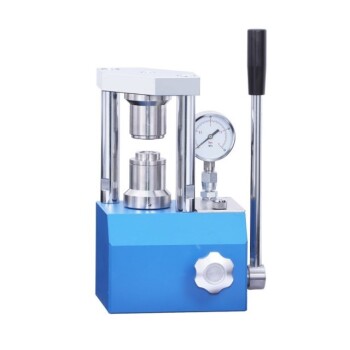
Unlock the full potential of your RUL prediction models with high-purity materials and reliable preparation equipment. KINTEK specializes in comprehensive laboratory pressing solutions, offering manual, automatic, heated, multifunctional, and glovebox-compatible models, as well as cold and warm isostatic presses.
Whether you are refining NCA chemistries or developing advanced battery architectures, our precision-engineered tools ensure the material integrity required for data stability. Contact us today to discover how our laboratory presses and processing equipment can streamline your workflow and deliver the accuracy your research demands!
References
- Chunsheng Cui, Jie Wen. Remaining Useful Life Interval Prediction for Lithium-Ion Batteries via Periodic Time Series and Trend Filtering Segmentation-Based Fuzzy Information Granulation. DOI: 10.3390/wevj16070356
This article is also based on technical information from Kintek Solution Knowledge Base .
Related Products
- Lab Round Bidirectional Press Mold
- Lab Cylindrical Press Mold for Laboratory Use
- Warm Isostatic Press for Solid State Battery Research Warm Isostatic Press
- Lab Double Plate Heating Mold for Laboratory Use
- Lab Button Battery Disassembly and Sealing Mold
People Also Ask
- What is the purpose of incorporating cartridge heaters into a lab press mold for MLCC block compression? Optimize Results
- What is the function of a pressing tool in thermoplastic panels? Master Precision Shaping & Fusion Bonding
- Why is precise cooling management of the lab press mold necessary? Protect Core Integrity in Thermoforming
- Why is a high-performance laboratory molding press critical for in-situ electrolyte formation? Unlock Battery Success
- How do the design and geometric precision of pressing molds and mandrels affect the quality of PTFE composite samples?