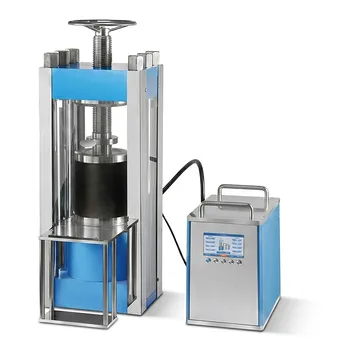
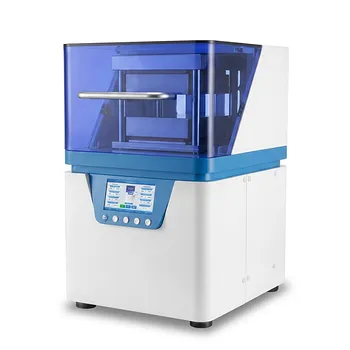
The laboratory heated platen press is the fundamental tool for transforming raw polymer-magnetic mixtures into functional Radio Absorber (RA) sheets. By providing a synchronized environment of precise thermal energy and uniform mechanical pressure, the press ensures the thorough curing of the polymer matrix and the total elimination of internal defects. This controlled processing is what grants RA sheets their specific thickness and density, both of which are non-negotiable for stable and predictable electromagnetic performance.
A laboratory heated press converts raw composite materials into high-performance sheets by simultaneously managing thermal cross-linking and physical densification. This dual-action process is essential for achieving the structural homogeneity required to ensure that radio waves are absorbed effectively rather than reflected or scattered.
Establishing Material Integrity
Achieving Dense Microstructures
A primary role of the heated press is to eliminate internal air bubbles, micropores, and voids within the composite. The application of high pressure forces the polymer melt into a tightly packed configuration, ensuring that magnetic fillers are encapsulated without air gaps. A dense, void-free structure is critical because internal air pockets can cause unintended scattering of electromagnetic waves, compromising the absorber's efficiency.
Ensuring Uniform Thickness and Surface Quality
Electromagnetic wave absorption is highly sensitive to the physical dimensions of the material, particularly its thickness relative to the target wavelength. The hydraulic or mechanical pressure of the platen press ensures that the material is compressed to a standardized, uniform thickness across the entire sheet. This precision prevents "hot spots" or performance leaks that occur when a sheet varies in density or depth.
Facilitating Phase Integration
By heating the material above its glass transition temperature or melting point, the press induces a viscous flow state in the polymer matrix. This allows the matrix to fully infiltrate the inorganic or magnetic filler framework, creating a more cohesive composite. Improved interfacial bonding strength between the polymer and fillers ensures the material maintains its structural integrity under mechanical stress.
Chemical and Structural Optimization
Facilitating Complete Polymer Cross-linking
For matrices like silicone rubber or phenolic resins, the press provides the stable thermal environment required for chemical cross-linking. Maintaining a precise temperature (such as 80°C or 180°C) ensures that the polymer chains bond thoroughly and uniformly. Without this controlled heat, the matrix may remain under-cured, leading to poor mechanical strength and unstable dielectric properties.
Controlling Rheology and Morphology
The press allows researchers to finely tune the microscopic morphology of the RA sheet by adjusting the heating and cooling rates. This control influences how magnetic particles are distributed and how the polymer crystallizes during solidification. These microscopic details directly dictate the material's final hardness, density, and its ability to dissipate electromagnetic energy as heat.
Understanding the Trade-offs
While the heated platen press is essential, it requires careful calibration to avoid material failure. Excessive temperature can lead to the thermal degradation of the polymer matrix, which ruins the chemical structure and dielectric profile of the sheet. Conversely, insufficient pressure may fail to expel all volatiles, resulting in a porous material that is mechanically weak and electromagnetically inconsistent.
There is also the risk of matrix "squeeze-out" if the pressure is applied too rapidly while the polymer is in a low-viscosity state. This can alter the filler-to-matrix ratio, leading to a sheet that is more brittle or magnetically "overloaded" than intended. Achieving the perfect balance between the heating curve and the pressure ramp is the primary challenge in laboratory molding.
How to Apply This to Your Project
When utilizing a heated platen press for RA composite molding, your technical parameters should align with your specific material objectives:
- If your primary focus is Electromagnetic Consistency: Prioritize the precision of platen parallelism and pressure uniformity to ensure a perfectly consistent thickness across the sheet.
- If your primary focus is Mechanical Durability: Focus on the "soak time" at the peak cross-linking temperature to ensure the polymer matrix is fully cured and bonded to the fillers.
- If your primary focus is High-Frequency Performance: Use higher pressures to eliminate even the smallest microscopic voids, as air inclusions have a significant impact at higher frequencies.
By mastering the synchronization of heat and pressure, you ensure that every RA sheet produced meets the rigorous standards required for modern radio frequency applications.
Summary Table:
| Key Press Function | Benefit to RA Composite Sheets | Electromagnetic & Structural Impact |
|---|---|---|
| Synchronized Heat/Pressure | Ensures thorough polymer cross-linking | Stable chemical & dielectric properties |
| High-Pressure Compaction | Eliminates internal voids and air bubbles | Prevents unintended wave scattering |
| Platen Parallelism | Guarantees uniform sheet thickness | Consistent performance across target wavelengths |
| Morphology Control | Optimizes magnetic filler distribution | Enhanced energy dissipation & absorption |
| Viscous Flow Induction | Facilitates complete matrix-filler integration | Superior mechanical & interfacial strength |
Elevate Your Material Research with KINTEK
Ready to achieve superior precision in your Radio Absorber composite molding? KINTEK specializes in comprehensive laboratory pressing solutions tailored for high-performance applications. We offer a versatile range of manual, automatic, heated, multifunctional, and glovebox-compatible models, as well as cold and warm isostatic presses widely used in advanced battery research and electromagnetic material development.
Don't settle for inconsistent results. Partner with KINTEK to ensure your RA sheets meet the most rigorous standards for modern radio frequency applications.
Contact our experts today to find your perfect laboratory press solution!
References
- Vladimír Babayan, Robert Moučka. Optimized Frequency Selective Surface for the Design of Magnetic Type Thin Broadband Radio Absorbers. DOI: 10.12693/aphyspola.131.1147
This article is also based on technical information from Kintek Solution Knowledge Base .
Related Products
- 24T 30T 60T Heated Hydraulic Lab Press Machine with Hot Plates for Laboratory
- Automatic Heated Hydraulic Lab Press Machine 200x200 Plate Size for Battery Research and Materials Science
- Automatic High Temperature Heated Hydraulic Press Machine with Heated Plates for Lab
- Automatic Heated Hydraulic Press Machine with Hot Plates for Laboratory
- Automatic Heated Hydraulic Press Machine with Heated Plates for Laboratory
People Also Ask
- Function of a Laboratory Hydraulic Press with Heated Platens in SSE? Enhance Battery Density & Conductivity
- Why is a laboratory hydraulic press with heating plates required for PLA/TEC films? Achieve Precise Sample Integrity
- What role does a laboratory heated hydraulic press play in LTCC? Essential for High-Density Ceramic Lamination
- What is the primary function of a laboratory heated hydraulic press? Mastering Thermoplastic Carbon Fiber Composites
- Why reduce load when applying composite strengthening tabs? Protect Specimen Integrity and Data Accuracy