
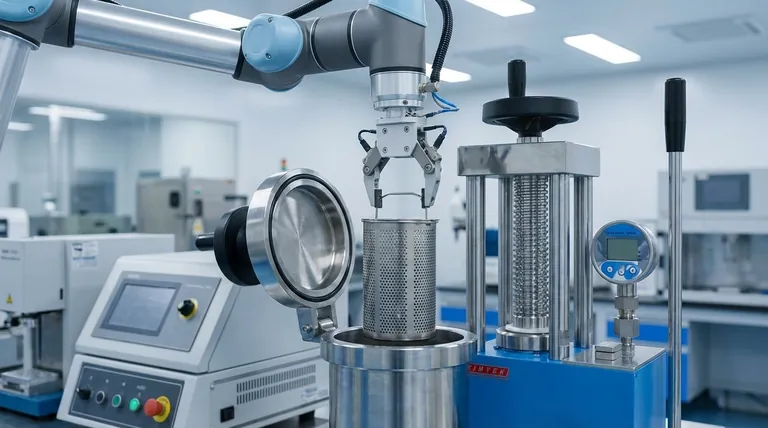
Automated loading and unloading mechanisms in Cold Isostatic Pressing (CIP) systems fundamentally transform the production workflow by replacing variable manual handling with robotic precision. These systems offer three distinct advantages: they significantly accelerate processing cycles, drastically minimize the risk of human error, and ensure a higher degree of material consistency by protecting samples from contamination.
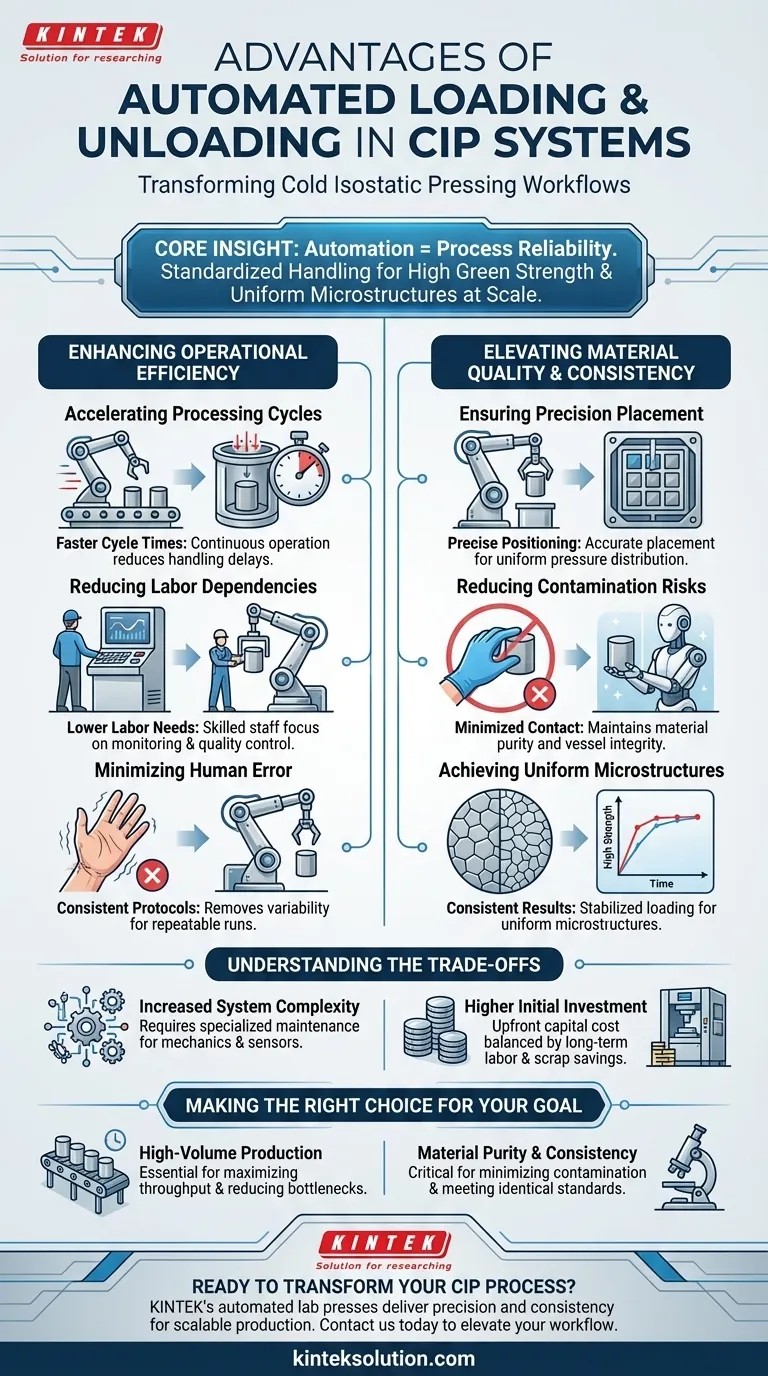
Core Insight: The value of automation extends beyond simple speed; it is the key to process reliability. By standardizing how materials are introduced and removed from the pressure vessel, you eliminate the inconsistencies inherent in manual labor, ensuring that high green strength and uniform microstructures are achievable at scale.
Enhancing Operational Efficiency
Accelerating the Processing Cycle
One of the most immediate impacts of automation is the reduction of cycle time. Automated systems operate continuously without fatigue, moving materials in and out of the vessel faster than human operators can.
Reducing Labor Dependencies
By automating the physical movement of materials, facilities can significantly reduce the need for manual labor. This allows skilled staff to focus on process monitoring and quality control rather than repetitive physical tasks.
Minimizing Human Error
Manual handling introduces variability that can disrupt sensitive high-pressure workflows. Automated mechanisms remove this variable, ensuring that protocols are followed exactly the same way during every single run.
Elevating Material Quality and Consistency
Ensuring Precision Placement
Systems equipped with robotic arms offer a level of placement accuracy that is difficult to replicate manually. Precise positioning within the pressure vessel is critical for ensuring uniform pressure distribution during the cycle.
Reducing Contamination Risks
Every time a human operator touches a sample or opens a vessel, there is a potential vector for contamination. Automated retrieval reduces direct contact, maintaining the purity of the material and the integrity of the pressure vessel environment.
Achieving Uniform Microstructures
Consistency in loading leads to consistency in results. By stabilizing the loading phase, automation supports the creation of materials with uniform microstructures and reliable high green strength.
Understanding the Trade-offs
Increased System Complexity
While automation solves workflow issues, it introduces mechanical complexity. These systems require specialized maintenance protocols to keep robotic arms and sensors functioning correctly.
Higher Initial Investment
Implementing automated loading and unloading mechanisms increases the upfront capital cost of the CIP system. This investment must be weighed against the long-term savings in labor and the reduction in scrap rates.
Making the Right Choice for Your Goal
To determine if automated loading is necessary for your CIP application, consider your production volume and quality requirements.
- If your primary focus is High-Volume Production: Automation is essential to maximize throughput and reduce the bottleneck caused by manual loading times.
- If your primary focus is Material Purity and Consistency: The precision of robotic arms is critical to minimize contamination and ensure every batch meets identical microstructural standards.
Automation is the bridge between a functional laboratory process and a scalable, industrial-grade manufacturing solution.
Summary Table:
| Advantage | Key Benefit |
|---|---|
| Faster Cycle Times | Accelerates production by eliminating manual handling delays. |
| Reduced Human Error | Ensures precise, repeatable processes for consistent results. |
| Improved Material Quality | Minimizes contamination and ensures uniform microstructures. |
| Lower Labor Dependency | Frees skilled staff for higher-value tasks like quality control. |
Ready to transform your CIP process with reliable automation?
KINTEK's automated lab presses, including isostatic and heated models, are engineered to deliver the precision and consistency your laboratory demands. By integrating robotic loading/unloading, we help you achieve scalable production, reduce operational costs, and maintain impeccable material purity.
Contact us today using the form below to discuss how our solutions can elevate your workflow. Let’s build a more efficient, error-free future together.
Visual Guide
Related Products
- Automatic Lab Cold Isostatic Pressing CIP Machine
- Electric Lab Cold Isostatic Press CIP Machine
- Electric Split Lab Cold Isostatic Pressing CIP Machine
- Manual Cold Isostatic Pressing CIP Machine Pellet Press
- Lab Cylindrical Press Mold with Scale
People Also Ask
- What are the key features of automated laboratory Cold Isostatic Press (CIP) systems? Achieve Precise, High-Pressure Powder Consolidation
- Why is an Isostatic Press (CIP) Necessary After Uniaxial Pressing? Achieve Transparency in Nd:Y2O3 Ceramics
- What is the primary function of a Cold Isostatic Press (CIP) in NASICON preparation? Achieve 96% Theoretical Density
- How does a Cold Isostatic Press (CIP) increase Bi-2223/Ag current density? Boost Superconductivity with Uniform Pressure
- How does a Cold Isostatic Press (CIP) facilitate the preparation of CaO-doped silicon carbide (SiC) green bodies?














