
For decades, KBr pellets have been a foundational technique in FTIR spectroscopy, offering distinct advantages over modern methods like Attenuated Total Reflectance (ATR). The primary benefits of using KBr pellets are their potential for higher sensitivity in detecting trace components, the ability to produce high-quality classic transmission spectra ideal for library matching, and broad versatility for analyzing a wide range of solid samples.
While ATR offers unparalleled speed and convenience, the KBr pellet method remains the superior choice when the analytical goal demands maximum sensitivity, quantitative accuracy, or the generation of a traditional transmission spectrum for comparison with historical data or reference libraries.
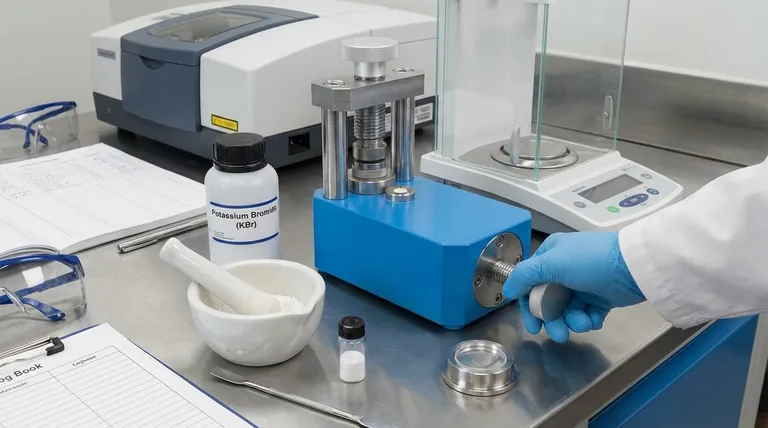
The Core Strengths of KBr Pellet Analysis
The KBr pellet technique is a transmission method. The goal is to uniformly disperse a small amount of a solid sample within an infrared-transparent salt matrix (potassium bromide, or KBr), which is then pressed into a thin, transparent disc.
High Sensitivity for Trace Analysis
The KBr method allows for the preparation of a very thin and uniform sample distribution within the pellet. This means the infrared beam passes through a longer effective pathlength of the sample compared to the shallow penetration depth of an ATR crystal, making KBr pellets excellent for detecting trace amounts or components at low concentrations.
High-Quality, Classic Transmission Spectra
This technique produces a true transmission spectrum, which is the gold standard for many applications. This type of spectrum often has a better signal-to-noise ratio and flatter baseline compared to ATR, which can sometimes introduce spectral artifacts due to its refractive index dependence.
Ideal for Quantitative Work and Library Matching
Because KBr pellets can be prepared with precise concentrations and thicknesses, they adhere more closely to the Beer-Lambert law. This makes the method highly suitable for quantitative analysis. Furthermore, the vast majority of historical and commercial FTIR spectral libraries were built using transmission data, making the KBr pellet method ideal for definitive compound identification.
Versatility for a Broad Range of Solids
The KBr technique is highly effective for a wide variety of solid samples, including pharmaceuticals, polymers, and inorganic compounds. It is particularly useful for brittle materials that can be easily ground into a fine powder.
The Principle: Why KBr Pellets Work
Understanding the preparation process reveals why this method yields such high-quality data. The entire process is designed to minimize interference and maximize the interaction between the infrared beam and the sample.
Creating an Optically Transparent Window
KBr is used because it is transparent to infrared radiation in the mid-IR region and has a refractive index that, when pressed, minimizes light scattering. The pressed pellet essentially acts as a solid "window" holding the finely dispersed sample in the path of the IR beam.
The Critical Role of Homogeneous Dispersion
The sample must be mixed with the KBr powder in a specific, low concentration (typically 0.2% to 1%). The mixture is then pulverized to reduce particle size. This ensures the sample is distributed evenly and prevents large particles from scattering the IR light, which would distort the spectrum.
The Impact of Pressure and Vacuum
A pellet press applies immense pressure (around 8 tons) to the KBr/sample mixture. This high pressure fuses the KBr powder into a translucent, glass-like disc. Applying a vacuum during pressing is also critical, as it removes trapped air and, most importantly, any adsorbed moisture, which would otherwise produce large, interfering water peaks in the spectrum.
Understanding the Trade-offs: KBr vs. ATR
The advantages of KBr pellets come with significant trade-offs, primarily in workflow and sample handling. This is where ATR often becomes the more practical choice.
The Preparation Burden
The KBr pellet method is labor-intensive. It involves weighing, grinding, mixing, pressing, and careful handling. In contrast, ATR analysis is often as simple as placing the sample on the crystal and running the scan, making it orders of magnitude faster.
The Moisture Problem
KBr is highly hygroscopic, meaning it readily absorbs water from the atmosphere. This is the primary source of frustration with the technique. Improperly dried KBr or exposure to humid air will result in large, broad water absorption bands (around 3400 cm⁻¹ and 1640 cm⁻¹) that can obscure key sample peaks.
Potential for Sample Alteration
The high pressure used to form the pellet can sometimes induce polymorphic changes in crystalline materials. This means the crystal structure of the sample can change during preparation, leading to a spectrum that does not represent the original material.
Reproducibility Requires Skill
While a high-quality press enhances consistency, achieving perfect reproducibility with KBr pellets is challenging. Minor variations in the sample-to-KBr ratio, grinding effectiveness, or pellet thickness can lead to changes in peak intensities between measurements. ATR, by its nature, provides more consistent sample contact.
Making the Right Choice for Your Goal
Selecting the correct sample preparation method depends entirely on your analytical objective. Neither technique is universally superior; they are tools designed for different tasks.
- If your primary focus is quantitative analysis or building a reference library: Choose KBr pellets for their adherence to the Beer-Lambert law and classic spectral quality.
- If your primary focus is high-throughput screening or rapid quality control: ATR is the undisputed winner due to its speed and minimal sample preparation.
- If your primary focus is detecting trace components or impurities: The sensitivity of the KBr pellet method gives it a clear advantage.
- If your primary focus is analyzing liquids, pastes, or very hard/irregular solids: ATR is far more versatile and is non-destructive, unlike the grinding required for KBr.
Ultimately, understanding the fundamental differences between these methods empowers you to select the tool that best aligns with your requirements for sensitivity, speed, and data quality.
Summary Table:
| Advantage | Description |
|---|---|
| High Sensitivity | Detects trace components with longer IR pathlength than ATR. |
| Quantitative Accuracy | Adheres to Beer-Lambert law for precise concentration measurements. |
| Library Matching | Produces classic transmission spectra compatible with historical data. |
| Versatility | Effective for various solid samples like pharmaceuticals and polymers. |
Enhance your laboratory's FTIR analysis with KINTEK's reliable lab press machines! Our automatic lab presses, isostatic presses, and heated lab presses are designed to deliver precise, high-quality KBr pellets for superior sensitivity and accuracy in your research. Whether you're in pharmaceuticals, materials science, or quality control, KINTEK supports your needs with durable, easy-to-use equipment that ensures consistent results. Contact us today to discuss how our solutions can optimize your sample preparation and boost your lab's efficiency!
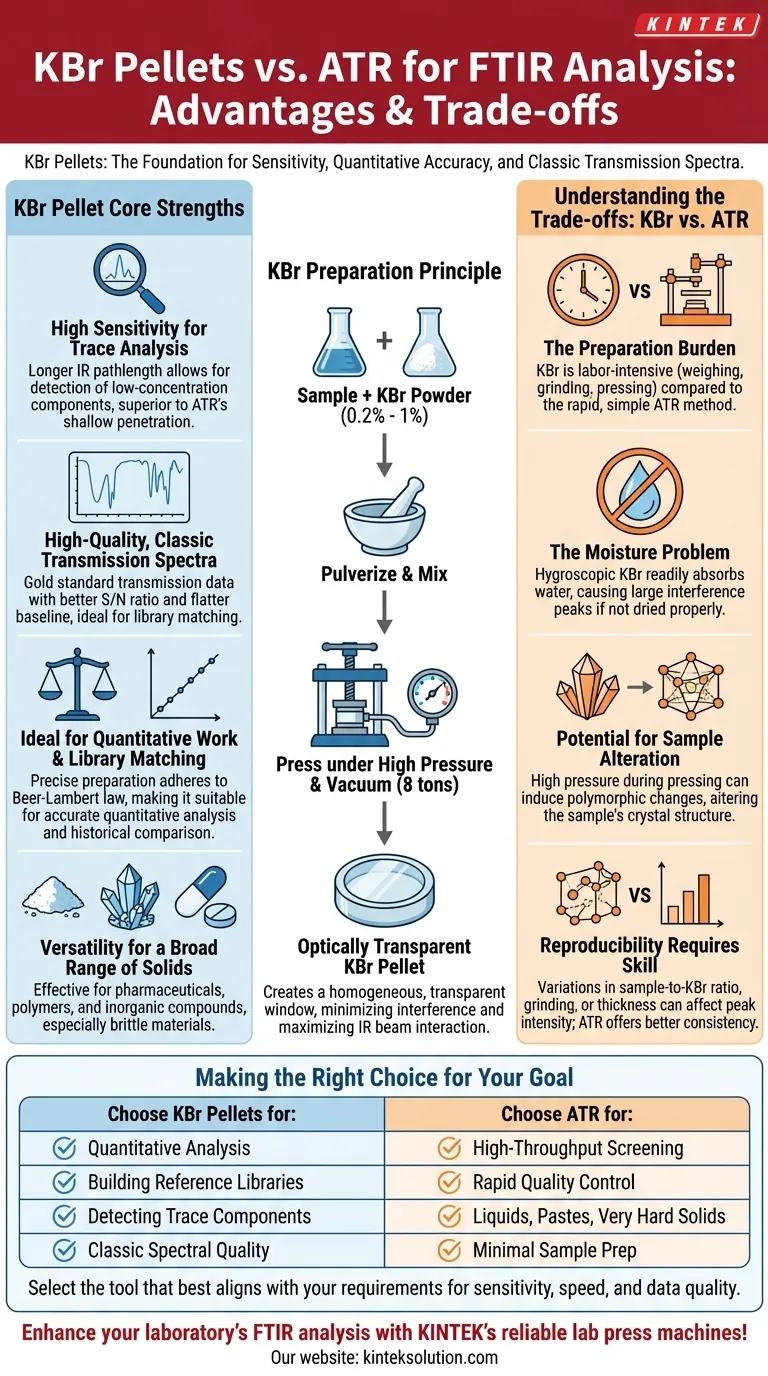
Visual Guide
Related Products
- XRF KBR Plastic Ring Lab Powder Pellet Pressing Mold for FTIR
- Laboratory Hydraulic Press 2T Lab Pellet Press for KBR FTIR
- Automatic Laboratory Hydraulic Press for XRF and KBR Pellet Pressing
- XRF KBR Steel Ring Lab Powder Pellet Pressing Mold for FTIR
- Laboratory Hydraulic Pellet Press for XRF KBR FTIR Lab Press
People Also Ask
- What is the purpose of making KBr pellets for FTIR? Achieve Precise Molecular Analysis with Solid Samples
- What factors should be considered when choosing a lab press for XRF pellet preparation? Ensure Accurate and Consistent Results
- Why are pellets used in XRF analysis, and what is their limitation? Boost Accuracy and Speed in Your Lab
- How are pellets prepared for XRF analysis and what is a potential drawback? Master XRF Sample Prep and Accuracy
- What should be included in a checklist for making XRF pellets? Ensure Accurate and Repeatable XRF Analysis














