A finished KBr pellet for FTIR analysis must be visibly clear or transparent, closely resembling a small disc of glass. Physically, the pellet should be approximately 2 mm thick; if the disc appears opaque or significantly thicker than this standard, the ratio of sample powder to KBr likely requires adjustment.
The Core Objective The goal is to produce a thin, uniform, and transparent medium that allows infrared light to pass through with minimal scattering or absorption by the matrix itself. A successful pellet acts as an invisible carrier, ensuring that the resulting spectral data reflects only the characteristics of your sample.
Key Physical Attributes
Visual Transparency
The most critical indicator of quality is clarity. The pellet should not be cloudy, milky, or opaque.
High transparency indicates that the KBr and sample were mixed homogeneously and compressed correctly. If the pellet is opaque, it suggests the sample concentration is too high or the particle size is too large, causing light scattering rather than transmission.
Specific Dimensions
According to standard protocols, the ideal pellet thickness is approximately 2 mm.
Maintaining this specific thickness prevents the path length of the infrared light from becoming too long, which could result in total absorption (saturation) of the signal. If a pellet is too thick, the detector may not receive enough energy to generate a reliable spectrum.
Geometric Uniformity
The pellet must be cylindrical with completely flat ends.
This geometry ensures that the infrared beam interacts with a constant amount of material across the cross-section. Uniformity is vital for producing reproducible results, particularly if you are conducting quantitative analysis where spectral intensity is directly correlated to sample concentration.
Factors Influencing Characteristics
Sample-to-Matrix Ratio
Achieving the correct physical state depends heavily on the mixture ratio. A standard preparation involves a very small quantity of sample (typically 1–2 mg) mixed with a much larger amount of KBr powder (100–200 mg).
Particle Size
The mixture must be finely ground, usually in an agate mortar. Large particles in the matrix will scatter light, resulting in a cloudy pellet even if the chemical composition is correct.
Compressive Force
To transition from a loose powder to a solid, transparent disc, the mixture requires high pressure—typically 8 to 10 tons (resulting in 8,000–10,000 psi). Insufficient pressure will fail to fuse the KBr crystals, leaving the pellet fragile and opaque.
Common Pitfalls to Avoid
The "White Spot" Error
If your pellet has white spots or looks entirely like a white tablet, it is too concentrated. You must reduce the amount of sample relative to the KBr. As noted in the primary guidelines, opacity often signals a need to adjust the powder amount used in preparation.
Moisture Contamination
KBr is hygroscopic, meaning it absorbs water from the air. A pellet that becomes cloudy or foggy over time (or immediately after pressing) may have absorbed moisture. This not only ruins the physical transparency but introduces broad water peaks into your spectrum, interfering with data interpretation.
Structural Fragility
A pellet that crumbles upon ejection or handling was likely not pressed at a high enough pressure or was pressed for an insufficient duration. A proper pellet should be solid enough to be mounted in a holder without breaking.
Optimizing for Your Analysis
To ensure you generate the highest quality data, tailor your inspection of the pellet to your specific analytical goals:
- If your primary focus is Qualitative Analysis (Identification): Prioritize transparency above all else to ensure clear spectral peaks and minimize noise caused by light scattering.
- If your primary focus is Quantitative Analysis (Measurement): Prioritize geometric uniformity and flatness to ensure the path length of the light is consistent across different samples.
A perfect KBr pellet is one that you can barely see, allowing the instrument to see your sample perfectly.
Summary Table:
| Characteristic | Ideal Specification | Impact on Analysis |
|---|---|---|
| Transparency | Clear/Glass-like | Minimizes light scattering and noise |
| Thickness | Approximately 2 mm | Prevents signal saturation/total absorption |
| Geometry | Flat-ended cylinder | Ensures consistent light path length |
| Sample Ratio | 1% sample (1-2mg) | Prevents opacity and "White Spot" errors |
| Pressure | 8 to 10 tons | Fuses crystals into a solid, durable disc |
Elevate Your FTIR Accuracy with KINTEK Pressing Solutions
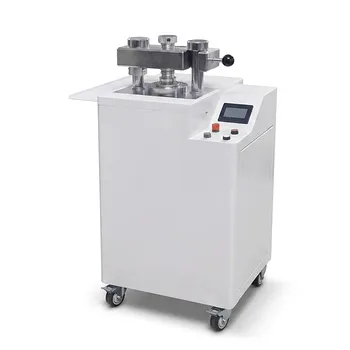
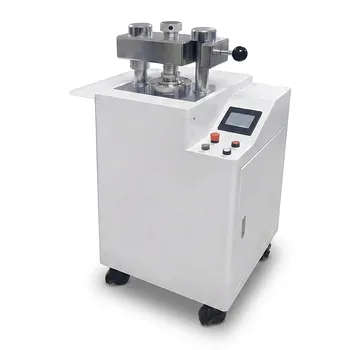
Achieving the perfect 2mm transparent pellet requires precision and reliable equipment. KINTEK specializes in comprehensive laboratory pressing solutions, offering a full range of manual, automatic, heated, and multifunctional presses, as well as glovebox-compatible models for moisture-sensitive samples.
Whether you are conducting battery research or material identification, our cold and warm isostatic presses ensure uniform force for reproducible, high-quality results. Contact KINTEK today to find the ideal press for your lab and eliminate pellet preparation errors for good.
Related Products
- XRF KBR Plastic Ring Lab Powder Pellet Pressing Mold for FTIR
- Laboratory Hydraulic Press 2T Lab Pellet Press for KBR FTIR
- XRF KBR Steel Ring Lab Powder Pellet Pressing Mold for FTIR
- Automatic Laboratory Hydraulic Press for XRF and KBR Pellet Pressing
- Laboratory Hydraulic Pellet Press for XRF KBR FTIR Lab Press
People Also Ask
- What is the purpose of making KBr pellets for FTIR? Achieve Precise Molecular Analysis with Solid Samples
- What factors should be considered when choosing a lab press for XRF pellet preparation? Ensure Accurate and Consistent Results
- Why are pellets used in XRF analysis, and what is their limitation? Boost Accuracy and Speed in Your Lab
- How are pellets prepared for XRF analysis and what is a potential drawback? Master XRF Sample Prep and Accuracy
- What checklist of factors should be considered when choosing an XRF pellet press? Ensure Accurate Sample Preparation