
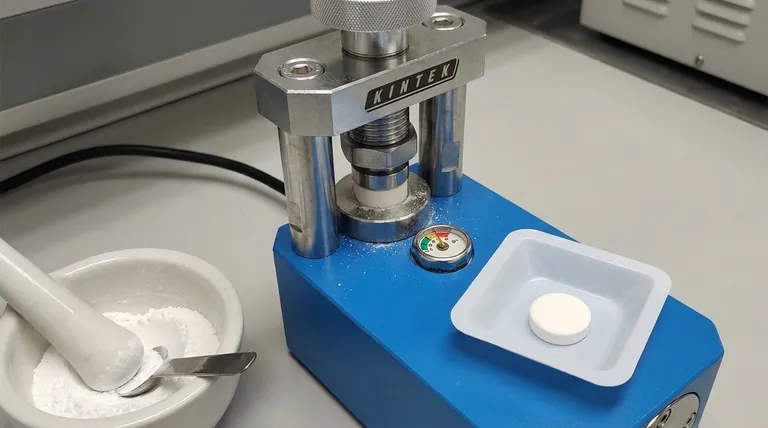
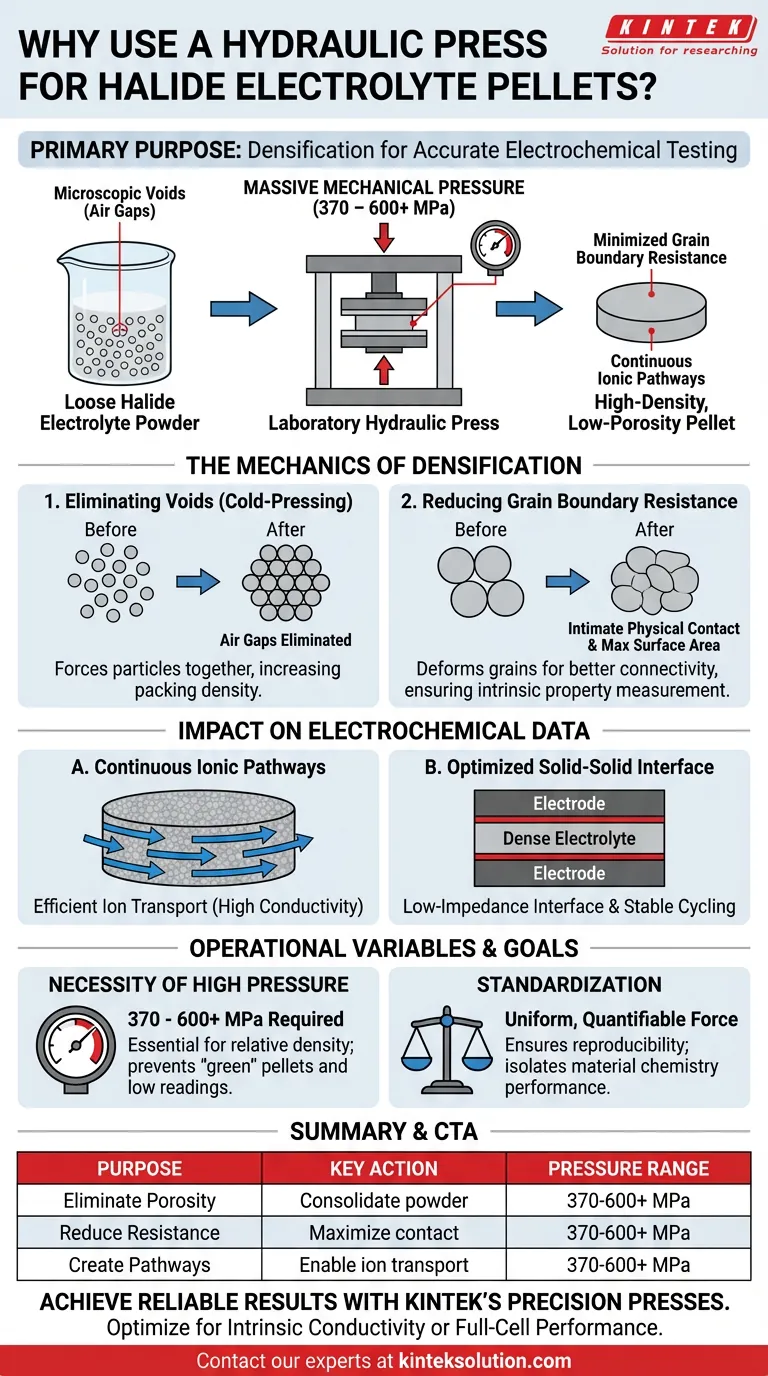
The primary function of a laboratory hydraulic press in this context is to consolidate loose halide electrolyte powder into a high-density, low-porosity pellet by applying massive mechanical pressure (often hundreds of megapascals). This physical compaction is the prerequisite for establishing continuous ionic pathways and minimizing grain boundary resistance, which are necessary for accurate electrochemical characterization.
The core objective is not merely to shape the material, but to fundamentally alter its microstructure by eliminating inter-particle voids. Without this densification, accurate measurement of ionic conductivity is impossible because ions cannot travel efficiently across air gaps or loose grain boundaries.
The Mechanics of Densification
Eliminating Microscopic Voids
Loose electrolyte powders naturally contain significant amounts of empty space, or porosity, between particles. Since air is an electrical insulator, these voids act as barriers to ion movement.
By applying precise pressure—often ranging from 370 MPa to upwards of 600 MPa—the hydraulic press mechanically forces particles together. This process, known as cold-pressing consolidation, drastically increases the packing density of the material.
Reducing Grain Boundary Resistance
Simply touching particles together is not enough; they must have "intimate" physical contact.
High-pressure compaction deforms the powder grains enough to maximize the surface area where they connect. This reduction in grain boundary resistance is critical, as it ensures that the resistance measured during testing reflects the material's intrinsic properties rather than the poor quality of the pellet.
Impact on Electrochemical Data
Creating Continuous Ionic Pathways
For a solid-state battery to function, ions must move freely from one end of the electrolyte to the other.
The densification process creates a continuous, solid network that serves as an efficient highway for ion transport. This structural continuity is fundamental to achieving low internal resistance and high-rate performance in the final cell.
Optimizing the Solid-Solid Interface
When assembling full cells, the press often compacts the electrolyte against electrode materials.
This creates a tight, low-impedance interface between the electrolyte and the electrodes. A high-quality physical interface is essential for stable cycling, as it prevents delamination and ensures uniform current distribution.
Understanding the Operational Variables
The Necessity of High Pressure
Standard pressures are rarely sufficient for solid-state electrolytes. References indicate that pressures in the hundreds of megapascals (e.g., 370 MPa, 500 MPa, or even 600 MPa) are required to achieve the necessary relative density.
Insufficient pressure results in a "green" pellet with high porosity, leading to artificially low conductivity readings and unreliable data.
Standardization and Reproducibility
The use of a hydraulic press allows for the application of uniform, quantifiable force.
This consistency is vital for scientific rigor. It ensures that differences in performance between samples are due to material chemistry, not inconsistencies in how the pellet was fabricated.
Making the Right Choice for Your Goal
When utilizing a hydraulic press for halide electrolytes, your specific testing goals should dictate your processing parameters.
- If your primary focus is measuring intrinsic ionic conductivity: Apply maximum safe pressure (e.g., 500–600 MPa) to minimize grain boundary resistance and isolate the bulk performance of the material.
- If your primary focus is full-cell cycling performance: Focus on the quality of the solid-solid interface between the electrolyte and electrode layers to minimize interfacial impedance.
Ultimately, the hydraulic press transforms a non-conductive loose powder into a cohesive, functional solid-state component capable of facilitating high-performance ion transport.
Summary Table:
| Purpose | Key Action | Typical Pressure Range |
|---|---|---|
| Eliminate Porosity | Consolidate loose powder into a dense solid | 370 - 600+ MPa |
| Reduce Grain Boundary Resistance | Maximize particle contact area | 370 - 600+ MPa |
| Create Continuous Ionic Pathways | Enable efficient ion transport for testing | 370 - 600+ MPa |
Achieve reliable and reproducible results for your solid-state battery research.
Accurate electrochemical testing starts with a perfectly dense pellet. KINTEK's precision laboratory presses, including our automatic and heated lab presses, are engineered to deliver the consistent, high-pressure compaction (up to 600 MPa) required to eliminate porosity and minimize grain boundary resistance in halide electrolytes.
Let us help you optimize your sample preparation:
- Measure Intrinsic Ionic Conductivity with high-density pellets.
- Improve Full-Cell Cycling Performance by creating superior solid-solid interfaces.
Contact our experts today to find the ideal lab press for your specific electrolyte and electrode research needs.
Visual Guide
Related Products
- Laboratory Hydraulic Press Lab Pellet Press Button Battery Press
- Laboratory Hydraulic Press 2T Lab Pellet Press for KBR FTIR
- Laboratory Hydraulic Press Lab Pellet Press Machine for Glove Box
- 24T 30T 60T Heated Hydraulic Lab Press Machine with Hot Plates for Laboratory
- Automatic Laboratory Hydraulic Press Lab Pellet Press Machine
People Also Ask
- How is a laboratory hydraulic press used for HAP composite gels? Master Mineral Substrate Standardization
- What role does a laboratory hydraulic press play in the preparation of piezoelectric ceramic discs for DC-PG? | KINTEK
- What role does a laboratory hydraulic press play in reaction pellets? Optimizing Lunar Soil and Metal Fuel Density
- Why is a laboratory hydraulic press required for PBAT and PLA sample preparation? Achieve Flawless Characterization
- What role does a laboratory hydraulic press play in the assembly of all-solid-state battery test cells? Expert Guide



















