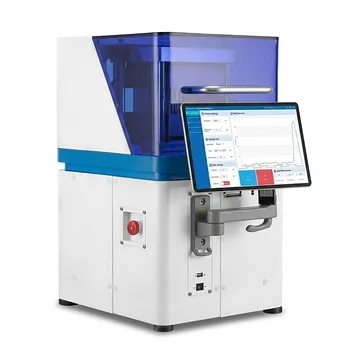
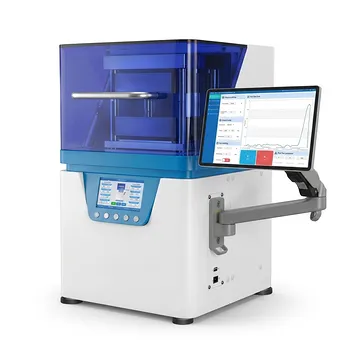
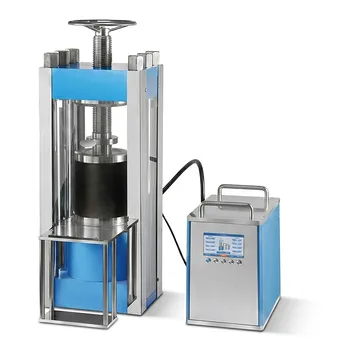
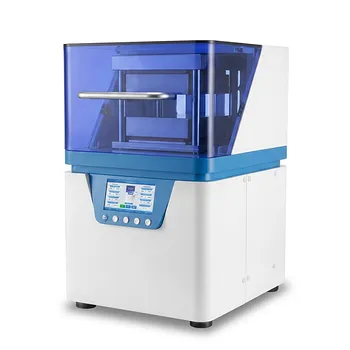
The laboratory heated plate press is the catalyst for binderless bonding. It functions by simultaneously applying high thermal energy—typically around 205 °C—to plasticize lignin and precise mechanical pressure to drive chemical cross-linking. This dual-action process transforms loose cellulose fibers into a dense, self-bonded structural board without the need for synthetic adhesives.
The primary function of a heated plate press in all-cellulose fiberboard production is to trigger a "self-bonding" mechanism by plasticizing lignin and inducing chemical condensation reactions. By providing synchronized high heat and pressure, the press eliminates internal voids and facilitates molecular cross-linking between lignin and polysaccharides to create a stable, dense composite.
Thermal Induction and Material Plasticization
Softening Lignin for Flow
The press provides the high temperatures necessary to reach the glass transition point of lignin located on the fiber surfaces. At approximately 205 °C, the lignin undergoes plasticization, shifting from a rigid state to a flowable state that allows it to coat individual fibers.
Activating Chemical Reactivity
Heat serves as the energy source to trigger thermochemical reactions within the fiber matrix. This thermal energy is essential for initiating the molecular movement required for new chemical bonds to form between the natural components of the wood.
Mechanical Densification and Structural Shaping
Eliminating Air Voids and Porosity
The application of high pressure (often measured in bars or tons) forces the softened fiber components to fill micro-pores and internal air pockets. This compaction is critical for achieving the high density required for structural integrity and moisture resistance.
Achieving Dimensional Precision
The press utilizes parallel heating platens to ensure the fiberboard reaches a uniform thickness and stable geometric dimensions. This precision is vital for standardized testing and ensures that the final product meets specific engineering tolerances.
Chemical Synthesis and Interface Bonding
Driving Condensation and Cross-linking
Under the combined influence of heat and pressure, the press facilitates condensation reactions between lignin molecules. Simultaneously, it promotes cross-linking between lignin and polysaccharides, effectively "welding" the fibers together at a molecular level.
Establishing Interfacial Adhesion
By forcing the plasticized matrix to wet the fiber surfaces, the press ensures strong interfacial adhesion. This creates a cohesive network where the fibers are mechanically anchored and chemically bonded, eliminating the need for traditional synthetic resins or glues.
Understanding the Trade-offs
Risk of Thermal Degradation
While high temperatures are required for bonding, excessive heat or prolonged pressing times can lead to thermal degradation of the cellulose fibers. This can weaken the board’s mechanical properties and cause discoloration or "charring" of the surfaces.
Challenges in Pressure Distribution
In a laboratory setting, ensuring perfectly even pressure distribution across the entire platen surface can be difficult. Any deviation in pressure can result in inconsistent density or "soft spots" within the fiberboard, compromising the reliability of characterization data.
Optimizing the Pressing Cycle for Material Performance
To achieve the best results in all-cellulose fiberboard production, the pressing parameters must be tailored to the specific fiber morphology and moisture content.
- If your primary focus is Maximum Tensile Strength: Prioritize higher temperatures (near 205 °C) to ensure complete lignin plasticization and maximum chemical cross-linking.
- If your primary focus is Dimensional Stability: Focus on maintaining constant high pressure throughout the cooling phase to prevent the board from warping or internal "spring-back."
- If your primary focus is Surface Finish: Use highly polished stainless steel platens and ensure the fiber mat has uniform moisture distribution to avoid steam blisters.
The heated plate press effectively replaces chemical binders by using precisely controlled physical variables to unlock the inherent bonding potential of natural plant fibers.
Summary Table:
| Function | Key Mechanism | Outcome for Fiberboard |
|---|---|---|
| Thermal Induction | Plasticizes lignin at ~205°C | Enables fiber flow and activation of self-bonding |
| Mechanical Pressure | Eliminates air voids and porosity | Achieves high density and structural integrity |
| Chemical Synthesis | Drives condensation and cross-linking | Creates molecular "welding" without synthetic glues |
| Dimensional Control | Parallel heating platen application | Ensures uniform thickness and stable geometric dimensions |
Elevate Your Material Research with KINTEK Precision
Unlock the full potential of your all-cellulose composites and battery research with KINTEK’s comprehensive laboratory pressing solutions. Whether you are optimizing lignin plasticization or developing next-generation energy storage, our range of manual, automatic, heated, multifunctional, and glovebox-compatible models—along with advanced cold and warm isostatic presses—provides the precise thermal and mechanical control your lab requires.
Why choose KINTEK?
- Unmatched Uniformity: Achieve perfectly even pressure and heat distribution.
- Versatile Applications: Tailored for everything from sustainable fiberboards to complex battery research.
- Industrial Durability: Built to withstand high-temperature cycles and rigorous testing.
Ready to achieve superior bonding and structural precision? Contact our technical experts today to find the ideal press for your application!
References
- Diego Ramos, Joan Salvadó. All-lignocellulosic Fiberboard from Steam Exploded Arundo Donax L.. DOI: 10.3390/molecules23092088
This article is also based on technical information from Kintek Solution Knowledge Base .
Related Products
- 24T 30T 60T Heated Hydraulic Lab Press Machine with Hot Plates for Laboratory
- Automatic Heated Hydraulic Lab Press 120x120mm Plate Fully Automated Material Research Press
- Automatic Heated Hydraulic Lab Press Machine 200x200 Plate Size for Battery Research and Materials Science
- Automatic Large Format Laboratory Heated Hydraulic Press 400x400mm Plate Capacity
- Manual Heated Hydraulic Lab Press with Integrated Hot Plates Hydraulic Press Machine
People Also Ask
- Function of a Laboratory Hydraulic Press with Heated Platens in SSE? Enhance Battery Density & Conductivity
- Why is a laboratory hydraulic press with heating plates required for PLA/TEC films? Achieve Precise Sample Integrity
- What role does a laboratory heated hydraulic press play in LTCC? Essential for High-Density Ceramic Lamination
- What is the primary function of a laboratory heated hydraulic press? Mastering Thermoplastic Carbon Fiber Composites
- Why reduce load when applying composite strengthening tabs? Protect Specimen Integrity and Data Accuracy